


Buying “the index” meant buying diversification. Not anymore. When 35% of the S&P 500’s weight sits in 10 stocks, “buy VOO and relax” has quietly become “buy Nvidia, Apple, and Microsoft, with 490 passengers along for the ride.”
RSP gives you the same 500 companies, each with an equal vote. In 2026, that structural difference has added up to roughly five percentage points of outperformance over the standard cap-weighted version. If you do not understand why one version of the same index is beating the other, or what it tells you about where we are in the cycle, your “safe” passive allocation might be working against you.
That is why we built Winvesta Crisps, to decode what is actually moving the funds you own in plain language before the consensus catches up. 60,000+ investors from all over India are already in. What about you?
🔔 Don’t miss out! Get the latest updates delivered straight to your inbox →
You have owned VOO for three years. You call it “the market.” You watched it compound through rate hikes, tariff scares, and an AI mania that made you feel very smart for a while. And then, in 2026, something slightly annoying happened: a fund tracking the same 500 companies started outperforming yours. Same index, different weights, different returns. That ETF is RSP (Invesco S&P 500 Equal Weight ETF), and it has outperformed VOO by a few percentage points year to date as of early May 2026, a gap that has been widening since January. Exact figures vary by data source and date cut, but the directional divergence is consistent across providers.
The context matters. The FOMC held rates in late April 2026, with an unusually high number of dissenting votes by historical standards, per the Federal Reserve’s own statement. Kevin Warsh is expected to be the incoming Fed chair after May 15. Q4 2025 GDP was close to stall speed. The macro environment that has been slowly tipping money away from high-multiple mega-cap tech has not been resolved. It has layers. And in that environment, carrying 35% of your “passive index” in 10 overvalued stocks is not a neutral position. It is an active bet you may not have intended to make.
But before you swap anything, the important question is whether this RSP outperformance is a structural rotation or just a temporary correction trade. And whether you are arriving at this thesis in May 2026 at the right moment, or after the easy money has already been made.
Let me introduce you to someone who might be you.
🎯 Meet Rohan: The accidental mega-cap investor
Rohan, 35, IT consultant in Bengaluru. Portfolio: ₹55 lakh across US markets through Winvesta. He built his allocation methodically over three years, starting with VOO after reading that index funds beat 90% of active managers. He added QQQ because colleagues kept talking about AI. Then, Nvidia said, “The AI cycle is real.” Then Apple said, “It never really goes down.”
Here is what Rohan thinks he owns:
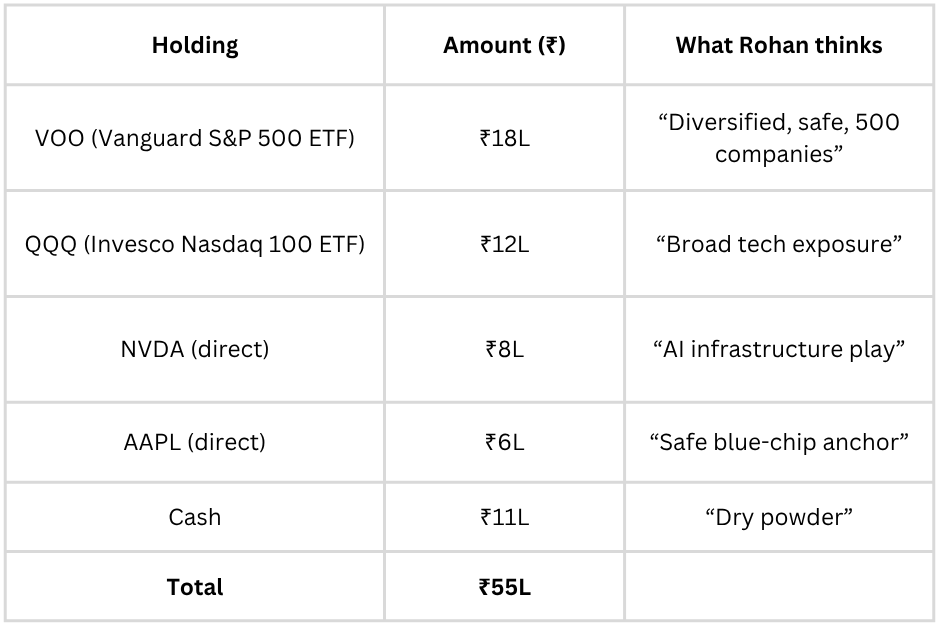
Here is what Rohan actually owns, once you account for how VOO and QQQ are built:
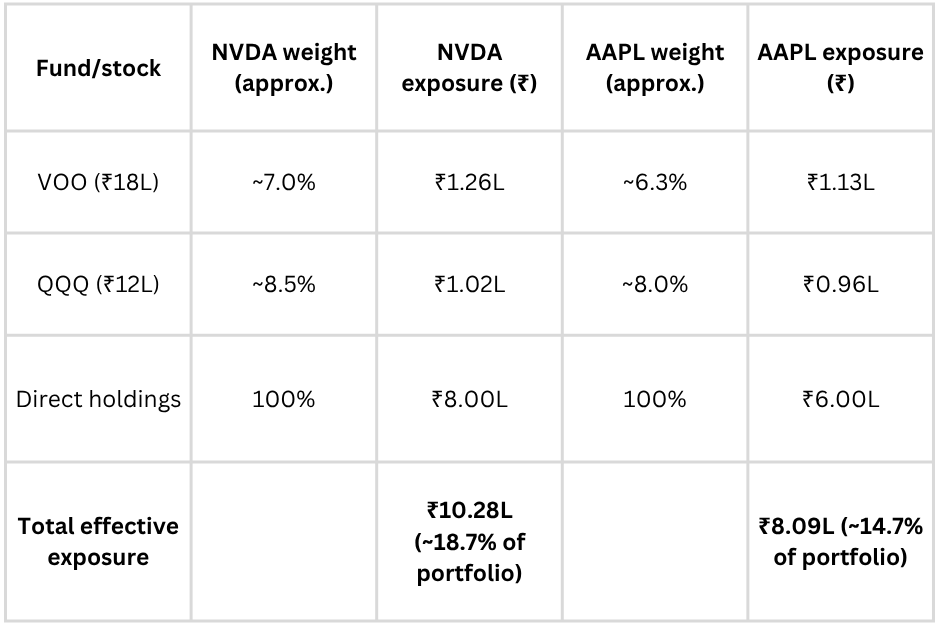
Note: ETF weights are approximate and shift daily. The above is illustrative of concentration risk, not a precision audit. Verify directly with Vanguard and Invesco before making allocation decisions.
Rohan thinks he owns five different positions. He actually has 18.7% of his portfolio in one chip company and 14.7% in one phone company. Together, Nvidia and Apple represent over a third of his entire portfolio, before you count Microsoft, Meta, Alphabet, and Amazon, which also lurk inside VOO and QQQ.
What happened to Rohan when Nvidia fell roughly 18% earlier in 2026 on data centre demand concerns:
Direct NVDA (₹8L at 18% drop): -₹1.44L
VOO’s NVDA drag (₹18L × ~7%): -₹0.23L
QQQ’s NVDA drag (₹12L × ~8.5%): -₹0.18L
Total Nvidia-driven portfolio loss: roughly ₹1.85 lakh, from one stock’s move
He had no idea 18.7% of his portfolio rode on one chip company’s earnings call. He thought he was “diversified across index funds.”
Now RSP is outperforming its index by a meaningful margin, and he wants to know if he has been doing this wrong. Let’s find out.
📊 What RSP actually gives you, and what ETF flows are saying
Most investors know what VOO holds. Almost no one has looked at how it actually weighs them. Here is the structural comparison:

Sources: Vanguard, Invesco fund pages; weights approximate as of early May 2026; verify current holdings directly with fund issuers.
The rebalancing mechanic is the part most investors miss. When Nvidia surges, a cap-weighted fund like VOO automatically buys more of it as the weighting grows. RSP does the opposite: it trims Nvidia every quarter and reallocates the proceeds to everything else. That forced sell-high, buy-low discipline is the structural reason RSP tends to outperform when concentration reverses.
In 2023 and 2024, when the Magnificent Seven ran wild, that same rebalancing made RSP lag. VOO was being pulled higher by concentrated winners. In 2026, the dynamic is reversing: tech has wobbled, the “other 493” companies are contributing to the index, and RSP’s equal-weighting structure is being rewarded for existing.
ETF flow direction, past four weeks (ILLUSTRATIVE, directional estimates only)
Note: Precise weekly flow figures vary by data provider and reporting lag. The table below reflects directional estimates and is not drawn from a single audited dataset. Cross-reference with Bloomberg, ETF.com, or TrackInsight before acting.
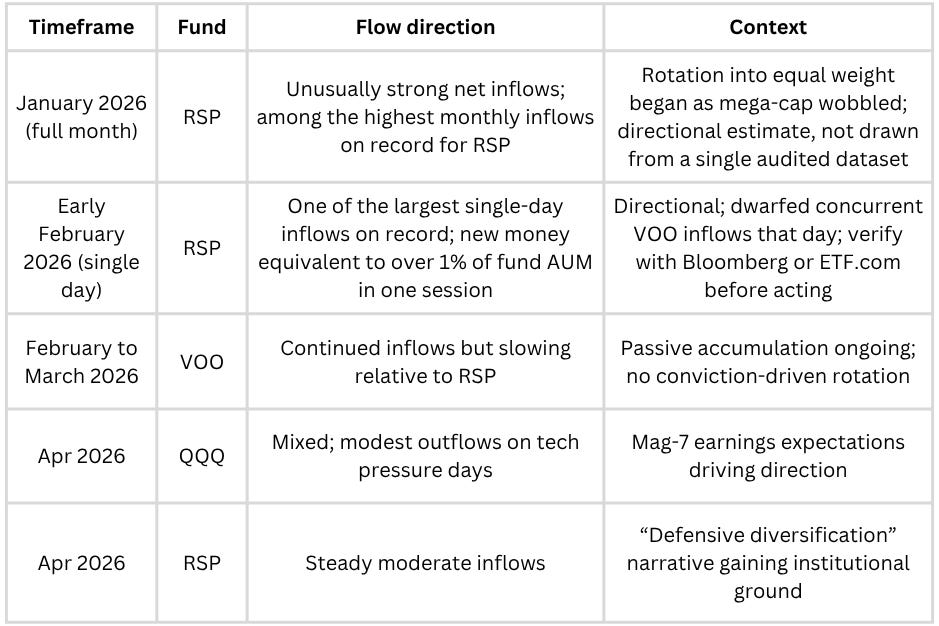
The unusually large single-day RSP inflow in early February was a signal, not noise. On at least one day, new money into RSP exceeded 1% of its total assets in a single session — a spike that institutional flow watchers treat as a positioning shift, not ordinary retail accumulation.
Here is the honest caveat: when an ETF has already absorbed record inflows over a four-month outperformance streak, you are not getting in early. You are getting in when the thesis is consensus. That does not mean RSP is wrong. It means your entry price matters, and the easy leg of the rotation may already be behind you.
🚀 Want to add RSP or VOO to your portfolio? Trade US ETFs directly from India on the Winvesta app. No US bank account needed!
Join 60,000+ investors, become a paying subscriber or download the Winvesta app and fund your account to get insights like this for free!
🧠 The psychology trap
Right now, your brain is constructing very good reasons why RSP is the obvious move: