


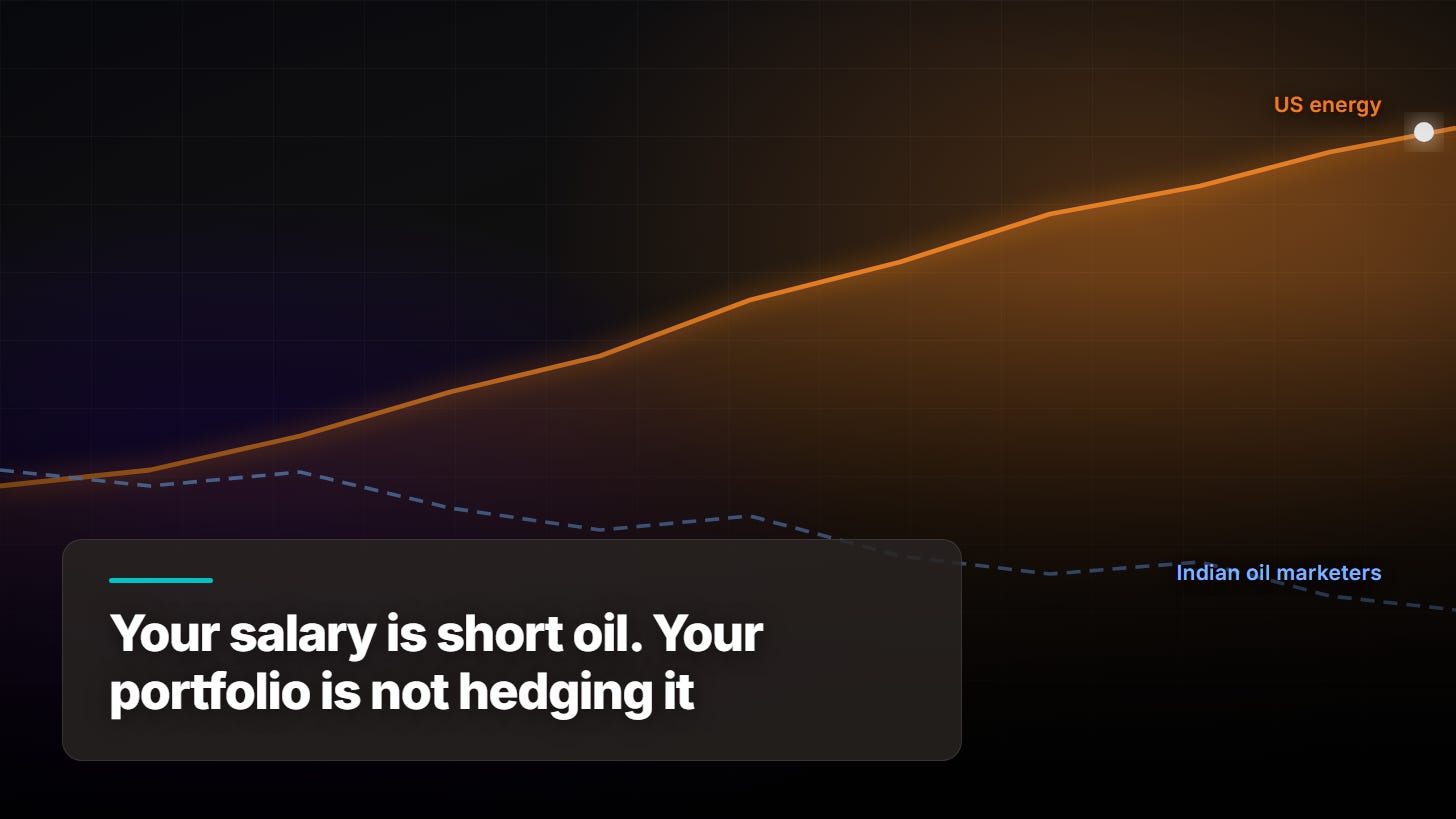
Five years ago, an Indian investor could treat the oil price as somebody else's problem, a line in a newspaper about the current account. Not anymore. India's crude import bill for April to July came in at $63.4 billion, up about 57% on the same months last year, and Brent is trading near $95 after a week in which it rose more than 9%. Energy is the best performing sector in the S&P 500 this year by a distance, and almost none of the Indian investors reading this own a single share of it. That's why we built Winvesta Crisps, to decode what's actually moving the funds you own, in plain language, before the consensus catches up. 60,000+ investors from all over India are already in. What about you?
🔔 Don't miss out!
Add winvestacrisps@substack.com to your email list so our updates never land in spam.
Two numbers from last week, sitting side by side.
US-listed energy ETFs took in roughly $796 million of net new money across 33 funds, per ETF Action's sector report published on 7 September. The State Street Energy Select Sector SPDR, ticker XLE, took $567 million of that on its own. In the same five days, information technology funds lost about $1.99 billion, with the iShares software fund shedding $545 million and the VanEck semiconductor fund $355 million. Energy gained 2.26% on the week and is up 45.29% for the year. Technology gained 1.08% on the week and money left anyway.
That is the rotation. It has been running most of 2026 and it is not subtle.
Now the second number, the one that should matter more to you than the first. India imported $63.4 billion of crude in the four months to July, against $40.5 billion in the same period a year earlier, per oil ministry data reported in August. Volumes barely moved. The price did. Domestic production fell to 9.1 million tonnes from 9.7 million, so a larger share of what India burns now has to be bought in dollars at Brent's price.
Most investors see an energy rally as a sector they missed. What it actually is, if you earn and spend in rupees, is a bill you have already been paying for eight months without owning the offsetting asset.
🎯 Meet Ishaan
Ishaan is 36, an engineering manager at a Hyderabad SaaS company, and has been investing in US markets from India since 2020. His portfolio is about ₹48 lakh. Around 70% sits in a broad S&P 500 fund, the rest split between two US technology names and a small position in an Indian energy fund he bought in March because oil was going up and that seemed like the obvious trade.
The obvious trade lost him money. That is where this article starts.
His S&P 500 fund has done its job, up roughly 13% this year. His Indian energy position has not. He assumed, reasonably, that an index with "energy" in the name goes up when crude goes up. It did not, and the reason is worth understanding properly, because it is the single most common mistake Indian investors make when they try to hedge the oil price from inside India.
His question this week is narrow. Brent is near $95, his petrol costs more, his grocery bill is up, the rupee is under pressure, and the one position he bought to offset all of that is red. What did he actually buy?
📊 What Indian energy exposure actually does
Start with what an energy index means in India, because it does not mean what it means in the United States.
Reliance Industries carried a weight of about 29.7% in the Nifty Energy index as of 1 September, per index composition data. Reliance today is a conglomerate with telecom and retail businesses that have very little to do with the price of a barrel. Most of the rest of India's listed energy complex is refining and marketing: Indian Oil, Bharat Petroleum, Hindustan Petroleum. Those companies buy crude and sell fuel at retail prices that do not move freely. When crude rises and pump prices do not, their margins compress. That is not a hedge against expensive oil. That is a leveraged bet against it.
The scoreboard for 2026 says exactly that. Through the calendar year, HPCL is down about 22%, BPCL about 21% and IOC about 17%, in a year when Brent rose roughly 45%. Analysts at Ambit have cut their integrated marketing margin assumptions for these companies to ₹3 to ₹5 per litre for FY27 to FY30, from ₹6 to ₹8 earlier.
Ishaan bought the word "energy". He got India's fuel subsidy mechanism.
The US energy sector is built the other way round. It is dominated by producers who sell the barrel rather than buy it.

XLE holds 23 large US energy companies, charges 0.08%, yields around 2.4% and manages roughly $39 billion. Its concentration is extreme by index standards: ExxonMobil is about 20.5% and Chevron about 15.0%, so more than a third of the fund sits in two companies, and the top ten holdings account for around 73%. The Vanguard fund, VDE, holds over a hundred names at 0.09% but ends up in nearly the same place, with Exxon and Chevron just under 40% between them. The SPDR exploration and production fund, XOP, is the different animal: roughly 50 equal weighted upstream companies, no integrated majors, 0.35%, and considerably more volatile in both directions.