


Nvidia was the most valuable company on earth a month ago. This week it slipped to third place, behind Apple and Microsoft, while Anthropic prepares to list on the Nasdaq at one of the richest valuations ever assigned to a newly public company. Both events point to the same thing: the index funds most Indian investors use to get "diversified" exposure to the US market now move on the fortunes of a handful of names. That is why we built Winvesta Crisps, to break down what is actually moving markets, in plain language, before the consensus catches up. 60,000+ investors from all over India are already in. What about you?
🔔 Get the Wednesday macro breakdown in your inbox every week, before the headlines catch up. Subscribe now!
Most people buying an S&P 500 fund think they are buying a stake in 500 different businesses. In practice, they are buying a concentrated bet on a cluster of AI-linked technology names, and that cluster has never made up a larger share of the index. Nvidia's drop from the world's most valuable company to third place this month, and Anthropic's pending Nasdaq debut at a valuation reports put between $1 trillion and $1.4 trillion, are both symptoms of the same shift. A smaller number of stocks now decide what "the market" does on any given day, and that changes what owning "the market" actually means for your portfolio.
🏗️ What concentration means, and why it has reached this point
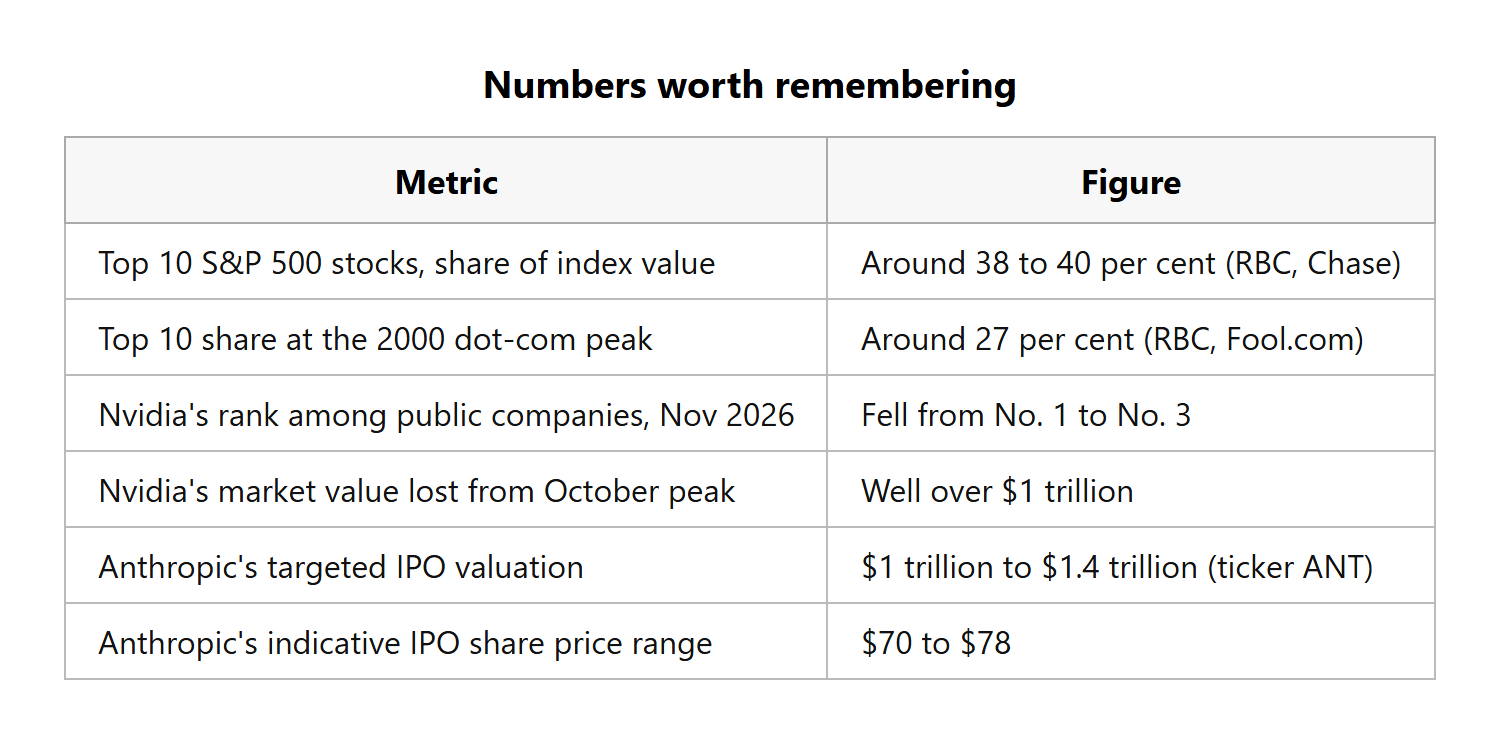
Stock market concentration is simply the share of an index's total value held in its largest constituents. By several recent estimates, including analysis from Chase and RBC Wealth Management, the ten largest companies in the S&P 500 account for roughly 38 to 40 per cent of the index's total market value, a level RBC has flagged as a record for the modern index. For comparison, at the peak of the dot-com bubble in 2000, the ten largest stocks made up closer to 27 per cent of the index, per RBC and Fool.com analysis. Today's concentration is higher than the last episode investors point to as a cautionary tale.
The ten names driving this are almost all tied to the AI buildout in some way: chipmakers, cloud providers, and the hardware and software layers underneath them. Their combined earnings have grown fast, but RBC's research also flags a widening gap between index weight and index earnings, meaning these stocks now account for a larger share of the market's value than they do of its profits. That gap is the part investors tend to notice only after it closes the hard way.
This did not happen overnight. It is the accumulated result of a multi-year AI capital spending boom (the subject of an earlier Crisps breakdown) pushing a small number of hyperscalers and chipmakers to valuations that dwarf the rest of the index. What is new is the volatility now showing up inside that concentrated group itself. Nvidia has shed well over a trillion dollars in market value from its October peak, enough to drop it behind Apple and Microsoft in the rankings, even as the broader AI trade has not collapsed. Concentration cuts both ways: when ten stocks drive the gains, they also drive the swings.
⚙️ How a "diversified" index fund actually works
A fund that tracks the S&P 500 or the Nasdaq-100 is not diversified by design in the sense most investors assume. These are market-capitalisation-weighted indices, meaning a company's weight in the fund is set by its market value relative to every other company in it. The larger a company gets, the more of the index it becomes, and the more new money flowing into passive funds is automatically directed toward it, regardless of whether its valuation still makes sense.
That mechanism is self-reinforcing on the way up. Index funds and the trillions of dollars that track them do not decide to buy more Nvidia or Microsoft because they look cheap; they buy more because the stock went up and now represents a larger slice of the benchmark everyone is replicating. The same mechanism works in reverse. When one of those names falls, as Nvidia has this month, its weight in every fund tracking that index falls with it, and so does the fund's total return, in proportion to how much of the fund that one name represented.
Anthropic's imminent listing is a live test of this same dynamic from the other direction. The company filed an amended registration in early November targeting a share price in the $70 to $78 range, implying a valuation reports place between $1 trillion and $1.4 trillion, down from the $2 trillion some earlier reports had floated. If a company can debut at that scale, on the strength of an AI narrative rather than a long public earnings record, it says something about how much of the market's current pricing power sits with a small number of AI-linked businesses rather than being distributed across the index.
The dynamics covered in this article affect every US stock in your portfolio. Trade from India on the Winvesta app. No US bank account needed!
🚀 Join 60,000+ investors, become a paying subscriber or download the Winvesta app and fund your account to get insights like this for free!
📊 Who gains and who is exposed
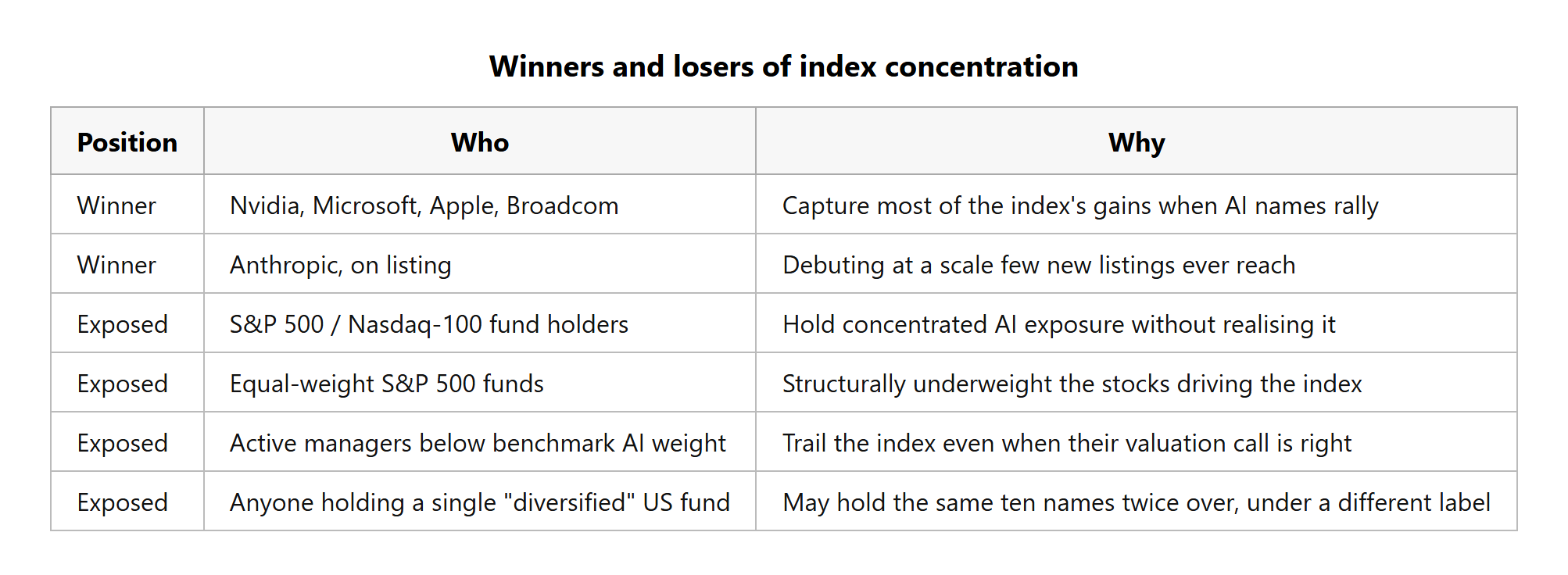
The split is not simply "tech versus everything else." It runs between investors who know how concentrated their holdings are and those who assume a broad-sounding fund name means broad exposure. Equal-weight versions of the S&P 500, which give each of the 500 companies the same weighting instead of weighting by size, have lagged the standard cap-weighted index for most of the AI run, a gap that only widens further every time the top ten pull away from the other 490. Active managers who have kept their AI-megacap weighting below the index's own, often for valuation discipline, have mostly trailed their benchmark for the same reason, even when their underlying judgement about valuations proves right.
🇮🇳 What this means if you are investing from India
Most Indian investors accessing US equities, whether through Winvesta or elsewhere, default to the same handful of instruments: an S&P 500 fund, a Nasdaq-100 fund, or direct positions in the familiar mega-cap names. There is nothing wrong with holding any of these. The mistake is treating that combination as diversification in the way the word is normally used, spreading risk across many independent bets, when in practice a large share of that exposure now depends on the fortunes of the same ten companies, whichever wrapper you hold them in.
The practical step is simple: look up what your specific fund actually holds, not what its name implies. Most fund fact sheets publish top-ten holdings and their combined weight. If that number sits near 35 to 40 per cent and most of those names are the same AI-linked businesses you would also find in a different "diversified" fund, you are not spreading risk the way the label suggests, you are adding a second ticket to the same bet. That is not a reason to avoid US equities. It is a reason to know exactly what you own before a month like this one tests it.
👀 What to watch from here
Anthropic's actual trading debut, whenever it lands in the coming days, is the nearest signal. A strong open validates the market's current appetite for AI-linked valuations; a weak one, or a stock that slides in its first weeks the way some recent high-profile tech listings have, would say the opposite. Nvidia's path after its latest quarterly results is the second signal to track, since the stock's swings now move the weight of the entire index, not just its own shareholders.
Beyond the two headline names, watch the gap between the equal-weight and cap-weighted S&P 500. A widening gap means concentration is still building; a narrowing one means money is rotating out of the largest names and into the rest of the market, which is usually a healthier sign for an index this top-heavy. The Federal Reserve's December meeting, where the path for rates past this year remains genuinely divided among policymakers, is a separate catalyst that could move all of these names together, for better or worse, given how much of their current valuation assumes rates keep falling.
If this changed how you see your "diversified" US portfolio, pass it on.
📌 The bottom line
An index fund is only as diversified as the index underneath it, and right now the S&P 500 and the Nasdaq-100 are more concentrated in their largest names than they have been in at least two decades. That is not an argument against holding them. It is a reason to actually check what you hold before assuming the label "index fund" has done your diversification for you. Look up your fund's top ten holdings, note how much of it sits in AI-linked mega-caps, and decide with open eyes whether you are comfortable with that level of concentration, or whether some of your US allocation belongs somewhere else entirely.
📈 Numbers worth remembering
This article is for educational purposes only and does not constitute investment advice. Winvesta India Technologies Ltd. does not guarantee the accuracy of third-party data cited above. Past performance is not indicative of future returns. Please consult a registered financial adviser before making investment decisions.