


xAI enters mid-February 2026, navigating internal turbulence amid reports of former employees raising concerns about Elon Musk’s approach to Grok’s content moderation and safety guardrails. The AI startup isn’t just building another chatbot—it is testing whether looser safety guardrails can become a competitive advantage in a market where OpenAI, Anthropic, and Google set the governance standard. As institutional investors weigh xAI’s secondary market valuation against escalating regulatory risks, the company offers a case study in how governance choices shape both innovation potential and commercial viability.
🔔 Don’t miss out!
Add winvestacrisps@substack.com to your email list so our updates never land in your spam folder.
🔥 Top movers
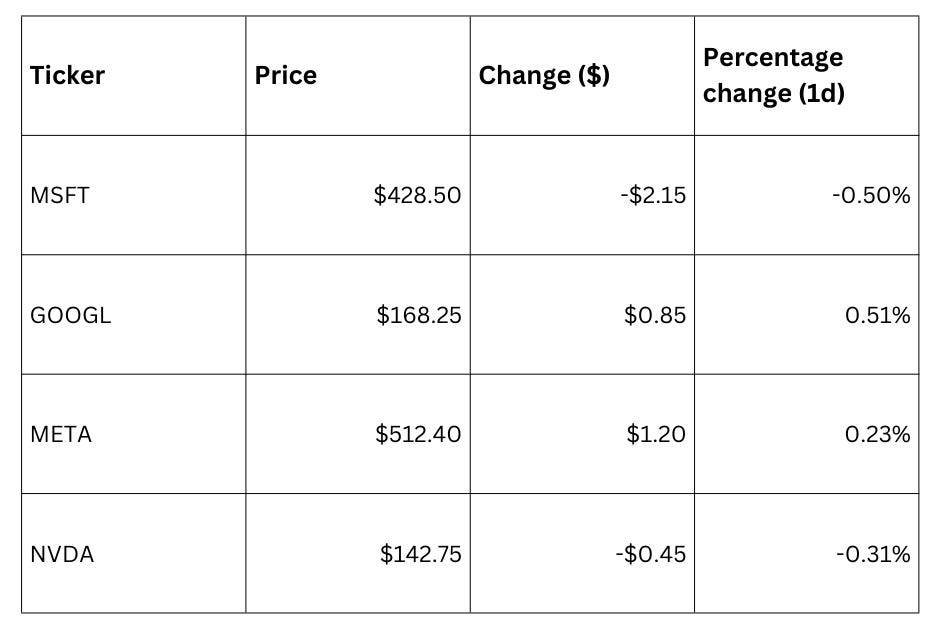
xAI remains private; comparable AI-adjacent public companies are shown.
Want exposure to the AI race?
While xAI isn’t listed, Microsoft, Google, Meta, and Nvidia are all making multi‑billion‑dollar AI investments and act as public‑market proxies for the theme.
Start investing in US stocks directly from India with the Winvesta app — fractional shares, no minimum investment.
🍏 Current landscape
xAI is estimated to trade on secondary markets at around $28–32 billion as of January 2026, up from $24 billion at its May 2024 Series B—a premium reflecting Grok-2’s performance gains but also pricing in significant execution risk around safety and regulation.
Ownership structure: xAI’s investor base includes Andreessen Horowitz and Sequoia Capital, with reported involvement from Gulf-linked investors through the broader Musk ecosystem, who participated in the $6 billion Series B. Unlike publicly traded AI peers, secondary market liquidity remains limited, creating bifurcated demand—AI-focused funds stay bullish while ESG-conscious investors exit positions amid safety concerns.
Competitive positioning: OpenAI dominates with a widely reported 200 million+ weekly active users and an estimated $3.4 billion in 2025 revenue. Anthropic gains enterprise traction through its Constitutional AI safety framework. Google’s Gemini integrates across 15+ products. xAI differentiates through Grok’s “rebellious” positioning—willingness to answer questions competitors refuse—and native X integration reaching 600 million monthly active users.
Infrastructure scale: The Colossus supercomputer in Memphis is estimated to run upwards of 100,000 Nvidia H100 GPUs with plans to scale significantly further, creating one of the world’s largest AI training clusters—at an estimated annual electricity and cooling cost in the hundreds of millions of dollars.
In short, xAI is a capital-rich, infrastructure-heavy bet on AI differentiation through fewer guardrails—a thesis that either validates or collapses based on the next 12 months of regulatory and commercial outcomes.
Someone shared this with you? Get your own insider updates directly—no middleman needed.