



🔔 New here? Add winvestacrisps@substack.com to your contacts so you never miss a drop.
You’re checking futures, scanning headlines, maybe glancing at your portfolio between meetings. Everything looks… fine. Markets are drifting, the S&P is near highs, and your watchlist isn’t doing anything dramatic.
Then tonight at 7:00 PM IST — a full hour before the US market even opens — a single number drops—and suddenly the Fed’s rate-cut timeline, the dollar, Treasury yields, and your portfolio allocation all shift in real time.
Here’s the thing most investors miss: The January 2026 jobs report isn’t just another monthly data point. It’s arriving after a government shutdown delayed it, it carries massive annual benchmark revisions, and it lands at a moment when markets are split on whether the Fed cuts twice or three times this year. One number. Multiple cascading effects.
This isn’t about predicting the print. It’s about understanding why this particular report carries outsized weight—and what the different scenarios mean for your money.
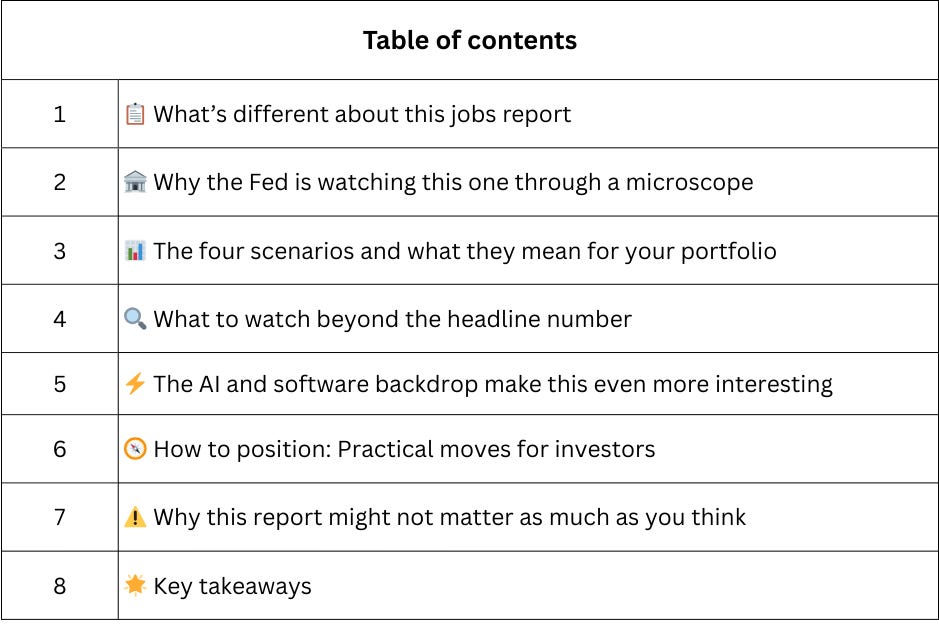
📋 What’s different about this jobs report
This isn’t a routine first-Friday-of-the-month release. Multiple factors are converging to make tonight’s print unusually loaded:
It was delayed. The partial government shutdown that ended on February 3 pushed the January nonfarm payrolls report back by a week. That means the BLS had compressed timelines for data collection and processing. Any data quality concerns will amplify market reactions.
It includes annual benchmark revisions. Every year, the BLS revises its seasonal adjustment factors and benchmarks payroll data against comprehensive counts. These revisions can dramatically reshape the narrative. A headline number of +70,000 could look very different once prior months are revised up or down by tens of thousands.
The labour market has been decelerating hard. Full-year 2025 saw just 584,000 jobs added—an average of roughly 49,000 per month—compared to 2 million in 2024. December came in at just 50,000. We’re not in crisis territory, but the trend line is clearly pointing downward, and investors want to know: is this a gentle glide or the start of something worse?
The consensus is soft. Economists expect around 70,000 jobs added and unemployment at 4.4%. That’s barely above stall speed. A significant miss in either direction could move markets sharply.
🏦 Why the Fed is watching this one through a microscope

The Federal Reserve is at a crossroads. Money markets are currently pricing in two rate cuts as fully baked for 2026, with growing odds of a third. But there’s a tension in the data:
The doves’ case: Job growth has slowed dramatically. Retail sales were flat in December. The labour market is cooling enough to justify cuts sooner—potentially as early as April.
The hawks’ case: Dallas Fed President Lorie Logan said this week that rates “may not need to be adjusted any further.” Inflation is running “stubbornly high” in her view. Consumer sentiment surveys show one-year inflation expectations at 3.5%. Cutting too early risks reigniting price pressures.
Tonight’s report is the tiebreaker. A weak print (say, below 30,000 or a negative surprise) would dramatically boost rate-cut expectations and likely send yields lower, the dollar weaker, and rate-sensitive stocks higher. A stronger-than-expected print (above 100,000) could push back rate-cut timing and create a hawkish repricing.
The gap between these scenarios is worth billions in market capitalisation across sectors. That’s why this report matters more than most.
📊 The four scenarios and what they mean for your portfolio
Scenario 1: Big miss (below 20,000 or negative)
Yields: Sharp drop. 10-year could test new lows.
Dollar: Weaker. Good for emerging markets and international holdings.
Stocks: Initial volatility, then likely rally in rate-sensitive sectors—REITs, utilities, small caps, growth tech.
Risk: “Bad news is good news” only works if markets believe the economy isn’t falling off a cliff. Watch the unemployment rate closely—if it jumps to 4.5%+, the mood shifts from “cuts are coming” to “recession is coming.”
Scenario 2: In-line (40,000–70,000 jobs)
Yields: Modest move lower, reinforcing current rate-cut pricing.
Dollar: Steady to slightly weaker.
Stocks: Limited drama. Markets continue drifting. The focus shifts to what the revisions show.
Key watch: The benchmark revisions could steal the show. If prior months are revised significantly lower, the “in-line” headline masks a weaker underlying trend.
Scenario 3: Upside surprise (100,000–150,000)
Yields: Jump higher. Rate-cut expectations get pushed back.
Dollar: Strengthens.
Stocks: Mixed. Financials may benefit from higher-for-longer rates. Growth and tech face headwinds. Consumer discretionary watches wage growth data closely.
Narrative shift: The “slowdown” story gets challenged. Fed stays patient.
Scenario 4: Blowout (200,000+)
Yields: Surge. Markets reprice toward fewer cuts—possibly just one in 2026.
Dollar: Rips higher. Pressure on EM currencies and commodities.
Stocks: Likely selloff in rate-sensitive sectors. The “higher for longer” trade comes roaring back.
Reality check: This scenario is unlikely given the trend, but if it happens, it would be the biggest market mover of Q1.
⏰ Track real-time price moves on every stock in your portfolio the moment the number drops.
🔍 What to watch beyond the headline number

The headline payrolls figure gets all the attention, but sophisticated investors know the real story often hides in the details:
Revisions to prior months. October was already revised to -173,000 (yes, negative) and November to +56,000. If December’s 50,000 gets revised down meaningfully, it paints a picture of a labour market that’s weaker than the headlines suggested.
Unemployment rate. At 4.4%, it’s elevated but manageable. A tick up to 4.5% or 4.6% crosses into territory that historically gets the Fed’s attention. A tick down to 4.3% eases pressure.
Average hourly earnings. This is the inflation bridge. Expectations are around +0.3% month-over-month. If wages come in hot (say 0.4%+), it complicates the rate-cut case even if jobs are soft—because sticky wages mean sticky inflation.
Labour force participation. Unemployment can fall for “good” reasons (more hiring) or “bad” reasons (people leaving the workforce entirely). A declining participation rate makes headlines look better than reality.
Where the jobs are. Healthcare and food services have been carrying the load. Federal government employment has been shrinking due to workforce reductions. If job gains are concentrated in just one or two sectors, that’s fragility, not broad strength.
Hours worked. Companies typically cut hours before they cut people. A decline in average weekly hours is often a leading indicator that layoffs are coming. Watch for any move below 34.3 hours.
⚡ The AI and software backdrop make this even more interesting

This jobs report arrives against a dramatic market backdrop. Over the past two weeks, the S&P 500 Software & Services Index has shed roughly $1 trillion in market value amid fears that AI—particularly tools from Anthropic, OpenAI, and Google—will displace entire categories of white-collar work.
Software stocks are down 25%+ in some cases. India’s IT services index had its worst week in nearly six years.
Why this matters for the jobs report: If nonfarm payrolls show weakness in professional services, information technology, or white-collar sectors specifically, it could confirm the AI disruption thesis that’s been hammering software stocks. That would add fundamental weight to what has so far been a sentiment-driven selloff.
Conversely, if those sectors hold up, it gives ammunition to the “this is overblown” camp led by Nvidia CEO Jensen Huang, who called AI disruption fears “illogical.”
Either way, the sector breakdown of tonight’s report will be parsed more carefully than usual.
Wondering how your portfolio is positioned for the AI shift? Check your exposure to software, IT services, and rate-sensitive sectors before tonight’s print.
Review your holdings on Winvesta →
🧭 How to position: Practical moves for investors

Before the report (today):
Don’t make big bets on the number. Predicting the exact print is a coin flip. Instead, know your plan for each scenario.
Check your exposure. Are you overweight in rate-sensitive sectors? Do you have positions that would get hurt by a hawkish repricing?
Set alerts, not orders. Watch the reaction for 30–60 minutes before acting. The first move is often wrong as algorithms trade the headline before humans process the details.
After the report (tonight):
Read the revisions first. They often matter more than the headline but get buried.
Watch the bond market. The 10-year Treasury yield is the market’s real-time verdict on what the data means for rates. If yields drop sharply, rate cuts are getting pulled forward. If they spike, the Fed stays patient.
Look for sector divergence. A weak report that sends small caps and REITs higher while mega-cap tech stalls tells you something about where money is rotating.
Don’t overreact. One report doesn’t make a trend. But this report, combined with the revisions, could confirm or challenge the trend that’s been building all year.
⚠️ Why this report might not matter as much as you think
Every macro argument has a counterpoint. Here’s when this jobs report becomes less important:
If revisions are messy. The government shutdown disrupted BLS data collection. If the numbers come with big caveats or unusual methodological notes, markets may discount the entire release and wait for cleaner February data.
If geopolitics dominate. A major trade policy shift, geopolitical event, or central bank surprise could overshadow any employment data.
If earnings season steals the show. With Q4 earnings still rolling in—79% of S&P 500 companies beating estimates so far—company-specific stories might matter more than macro data for individual stock moves.
If it’s a “Goldilocks” print. An in-line number that confirms the status quo might be met with a shrug. Markets move on surprises, not confirmations.
🌟 Key takeaways

Tonight’s January jobs report is unusually loaded because it was delayed by the government shutdown, includes annual benchmark revisions, and arrives at a moment when the Fed’s rate-cut path is actively debated.
The consensus expects ~70,000 jobs and 4.4% unemployment—barely above stall speed. Any significant deviation will move markets.
Beyond the headline, watch revisions, wage growth, participation rate, and sector breakdown. These details often tell a more important story than the top-line number.
The AI disruption narrative adds a new layer. White-collar job data will either confirm or challenge the thesis driving the $1 trillion software selloff.
Rate-cut expectations are the main transmission mechanism. This report directly influences whether the Fed cuts two or three times in 2026, which ripples through every asset class.
Don’t predict—prepare. Know what each scenario means for your portfolio and let the data guide your next move, not your gut.
Your move: Review your portfolio’s rate sensitivity today. Know which of your holdings benefit from cuts and which need a strong economy. Tonight, watch the bond market first, stocks second. The 10-year yield will tell you what really matters faster than any headline.
📩 Know someone who’s watching the report tonight? Forward this to them
Disclaimer: All content provided by Winvesta India Technologies Ltd. is for informational and educational purposes only and is not meant to represent trade or investment recommendations. Investing in securities involves risk, including potential loss of principal. Past performance is not indicative of future results. Remember, your capital is at risk. Terms & Conditions apply.