


Most investors watch the Fed's rate decision and assume it sets the cost of money. The number that actually prices your US stocks is the 10-year Treasury yield, and it has been moving on its own logic. It touched a 20-year high in early October, has since fallen back, and still sits roughly a full percentage point above where it was before this year's Middle East war. That's why we built Winvesta Crisps, to break down what's actually moving markets, in plain language, before the consensus catches up. 60,000+ investors from all over India are already in. What about you?
🔔 Don't miss out! Add winvestacrisps@substack.com to your email list so our updates never land in spam.
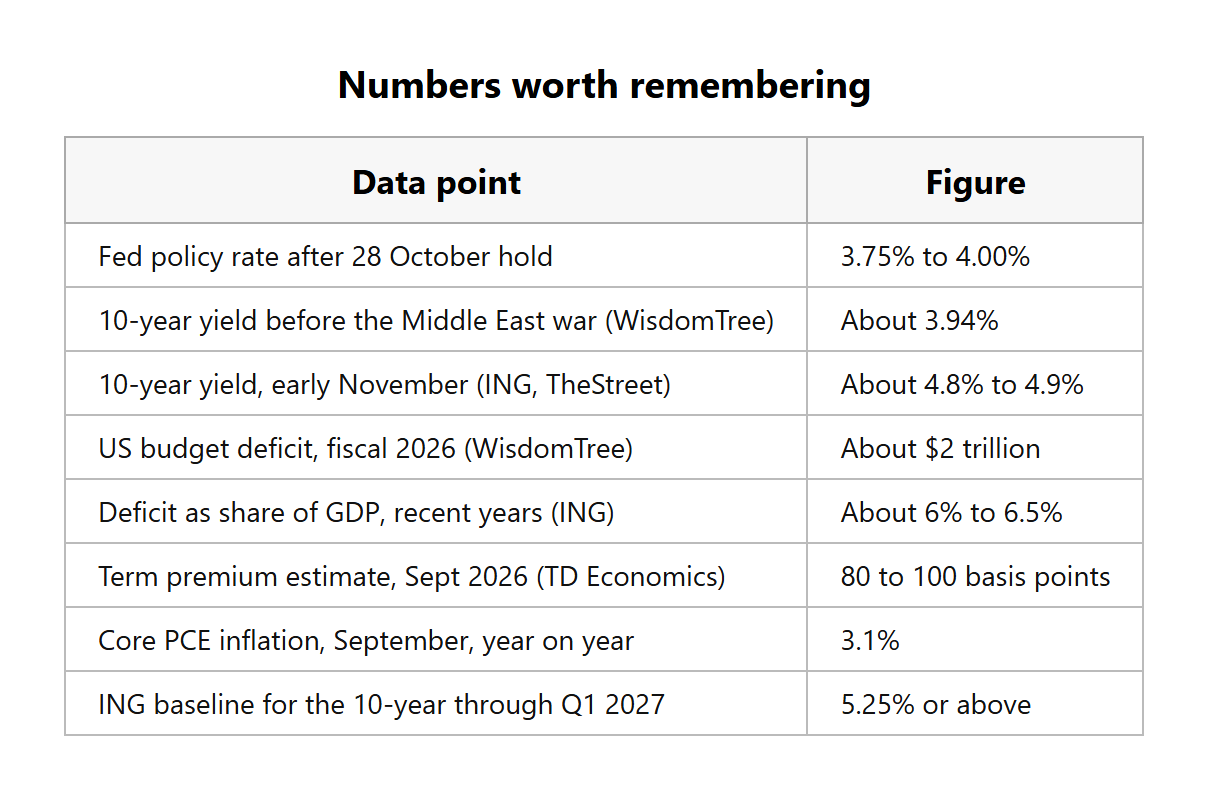
On 28 October the Fed held its policy rate at 3.75% to 4.00%. Yet the yield on the 10-year Treasury, the loan the US government takes out for a decade, has spent weeks near 5%, and touched a multi-decade high in early October. Per WisdomTree's Kevin Flanagan, writing on 5 November, it has since come down by about 40 basis points, and it was around 3.94% before the Middle East war began. Most people don't realise how much of their US portfolio is priced off that one number. Here is how it works, and why it keeps surprising people who only follow the Fed.
🧭 What the 10-year yield actually is
When the US government borrows money for ten years, it pays investors an interest rate. That rate is the 10-year yield. Because the US government is treated as the safest borrower in the world, every other asset is priced as a premium over it: mortgages, corporate bonds, and the return investors demand from a stock.
The Fed controls something different. It sets the overnight rate, the cost of borrowing for a day. The 10-year yield is set by buyers and sellers in the open market, and it depends on what they expect over the next decade, not the next month.
Think of it as two parts. The first is the average policy rate investors expect the Fed to deliver over ten years. The second is the term premium, the extra yield investors demand for locking their money away for a decade instead of rolling it overnight. That extra yield is compensation for the risk that inflation or government borrowing turns out worse than expected.
The Fed influences the first part directly. It has very little say over the second.
⚙️ How a higher yield reaches your stocks
A share is worth the cash it will pay you in future, adjusted for the fact that money later is worth less than money today. The adjustment uses a discount rate, and the 10-year yield is the starting point for that rate.
Raise the starting point and every future rupee or dollar of profit is worth less today. The effect is largest for companies whose profits are far in the future. A business expected to earn the bulk of its cash a decade from now loses more value from a higher discount rate than a business paying a steady dividend today. That is why long-duration growth stocks, particularly technology, tend to react first when yields jump.
There is also a competition effect. When a 10-year Treasury pays close to 5% with almost no risk, a stock has to offer a lot more to look attractive. Money moves from the riskiest assets to the safest ones, and valuations compress.
The dynamics covered in this article affect every US stock in your portfolio. Trade from India on the Winvesta app. No US bank account needed!
🚀 Join 60,000+ investors, become a paying subscriber or download the Winvesta app and fund your account to get insights like this for free!
💸 Why the term premium is back
For years after 2008, the term premium was close to zero or negative, because central banks were buying bonds and inflation was low. It has returned. TD Economics estimated it at roughly 80 to 100 basis points in September 2026, above the average of the past 15 years but below historical extremes. Estimates vary by model, and no one can observe it directly.
Three forces are pushing it up.
The first is supply. The US budget deficit was about $2 trillion for fiscal 2026, per WisdomTree. ING puts deficits at around 6% to 6.5% of GDP for roughly three years. WisdomTree expects Treasury to raise the size of its bond auctions, with any increase possible by mid-2027 and concentrated in the 2 to 10 year range. More bonds for sale means buyers demand a better price to absorb them.
The second is sticky inflation. WisdomTree cites September core PCE inflation at 3.1% from a year earlier, above the Fed's 2% target. ING calls sticky inflation the "ugly" scenario, and notes it set off the bond sell-off of February 2026.
The third is uncertainty about the Fed itself. The 28 October decision came with a 10 to 2 vote, and the two dissenters wanted a rate hike, not a hold. When investors cannot tell where policy is going, they ask for more yield to hold long bonds.
A strong economy adds to this. WisdomTree points to Q3 real GDP growth of 3.4%, an unemployment rate of about 4.2%, and weekly jobless claims below 200,000. Good growth means fewer reasons for the Fed to cut, which keeps yields up.
🏆 Who a high-yield world helps and who it hurts
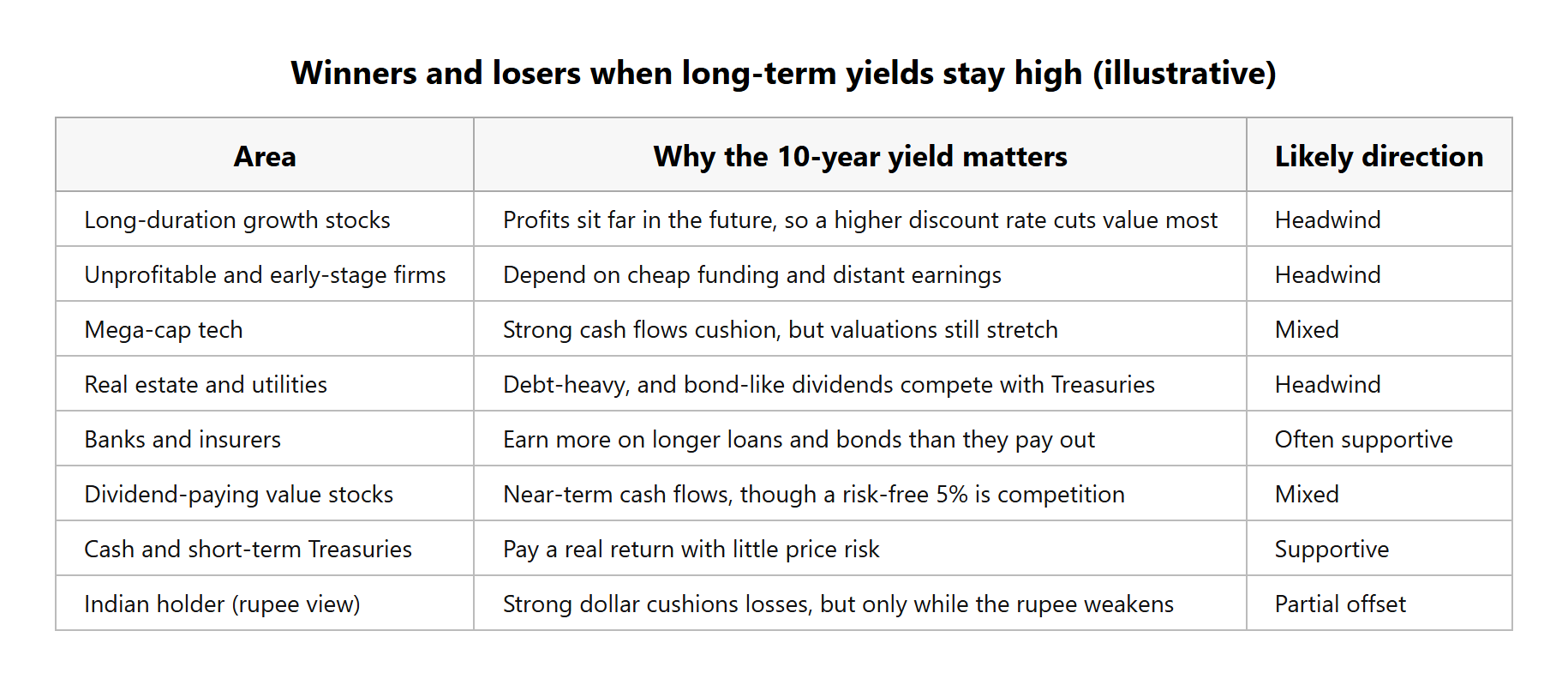
The table above is an illustrative framework, not a forecast. Real outcomes depend on earnings, and a rise in yields that comes from strong growth hurts less than one that comes from inflation fear.
Notice who sits at the top of the pain list. Long-duration growth and unprofitable companies take the hardest hit, because their value rests on distant profits. The Technology Select Sector SPDR fund (XLK) was reported on 9 November to be about 13% below its peak, per TheStreet, which fits that pattern, although yields were not the only cause.
Banks and insurers can gain from a steeper yield curve, because they earn more on longer loans and bonds than they pay on deposits. Cash and short-term Treasuries finally pay something worth having. Dividend-paying value stocks hold up better than growth stocks, though they also lose some appeal when a risk-free bond pays so well.
🌏 What this means if you are investing from India
Three points matter for an Indian investor holding US stocks.
The first is concentration. If most of your US money sits in a few technology and AI names, you are carrying the most yield-sensitive part of the market. A falling yield helps you quickly, and a rising one hurts you quickly. Check how much of your portfolio is made up of companies whose profits lie years ahead.
The second is the rupee. High US yields pull money towards the dollar. The rupee has traded in the mid-90s per dollar for much of this autumn, with a record low near 97 reached earlier in the year, per Trading Economics and Outlook Business reporting. A weak rupee cushions your returns on US holdings. Here is the plain maths: if your stock falls 5% in dollars and the dollar gains 3% against the rupee, you are down roughly 2% in rupee terms. The cushion works only if the rupee keeps weakening, and it is not a plan.
The third is the cost of the alternative. A 10-year US yield near 5% is a benchmark for every global investor, including the foreign funds that buy Indian shares and bonds. When US yields rise, those funds have a reason to sell Indian assets and buy Treasuries, which is one of the forces behind the rupee's pressure. So a move in a US bond that you may never buy can show up in your Indian portfolio too.
🔭 What to watch next
US inflation prints come first. October CPI landed this week, and the next releases will show whether inflation is easing or sticking. Banks cited by TheStreet ahead of the print that gave a view all expected the Fed to raise rates in December, so any surprise matters.
The Fed meets on 8 and 9 December, with fresh projections. Watch whether the dissenters from October become a majority.
Watch Treasury auctions. Weak demand at an auction, where yields jump just after the sale, is a sign that term premium is rising. The Treasury's next quarterly refunding statements are where any increase in bond sizes would be signalled.
Finally, watch ING's range. The firm's baseline puts the 10-year at 5.25% or above through at least the first quarter of 2027, with a cap near 5.5%. If yields push through that range, expect more pressure on growth stocks. If they fall back towards 4.5%, as ING sees later in 2027, the relief goes first to the same names that fell hardest.
If this changed how you see the 10-year yield, pass it on.
📊 The bottom line
The Fed sets the price of money for a day. The bond market sets the price of money for a decade, and that is the price your stocks are measured against. With deficits near 6% of GDP, inflation above target and a divided Fed, the term premium has a reason to stay. That does not mean stocks must fall. It means the bar for growth stocks is higher than it was a year ago. Look at your US holdings, find the ones that depend on profits far in the future, and decide whether you are being paid enough to wait.
📈 Numbers worth remembering
This article is for educational purposes only and does not constitute investment advice. Winvesta India Technologies Ltd. does not guarantee the accuracy of third-party data cited above. Past performance is not indicative of future returns. Please consult a registered financial adviser before making investment decisions.