


Most investors still get their central bank analysis from CNBC headlines and Twitter threads. By the time they read “Powell signals steady rates,” the move is done. The transcripts are free. The speeches are public. But nobody teaches you how to read them.
That’s why we built Winvesta Crisps—to decode what actually drives markets, in plain language, before the consensus catches up.
60,000+ investors from all over India are already in. What about you?
Every February, markets obsess over rate decisions while ignoring the real alpha: what central bankers say when they think no one’s listening. This month, as the Fed chair prepares for semi-annual Congressional testimony and ECB officials scatter across European finance conferences, the gap between official statements and casual remarks is widening in ways that deserve close attention.
You’ve been trained to watch the headline number. Markets can move sharply on a 25-basis-point cut. But here’s what nobody tells you: the language shifts in prepared speeches—buried in paragraphs six through nine—have preceded major market regime changes over the past two decades. Learning to read those shifts is one of the last genuine edges available to individual investors.
📅 What’s happening right now
February 2026 is packed with central bank communication events that will set the tone for Q1 positioning:
February 5: ECB President Christine Lagarde held rates unchanged and reiterated the “data-dependent and meeting-by-meeting” framework at her press conference. She noted inflation had dropped to 1.7% in January — below the 2% target — but pushed back against expectations of imminent easing, emphasising resilience in the economy and lingering concerns about services inflation. What she didn’t say mattered as much as what she did.
February 18: The FOMC released minutes from the January 27–28 meeting, and they highlighted an unusually wide range of views, from participants arguing for cuts to others arguing to hold, with some warning that upside inflation risks remained. Governors Miran and Waller had already dissented from the hold decision at 3.5–3.75%, voting for a 25bp cut. The tone made clear that consensus on the path ahead is far weaker than a simple “Fed holds rates steady” headline suggests. If you only read that headline, you missed the real story entirely.
February 20: December 2025 PCE data landed, with core PCE running around 3.0% year-over-year. Meanwhile, the January 2026 PCE release was pushed to March due to earlier scheduling disruptions, leaving a gap that markets had to price around rather than through.
Late February: Around this period, Governor Waller argued in a public speech that policy might already be tighter than necessary and downplayed tariff-driven inflation risks, while Vice Chair for Supervision Bowman focused on regulatory issues in testimony to lawmakers. Lagarde, in her ECON hearing before the European Parliament, leaned into the gap between measured and perceived inflation — a subtle but meaningful shift in framing worth tracking.
These events have already happened. The question is: did you read the transcripts, or did you wait for CNBC’s 90-second summary?
🔦 Why central bank rhetoric moves markets quietly but powerfully
Central bankers operate under dual constraints: they must guide markets without causing panic, and they must maintain credibility without committing to specific actions months in advance. The result? A carefully constructed language system where individual word choices carry enormous weight.
The mechanism is simple: rate decisions tell you what happened. Speeches tell you what’s about to happen. By the time the decision arrives, sophisticated investors have already repositioned based on linguistic shifts they detected weeks earlier in supposedly “routine” remarks.
Consider two of the most famous examples. When Draghi said “whatever it takes” in July 2012, European bond yields fell sharply over the following months—the exact phrasing became a policy anchor that markets priced for years. When the Fed shifted from “ongoing increases” to “any additional increases” in early 2024, Treasury yields moved meaningfully over several sessions as traders repriced the entire rate path. In both cases, the words moved markets before any actual policy change occurred.
🗣️ Reading the signals: Tone and subtext
Central bankers telegraph future policy through five key rhetorical devices:
Conditional language intensity: The difference between “if conditions warrant” versus “when conditions allow” versus “as conditions require” signals conviction levels about future action. Each step up the intensity ladder narrows the range of possible outcomes.
Data dependency framing: Watch for shifts from “data-driven” (reactive) to “data-informed” (discretionary). In historical episodes, the latter has tended to precede policy pivot points—sometimes by weeks, sometimes by months.
Risk balance descriptions: When bankers discuss “risks to the outlook,” count the sentences dedicated to upside versus downside risks. When the balance flips noticeably from one speech to the next, it often indicates a shift in the committee’s internal debate.
Dissent acknowledgement When a chair explicitly addresses dissenting votes in prepared remarks—not just in Q&A—it often signals that the internal debate is intensifying and that major policy recalibration may be on the horizon.
International cross-references: When one central banker cites another’s recent speech by name, they may be coordinating messaging. This kind of cross-referencing has appeared at several key policy inflexion points over the past decade.
🔍 Case studies from February in prior years

These episodes illustrate how language shifts can drive multi-week market trends—though the exact magnitudes of the moves varied, and the examples below are directionally accurate rather than precise to the decimal.
February 2016 – Yellen’s “considerable uncertainty” pivot: Fed Chair Janet Yellen testified to Congress on February 10–11, 2016. Markets expected four rate hikes that year based on December 2015 guidance. Buried in her testimony: she mentioned “considerable uncertainty” repeatedly—a phrase that had been absent from her December remarks. Investors who caught this language shift were better positioned for the subsequent repricing when the Fed delivered only one hike instead of four. The S&P 500 declined meaningfully around this period before rallying as the dovish reality set in.
February 2019 – Powell’s “patient” framework introduction: Around this period, the FOMC dropped language about “some further gradual increases” and replaced it with a commitment to being “patient.” That single-word addition effectively marked the end of the hiking cycle. Investors who parsed the language shift repositioned into duration and growth stocks. The NASDAQ surged over the following months—the Fed didn’t actually cut until July, but the speech moved markets months earlier by reframing the entire reaction function. (The full FOMC meeting transcripts and statements from this period are available on the Federal Reserve’s website.)
February 2023 – Lagarde’s “significant ground to cover” warning: ECB President Christine Lagarde used the phrase “significant ground to cover” repeatedly in her February 2, 2023, press conference. This was new language—she’d never used that exact construction before. European rates rose substantially over the following months, punishing bond portfolios that assumed the hiking cycle was near its end. The phrase signalled duration, not magnitude—exactly the kind of qualitative shift that transcripts reveal but headlines miss.
🚀 Want to trade US markets based on smarter macro analysis? Access US stocks directly from India on the Winvesta app. No US bank account needed.
📰 Why press conference headlines often mislead investors
Financial media optimises for clicks, not context. When Bloomberg runs “Powell Signals Steady Rates,” they’re summarising a lengthy transcript with an eight-word headline. The actual information—the shift from “monitor incoming data” to “assess incoming data,” the addition of “balanced” to describe risk outlooks, the conspicuous absence of previously standard phrases—gets buried deep in the article.
Press conferences generate dozens of Q&A exchanges. Headlines capture one. Usually, it is the one that confirms market consensus. The contrarian signals hide in non-headline answers.
Example: In February 2024, when asked about inflation persistence, Powell spent notably more time discussing labour market dynamics than inflation metrics. The time allocation mattered more than the words. Reporters focused on his inflation comments (the question topic), missing his pivot toward employment concerns that signalled the end of aggressive tightening.
Television segments compress hour-long testimonies into 90-second summaries. What gets cut? The qualifications, the conditional language, the subtle shifts—exactly the parts that matter.
🏭 The sectors where central bank rhetoric matters most
Not all sectors respond equally to speeches versus actions:
Financials (especially regional banks): Net interest margin projections depend entirely on expectations of the rate path. When Powell shifts language about “higher for longer,” bank stocks can move substantially within days, long before actual rate changes—because bank analysts are repricing over a year’s worth of earnings expectations based on a few changed words.
Real estate and REITs: Cap rate assumptions live or die on forward guidance. A single speech changing terminal rate expectations can swing REIT valuations meaningfully—making speech analysis more valuable than tracking actual decisions.
Emerging-market currencies and bonds: Developing-economy central banks shadow Fed rhetoric almost verbatim. When Powell introduces new framing, EM central bankers tend to adopt it within weeks, creating predictable policy cascades across currency markets.
Gold and commodities: These assets trade on real rate expectations. Central bank language about inflation persistence versus transitory pressures moves real yields—and therefore gold prices—more than actual CPI prints.
Growth tech: Long-duration assets with distant cash flows are mathematically hypersensitive to discount rate changes. Subtle shifts in terminal rate guidance can justify significant valuation swings purely based on DCF mechanics.
Someone shared this with you? If this changed how you think about central bank speeches, pass it on.
🧭 How to distil signals into actionable insights
1. Read the actual transcript, not the summary. Allocate 30 minutes after major speeches to read full remarks. The FOMC posts transcripts within hours. The ECB publishes introductory statements and press conference materials on the same day. This is free, primary-source information most investors ignore.
2. Build a language tracker spreadsheet. Track key phrases across speeches: “significant,” “considerable,” “appropriate,” “balanced,” “patient.” Note frequency changes month-over-month. When key phrases appear twice as often—or disappear entirely—the policy framework is shifting. This kind of tracking flagged the early 2019 “patient” pivot weeks before consensus caught up.
3. Watch Q&A response length. How long do chairs spend on different question categories? Unusually long answers on topics they usually dismiss quickly signal emerging priority shifts.
4. Cross-reference speeches with dissent votes. When a dissenting FOMC member gives a speech defending their position shortly after a decision, they’re building public support for a policy shift. Watch for this pattern—it has preceded several notable pivots.
5. Monitor speaking engagement choices. When central bankers accept invitations to speak at non-traditional venues (tech conferences instead of banking symposia, university economics departments instead of central banking forums), they’re often preparing markets for non-traditional policy approaches.
📈 Why markets reward early readers disproportionately
Information diffusion in financial markets is deeply unequal. The earliest investors to identify a language shift capture a disproportionate share of the available returns. By the time a central bank's language shift becomes “common knowledge,” it’s fully priced in.
Consider the typical timeline after a major testimony:
Day 0: Testimony delivered, transcript posted online for free.
Day 1: Sophisticated macro funds identify the language shift, begin repositioning.
Day 2–3: Prop desks and hedge funds notice unusual options flow, investigate transcripts.
Day 4–7: Financial media runs the first “Fed may be less hawkish” stories.
Day 14+: Retail investors adjust portfolios based on mainstream coverage.
The spread between Day 1 positioning and Day 14 entry represents the entire exploitable edge. After two weeks, the insight becomes consensus and stops generating returns.
This isn’t about illegal front-running. It’s about treating publicly available information as a primary source rather than waiting for interpreted summaries. Every transcript, every speech, every press conference is public the moment it’s delivered. The vast majority of market participants wait for someone else to read it first.
🗂️ Your checklist for February 2026
By February 5: Review Lagarde’s ECB post-meeting press conference. Track whether “data-dependent and meeting-by-meeting” still means “dovish lean” or if the framing is shifting — she noted inflation dropped to 1.7% in January, below target, but pushed back on imminent easing. Pay special attention to Q&A divergence from prepared remarks.
By February 18: Read the full FOMC meeting minutes from the January 27–28 meeting. The minutes showed an unusually wide range of views — “several” officials open to more cuts if inflation keeps easing, “some” preferring to hold rates steady for longer, and others warning that hikes couldn’t be ruled out if inflation stays above target. Track how phrases like “several,” “some,” “many,” and “a vast majority” are used to describe inflation and employment risks — that language maps the committee’s fault lines heading into March 17–18.
By February 20: Review what the Fed has been signalling about inflation versus what December 2025 PCE actually showed (core running around 3.0% year-over-year). Note that the January 2026 PCE release was delayed from its original February 26 date to March 13 because of missing source data — when the Fed makes its March decision, speech-based forward guidance carries even more weight.
By February 26: Parse Lagarde’s testimony before the European Parliament’s ECON committee. She shifted from pure data-dependency toward inflation perceptions — acknowledging the gap between measured and perceived inflation. Compare this to her February 5 press conference for evolution in language.
Throughout February: Cross-reference Governor Waller’s speech — where he argued rates are tighter than necessary and tariff-driven inflation is overstated — with his dissent in the January meeting. When dissenting governors build public cases within weeks of a decision, they’re lobbying for the next one. Build your phrase frequency tracker for “patient,” “restrictive,” “neutral rate,” and “data-dependent.” When the top phrases from January don’t appear in March, the framework is changing under your feet.
⚖️ Prepared remarks vs Q&A: Which to trust?
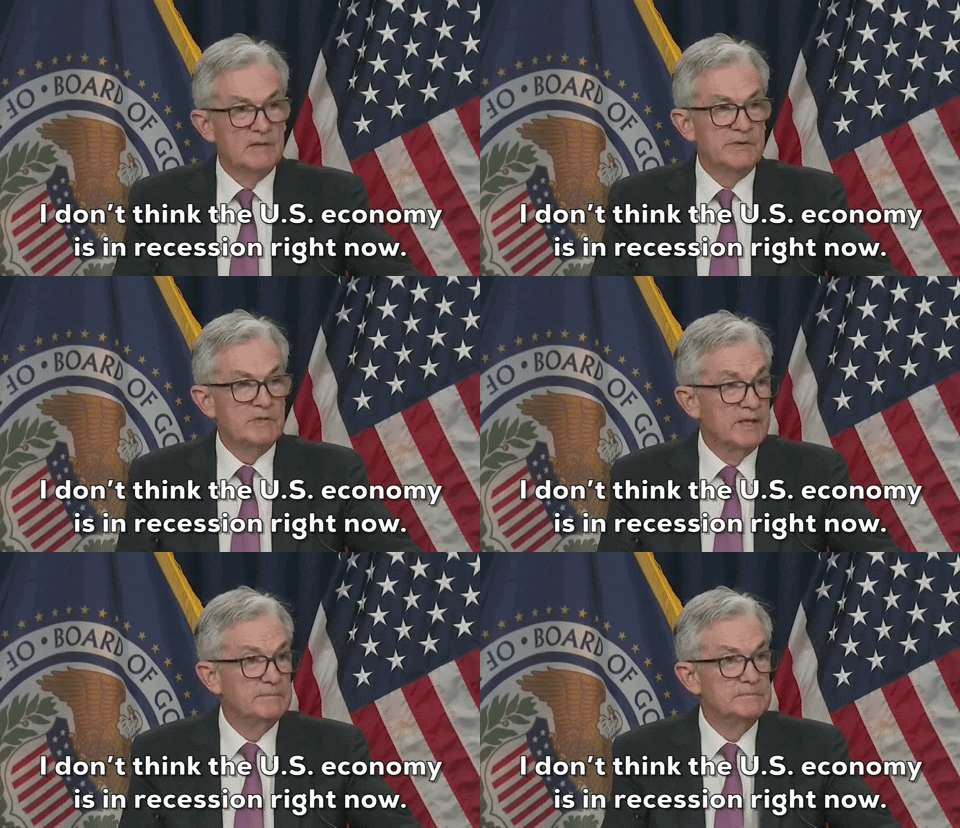
Prepared remarks reflect committee consensus and legal review. Q&A reveals individual chair priorities and real-time thinking. Both matter, but differently.
Trust prepared remarks for: Official policy framework changes, formal guidance adjustments, coordinated messaging with other central banks. These are deliberate signals meant to move markets in specific directions.
Trust Q&A for: Emerging concerns not yet formalised in policy, personal chair priorities that might influence future debates, reactions to very recent data that didn’t make it into the prepared text. These are authentic signals with less political filtering.
Red flag: When Q&A contradicts prepared remarks. This happened in February 2020, when Powell’s prepared remarks discussed the “baseline outlook,” while his Q&A responses kept returning to “downside risks.” The Q&A was right—recession followed within weeks.
Strongest signal: When a chair uses Q&A to reinforce prepared remarks with new examples or stronger language. This indicates high conviction and committee alignment.
👂 Key takeaways
February speeches matter more than rate decisions. Policy pivots telegraph through language shifts well before formal decisions. Read transcripts, not headlines.
Track language frequency changes month-over-month. When key phrases appear twice as often—or disappear entirely—policy frameworks are shifting. This kind of tracking has flagged pivots weeks before consensus in multiple historical episodes.
Q&A response length indicates priority shifts. When chairs spend unusual time on topics they typically dismiss quickly, that’s a signal of emerging concerns worth paying attention to.
Historical February precedents illustrate the pattern. The 2016 “considerable uncertainty” pivot, the 2019 “patient” framework shift, and the 2023 “significant ground to cover” warning all show that mid-quarter communication drives multi-month trends when language shifts precede policy changes.
Early readers capture the edge. The gap between reading the transcript yourself and waiting for media interpretation is where returns live. Public information remains exploitable if you access it directly and immediately.
Powell testified February 11–12. Lagarde spoke on January 30. The FOMC minutes dropped on February 19. PCE data landed in late February. By the time CNBC summarised these in sound bites, the actionable signals were already priced. Build the habit of reading primary sources before they become secondary stories. The next major market regime change is hiding in paragraph seven of a speech most investors will never finish reading.
Disclaimer: This article is for educational purposes only and is not financial advice. The author and Winvesta are not SEBI-registered investment advisors. Historical examples are directionally illustrative and not guaranteed to repeat. Sector-specific impact descriptions are based on general historical patterns rather than precise measurements. Always consult a qualified financial advisor before making investment decisions. Investing in US stocks from India involves currency risk and regulatory considerations.