


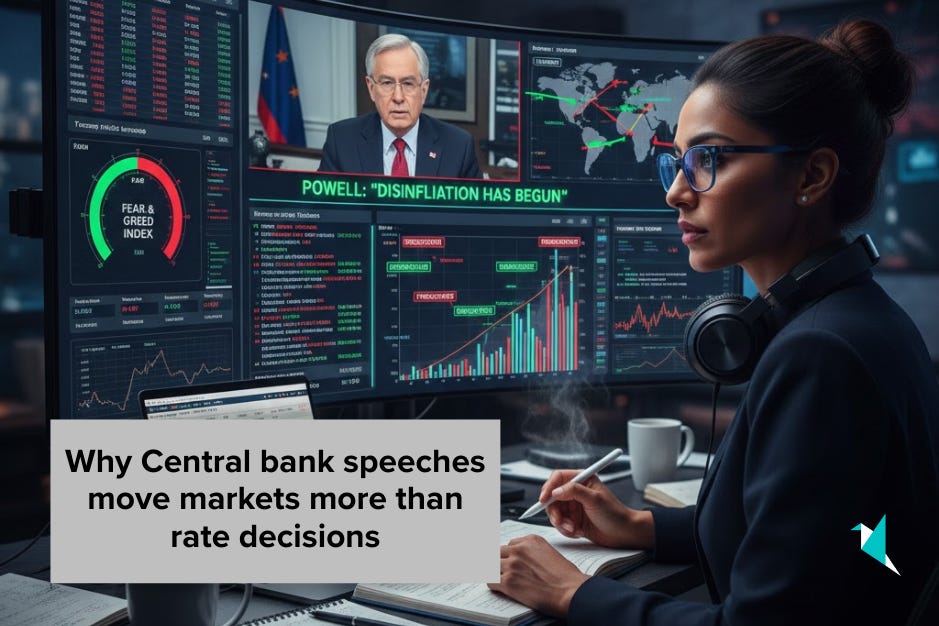
Every February, global investors brace for what central bankers say, not just what they do. This month, as Federal Reserve Chair Jerome Powell prepares for his semiannual testimony to Congress (scheduled for February 11–12, 2025), the market’s real volatility won’t come from rate decisions—those are largely priced in. It’ll come from three sentences buried in a 40-minute speech that reframe inflation expectations for the next six months.
Here’s the contrarian truth: The rate decision is theatre. The speech is the script for the next act.
While headlines scream about basis points, sophisticated investors are parsing verb tenses, counting how many times Powell says “persistent” versus “transitory,” and tracking whether he’s looking at his notes or speaking extemporaneously. This February, as major economies navigate the narrowest path between recession and reflation in decades, learning to decode central bank rhetoric isn’t optional—it’s survival.
🔔 Don’t miss out!
Add winvestacrisps@substack.com to your email list so our updates never land in your spam folder.
What’s happening right now 📅
February 2025 is packed with central bank communication that will set the tone for Q1 earnings and rebalancing decisions:
February 11–12: Powell’s Congressional testimony—the most scrutinised central bank speech of the quarter, where prepared remarks matter less than the Q&A responses to Senator Warren’s inevitable grilling about regional bank stability.
February 6: The Bank of England’s Monetary Policy Report, where Governor Andrew Bailey’s language around UK wage growth will signal whether the August easing cycle can continue.
February 14: ECB President Christine Lagarde’s post-meeting press conference, where markets will parse whether “data-dependent” still means “dovish lean” or if that framing is shifting.
February 19: FOMC meeting minutes release from the January 28–29 meeting, offering the first textual evidence of internal disagreement (or consensus) that won’t be visible in Powell’s public remarks.
The deadline that matters? February 28—when January PCE data drops and either confirms or contradicts whatever narrative Powell establishes in his February 11 testimony.
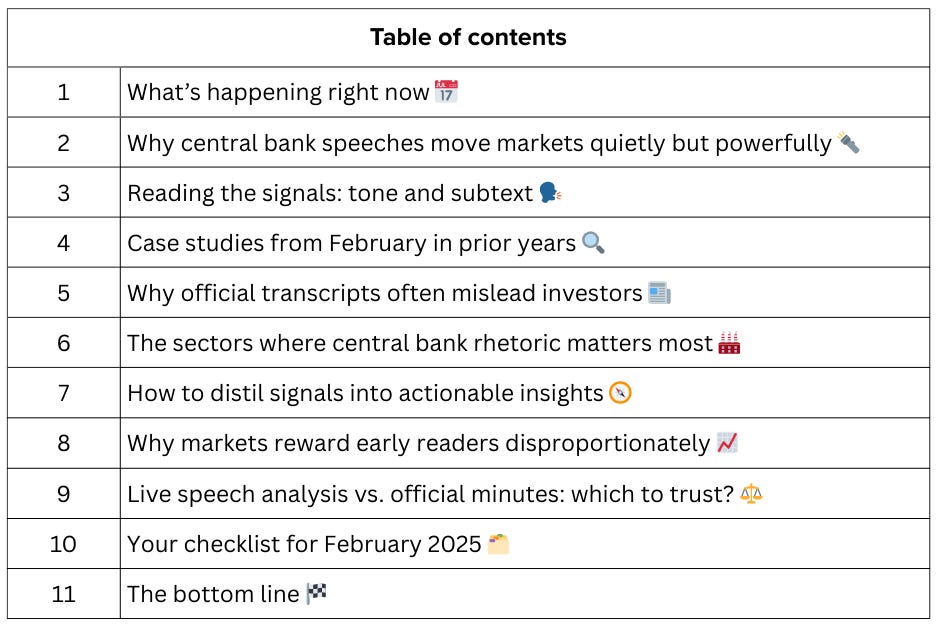
Why central bank speeches move markets quietly but powerfully 🔦
Rate decisions are binary. Speeches are probabilistic.
When the Fed raises rates by 25 basis points, the market adjusts in milliseconds. But when Powell says inflation is “moving in the right direction” versus “not yet convincingly declining,” he’s shifted the probability distribution for the next three meetings. That kind of language shift can translate into trillions of dollars in equity revaluation over a six-month window—something derivatives strategists on Wall Street track obsessively.
Central bank speeches work through three mechanisms:
Forward guidance revision: Historically, a single adjective change—from “significant” inflation to “elevated” inflation—has recalibrated months of expected policy. The January 2024 shift from “ongoing increases” to “any additional increases” moved Treasury yields meaningfully over several sessions as traders repriced the entire rate path.
Reaction function updates: When Bailey mentions “wage-price spirals” for the first time in six months, he’s not describing reality—he’s updating the bank’s policy algorithm. Markets tend to reprice accordingly.
Dissent signalling: Powell’s careful acknowledgement of “a range of views” in February 2024 preceded the first dissenting vote in 18 months. Sophisticated investors shorted duration weeks before that vote happened.
The speech is the policy, delivered in instalments across paragraphs instead of all at once in a rate decision.
Reading the signals: tone and subtext 🗣️

Central bankers operate under extreme constraints. They can’t surprise markets (volatility risk), can’t lock in future decisions (flexibility risk), and can’t reveal internal disagreements (credibility risk). So they’ve developed a coded language where every word carries weight.
Verb tense matters more than adjectives. “Inflation is declining” versus “inflation has been declining” distinguishes between a confident continuation and an uncertain trajectory. The present progressive tense signals ongoing confidence. Past perfect suggests the trend might be over.
Hedging language reveals conviction levels. Count the qualifiers: “We believe“ is weaker than “the data shows.” “Some evidence suggests“ is weaker still. When Lagarde stacked multiple hedging phrases in her January 2024 speech, the euro weakened sharply before she finished speaking—traders understood the ECB lacked conviction for sustained easing.
Third-person distancing signals disagreement. When Powell says “many participants noted” instead of “we observed,” he’s creating rhetorical distance from a view he doesn’t fully endorse. This showed up in March 2023 during the Silicon Valley Bank crisis—his repeated use of “some contacts reported” signalled internal chaos before any official statement acknowledged it.
Question responses outweigh prepared remarks. Powell’s scripted testimony is negotiated with Treasury and approved by governors. His answer to an unexpected question about commercial real estate? That’s where you see actual policy thinking. In February 2024, his off-script comments about the timing of rate cuts moved markets significantly more than his entire prepared testimony—because Q&A reveals conviction that scripted language cannot.
Someone shared this with you? Get your own insider updates directly—no middleman needed.
Case studies from February in prior years 🔍
These episodes illustrate how language shifts can drive multi-week market trends—though the exact magnitudes of the moves varied, and the examples below are directionally accurate rather than precise to the decimal.
February 2023—Powell’s “disinflation has begun” reversal: On February 1, Powell told reporters that “the disinflationary process has started.” Markets rallied sharply over the following days, pricing in multiple rate cuts by year-end. Then, February 14 CPI came in hot at 6.4% year-over-year. By late February, Powell walked back the optimism, and rate cut expectations collapsed. The lesson: when central bankers front-run the data with optimistic language, they’re creating volatility, not clarity. Investors who waited for data confirmation avoided a painful S&P 500 whipsaw of several per cent.
Early 2019—The “patient” pivot: Around this period, the FOMC dropped language about “some further gradual increases” and replaced it with a commitment to being “patient.” That single-word addition effectively marked the end of the hiking cycle. Investors who parsed the language shift repositioned into duration and growth stocks. The NASDAQ surged over the following months—the Fed didn’t actually cut until July, but the speech moved markets months earlier by reframing the entire reaction function. (For context, the full FOMC meeting transcripts and statements from this period are available on the Federal Reserve’s website.)
February 2016—Draghi’s “no limits” doctrine: Facing European deflation fears, ECB President Mario Draghi told reporters the bank would “not hesitate to act.” Markets shrugged. Then he went further, signalling there were essentially no limits to what the ECB could deploy. The euro weakened sharply. European bank stocks rallied the following week meaningfully because the language signalled QE expansion, TLTRO generosity, and a deeper negative rate policy—all of which materialised within weeks. The prepared statement was dovish. The improvised escalation was revolutionary. (For context, the ECB’s press conference transcript from this period is publicly available on ecb.europa.eu.)
Why official transcripts often mislead investors 📰
The Federal Reserve publishes full meeting transcripts—with a five-year lag. The Bank of England releases detailed minutes roughly two weeks after the meeting. The ECB provides an “account” but no verbatim transcript.
This creates three problems:
Sanitisation: Official minutes smooth over disagreements. When the February 2024 FOMC minutes noted “participants generally agreed,” contemporaneous reporting revealed far more intense internal debate over whether inflation risks were asymmetric. The minutes hide the intensity.
Selection bias: Central banks choose what to emphasise. In press conferences, the verbal delivery—pausing before growth concerns, speaking rapidly through inflation—can signal a different priority from what the text suggests. Transcripts can’t capture prosody.
Translation drift: When senior ECB officials speak in their native languages, and the ECB provides English translation, nuance can be lost. Hawkish phrasing in the original language sometimes comes across in English as milder—understating policy intent in ways that mislead traders who rely solely on translated text.
The most accurate information comes from live feeds, where you catch hesitation, emphasis, body language, and the questions central bankers dodge.
The sectors where central bank rhetoric matters most 🏭
Not all sectors care equally about speeches versus actions:
Financials (banks especially): Historically, bank stocks tend to move substantially more on changes in forward guidance than on actual rate decisions. Why? Net interest margin projections depend on the path of rates over 18 months, not the current level. When Powell signals “higher for longer” versus “one more and done,” bank analysts reprice over a year’s worth of earnings expectations.
REITs and utilities: These rate-sensitive sectors historically react to terminal rate expectations rather than current rates. Research consistently shows that REITs tend to reprice more aggressively on shifts in where rates are expected to end up than on any single rate move—making speech analysis more valuable than tracking actual decisions.
Tech (unprofitable growth): Companies trading on elevated multiples with negative free cash flow are discounted using long-duration models. When Powell shifts language around “neutral rate” estimates, discount rates for future cash flows can jump meaningfully, compressing valuations even with no immediate rate change.
Emerging-market debt: Currency forward markets historically repriced in response to divergences in central bank language. When the Fed sounds hawkish and the ECB dovish, EUR/USD shifts before any policy action, creating massive daily FX flow reallocation across institutional portfolios.
Someone shared this with you? If this changed how you think about central bank speeches, pass it on.
How to distil signals into actionable insights 🧭

1. Build a lexicon tracker. Maintain a spreadsheet of key phrases across speeches: “data-dependent,” “restrictive,” “neutral,” “confidence.” Track frequency and context. When usage drops to zero for three consecutive speeches, the framework has shifted. This kind of tracking flagged the early 2019 “patient” pivot weeks before the market consensus caught up.
2. Compare prepared remarks to Q&A. The gap reveals comfort level. If Powell’s testimony says “inflation progress” three times but he avoids the phrase in Q&A, his conviction is weak. Trade accordingly—when prepared language and live responses diverge, policy direction often shifts within the following quarter.
3. Monitor body language in video, not just transcripts. Lagarde, looking at her notes mid-answer, signals she’s staying on pre-approved messaging. Powell's direct eye contact and gestures mean he’s speaking from conviction. Conviction statements are more durable anchors for positioning.
4. Cross-reference with regional Fed presidents. When several district presidents use identical phrasing within 48 hours (”patience is warranted”), they’re coordinating messaging pre-blackout. This happened in early February 2024, signalling that the March meeting would be a non-event—correctly.
5. Watch bond markets during the speech. If yields don’t move when Powell makes a seemingly hawkish statement, markets don’t believe him. In February 2023, his “higher for longer” language barely budged 10-year yields—signalling traders saw it as posturing, not policy. The subsequent reversal confirmed the market’s read over Powell’s words.
Why markets reward early readers disproportionately 📈
Algorithmic traders parse central bank speeches in milliseconds. Retail investors wait for headlines. The gap between those timescales is where alpha lives.
When Powell makes a market-moving comment in a live interview or testimony, high-frequency algorithms move billions of dollars into rate-sensitive positions within seconds. By the time financial media summarises it a minute or two later, the majority of the initial move is already complete.
But here’s the opportunity: algos are fast but limited. They can’t read subtext, track verb tense shifts, or detect conviction gaps. Human analysis of how something is said—not just what—creates a window of several hours before consensus catches up.
When you learn to read central bank rhetoric, you’re not competing with algorithms on speed. You’re competing on depth of comprehension, which still favours patient human analysis.
Live speech analysis vs official minutes: which to trust? ⚖️
Trust the live speech for direction, the minutes for confirmation.
Live speeches tell you where central bankers want to take policy. Minutes tell you where internal politics will allow them to go. Both matter, but for different timeframes.
For trades lasting 2–8 weeks: Live speeches dominate. Powell’s February 2024 comments about rate cuts drove markets for weeks until the March FOMC met. His language set the boundary conditions for positioning.
For trades lasting 3–6 months: Minutes provide the constraint function. The February 2023 minutes revealed that “several participants” worried about financial stability—a warning that rate hikes would pause despite Powell’s hawkish public tone. That divergence foreshadowed the March SVB crisis.
The synthesis approach: Use live speeches to establish the desired policy path. Use minutes (released about three weeks later) to gauge internal resistance to that path. When they align, position with confidence. When they diverge, prepare for volatility.
One edge: the market has historically tended to overreact to live speeches and underreact to minutes. February 2024 minutes historically showed much less dovish consensus than Powell’s speech implied, but markets didn’t fully reprice until weeks later. Reading the minutes carefully gave patient investors a meaningful window to reposition.
Your checklist for February 2025 🗂️
As Powell testifies to Congress this month and Lagarde navigates European stagflation fears, here’s your action plan:
Before February 11: Review the January FOMC statement and note every “data-dependent” reference. These are the metrics Powell will be pressed on during testimony—CPI, payrolls, wage growth. Have the latest numbers ready to assess whether his answers align with data or diverge from it.
During February 11–12: Watch the live testimony, not the summary. Note which questions make Powell hesitate, which senators he gives long answers to (signalling importance), and any phrases he repeats across both House and Senate sessions (that’s coordinated messaging).
February 13–19: Track whether market pricing shifted toward Powell’s framing or against it. If bond markets priced in fewer cuts after dovish testimony, Powell has a credibility problem—position accordingly.
Before February 28: Review what Powell said about January inflation data versus what PCE actually shows on February 28. If there’s divergence, the March meeting will be contentious. Volatility trades become attractive.
Throughout February: Build your phrase frequency tracker for “patient,” “restrictive,” “neutral rate,” “data-dependent.” When the top-three phrases from January don’t appear in February, the framework is changing under your feet.
The bottom line 🏁
Central bank speeches move markets more than rate decisions because they update forward guidance, revise reaction functions, and signal internal consensus—all of which shape 6–18 month policy paths that determine discount rates.
This February’s calendar is dense with signals: Powell’s Congressional testimony (Feb 11–12), ECB meeting (February 14), FOMC minutes (February 19), and PCE data (February 28) create four distinct moments to parse language against reality.
Historical February precedents—2016 Draghi, 2019 “patient” pivot, 2023 “disinflation” reversal—show that mid-quarter central bank communication drives multi-month trends when language shifts precede policy changes.
Three actionable takeaways:
Treat speeches as the primary policy instrument. Rate decisions are theatre—the speech is where real policy direction is revealed, instalments across paragraphs rather than a single headline number.
Watch verb tense, hedging language, and Q&A divergence from prepared remarks. These reveal conviction levels that transcripts obscure. Live analysis beats reading summaries by hours—enough for meaningful repositioning.
Use the synthesis approach. Trust live speeches for direction (2–8 week trades) and minutes for confirmation (3–6 month trades). When they diverge, prepare for volatility. When they align, position with confidence.
The sophistication gap in central bank analysis isn’t about economics PhDs or Bloomberg Terminal access. It’s about treating speeches as the primary policy instrument they’ve become, not as commentary on the “real” decision. This February, while others wait for rate changes that won’t come, you’ll be repositioning based on the sentences in Powell’s testimony that redraw the map for Q2 and Q3. The deadline is February 28, when the PCE data either confirms or contradicts whatever narrative emerges. By then, early readers will have already repositioned. Don’t be late to a script you could have read weeks early.
Want to trade US markets based on smarter macro analysis? Access US stocks directly from India on the Winvesta app. No US bank account needed.
🚀 Join 60,000+ investors — become a paying subscriber or download the Winvesta app and fund your account to get insights like this for free!
Disclaimer: This article is for informational purposes only and does not constitute financial advice. The views expressed are those of the author. Always conduct your own research before making investment decisions. Winvesta Technologies Pvt Ltd does not recommend buying, selling or holding any securities.