


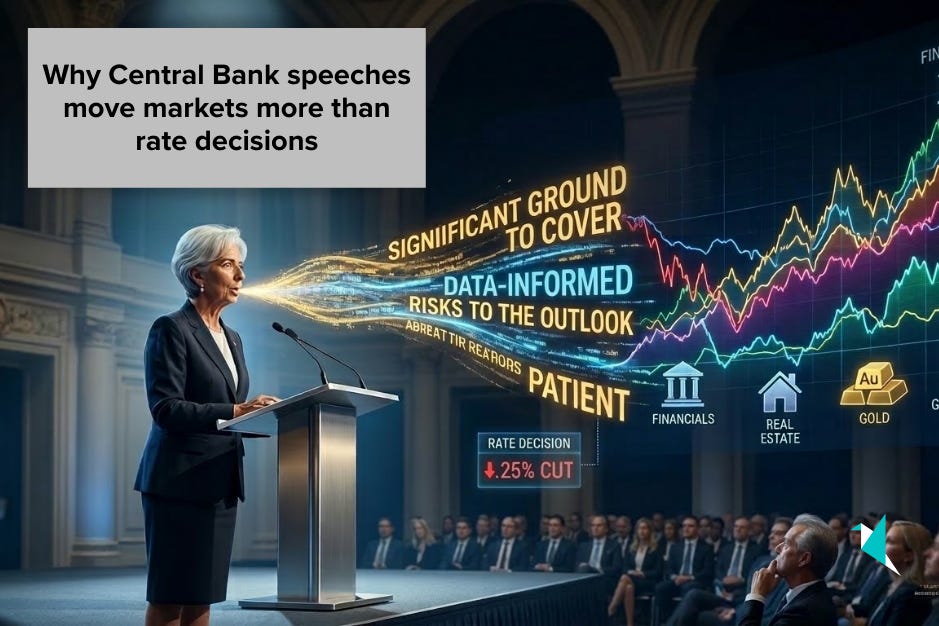
Most investors will wait for the March 18 headline: “Fed holds rates steady.” By then, the move is done. The transcripts from February’s speeches already contained the signals that will shape Q2 positioning. The information was public. The transcripts were free. But almost nobody read them.
That’s why we built Winvesta Crisps — to decode what central bankers actually said, in plain language, before the consensus catches up.
60,000+ investors from all over India are already in. What about you?
🔔 Don’t miss out!
Add winvestacrisps@substack.com to your email list so our updates never land in your spam folder.
Every March, central bankers deliver some of their most consequential speeches of the year. While retail investors obsess over rate decisions announced on single days, sophisticated traders know the real alpha comes from parsing the language shifts in speeches delivered at conferences, university lectures, and policy forums across financial capitals.
March 2026 is no exception. The FOMC meets on March 17–18, with Powell’s press conference immediately after. But the blackout period has already begun — meaning the last window of Fed speeches closed on March 7. Whatever signals were dropped in late February and early March will shape the March decision. And with Powell’s term as chair ending in May and Kevin Warsh nominated to succeed him, pending Senate confirmation, every remaining communication carries the weight of a farewell and a handoff.
Here’s the contrarian truth: The rate decision is theatre. The speech is the script for the next act. The vast majority of forward-looking policy information lives in speeches, testimonies, and press conferences — not in the headline rate number.
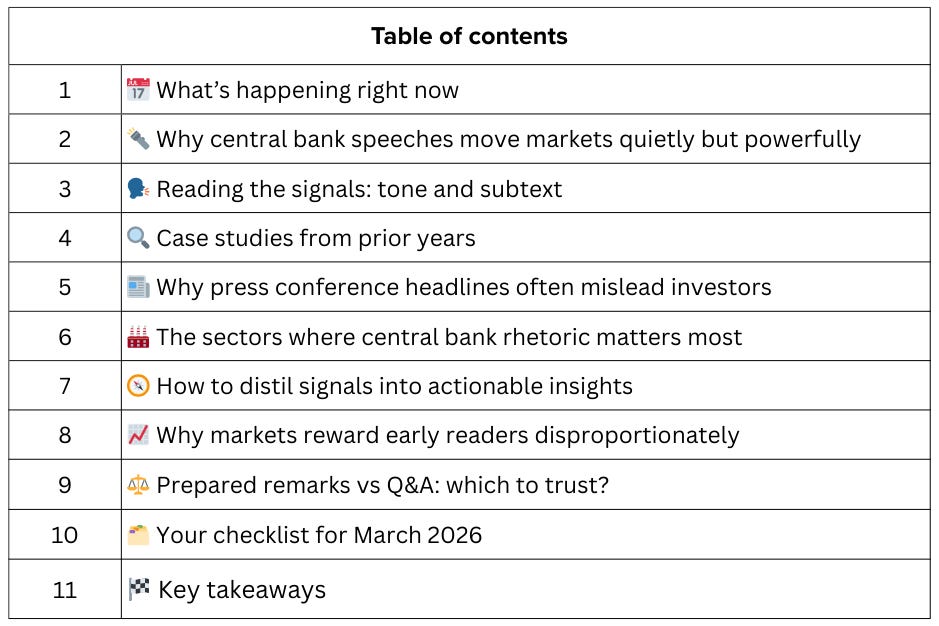
📅 What’s happening right now
March 2026 is defined by the FOMC meeting and the Iran conflict’s impact on the Fed’s calculus:
March 7–19: FOMC blackout period. Fed officials cannot make public speeches or comments about monetary policy. This means the last signals were delivered in late February and the first week of March — including Waller’s speech arguing rates may be too tight, Bowman’s testimony on banking oversight, and the January FOMC minutes released February 18 showing an unusually wide range of views on the committee.
March 17–18: FOMC meeting. The committee is widely expected to hold rates at 3.50–3.75%. But the press conference matters far more than the decision. With oil recently trading around $80, the Iran conflict disrupting energy markets, and the January PCE data released in March, Powell is flying partially blind. Watch for how he frames the inflation-versus-growth trade-off — that language will set the tone for Q2.
March 18: Powell’s press conference. This is likely one of his last as chair. Markets will parse whether he’s anchoring his successor’s starting position or stepping back. Every word carries double weight when the speaker is about to hand over the microphone.
Late March: Post-blackout speeches resume. Once the meeting passes, Fed governors will fan out to conferences and forums. These speeches will reveal how officials are processing the oil shock, the inflation implications of the Iran conflict, and whether the March decision was contested internally.
These aren’t ceremonial appearances. They’re coordinated communication exercises where central bankers deliberately shift language to prepare markets for policy pivots — sometimes months before official announcements.
🔦 Why central bank speeches move markets quietly but powerfully
Rate decisions are binary: up, down, or hold. Speeches contain something far more valuable — conditional guidance.
When a central banker says, “if inflation remains sticky, we’ll need to reassess our timeline,” that “if” clause contains multiple data dependencies that sophisticated traders immediately model. The word “reassess” signals flexibility. “Timeline” suggests the change window is open.
This is why markets have historically moved meaningfully after ECB or Fed speeches that changed a single word — like shifting from “patient” to “data-dependent.” To laypeople, these sound identical. To professional traders, they represent a seismic shift in the reaction function.
Central bank speeches work through three mechanisms:
Forward guidance revision: A single adjective change — from “significant” inflation to “elevated” inflation — can recalibrate months of expected policy. The January 2024 statement dropped earlier language about further rate increases and instead talked more cautiously about any additional policy tightening, which markets interpreted as a pivot toward cuts — moving Treasury yields meaningfully over several sessions as traders repriced the entire rate path.
Reaction function updates: When a central banker mentions a new risk for the first time — like “wage-price spirals” or “inflation perceptions” — they’re not describing reality. They’re updating the policy algorithm. Markets tend to reprice accordingly.
Dissent signalling: Powell’s careful acknowledgement of “a range of views” in recent meetings preceded notable dissenting votes. When a chair explicitly names disagreement, sophisticated investors adjust duration positioning weeks before the next decision.
The speech is the policy, delivered in instalments across paragraphs instead of all at once in a rate decision.
🗣️ Reading the signals: Tone and subtext
Central bankers operate under extreme constraints. They can’t surprise markets (volatility risk), can’t lock in future decisions (flexibility risk), and can’t reveal internal disagreements (credibility risk). So they’ve developed a coded language where every word carries weight.
Verb tense matters more than adjectives. The distinction between “Inflation is declining” and “inflation has been declining” indicates a confident continuation versus an uncertain trajectory. The present progressive signals ongoing confidence. Past perfect suggests the trend might be over.
Hedging language reveals conviction levels. Count the qualifiers: “We believe” is weaker than “the data shows.” “Some evidence suggests” is weaker still. When central bankers stack multiple hedging phrases in a single speech, traders understand the institution lacks conviction — and price assets accordingly.
Third-person distancing signals disagreement. When Powell says “many participants noted” instead of “we observed,” he’s creating rhetorical distance from a view he doesn’t fully endorse. This pattern showed up during the SVB crisis in March 2023 — his repeated use of “some contacts reported” signalled internal chaos before any official statement acknowledged it.
Question responses outweigh prepared remarks. Scripted testimony is negotiated and approved by committees. The answer to an unexpected question? That’s where you see actual policy thinking. In February 2024, Powell’s off-script comments about the timing of rate cuts moved markets significantly more than his entire prepared testimony — because Q&A reveals conviction that scripted language cannot.
Someone shared this with you? Get your own insider updates directly — no intermediary needed.
🔍 Case studies from prior years

These episodes illustrate how language shifts can drive multi-week market trends — though the exact magnitudes of the moves varied, the examples below are directionally accurate rather than precise to the decimal point.
February 2023 — Powell’s “disinflation has begun” reversal: On February 1, Powell told reporters that “the disinflationary process has started.” Markets rallied sharply over the following days, pricing in multiple rate cuts by year-end. Then, on February 14, the CPI came in hot at 6.4% year-over-year. By late February, Powell walked back the optimism, and rate-cut expectations collapsed. The lesson: when central bankers front-run the data with optimistic language, they’re creating volatility, not clarity.
Early 2019 — The “patient” pivot: Around this period, the FOMC dropped language about “some further gradual increases” and replaced it with a commitment to being “patient.” That single-word addition effectively marked the end of the hiking cycle. Investors who parsed the language shift repositioned into duration and growth stocks. The NASDAQ surged over the following months — the Fed didn’t actually cut until July, but the speech moved markets months earlier by reframing the entire reaction function.
February 2016 — Yellen’s “considerable uncertainty” pivot: Fed Chair Janet Yellen testified to Congress on February 10–11, 2016. Markets expected four rate hikes that year. Buried in her testimony: she mentioned “considerable uncertainty” repeatedly — a phrase absent from her December remarks. Investors who caught this shift were better positioned when the Fed delivered only one hike instead of four.
February 2026 — The three-way split: The January FOMC minutes, released February 18, revealed an unusually wide range of views — some officials open to cuts, some preferring to hold, others warning hikes couldn’t be ruled out. Meanwhile, Lagarde at the ECB shifted from a pure data-dependent stance to one focused on “inflation perceptions,” and Governor Waller publicly argued that rates may be too tight. Each of these signals is now being priced into the March 17–18 decision.
📰 Why press conference headlines often mislead investors
Financial media optimises for clicks, not context. When Bloomberg runs “Powell Signals Steady Rates,” they’re summarising a lengthy transcript with an eight-word headline. The actual information — the shift from “monitor incoming data” to “assess incoming data,” the addition of “balanced” to describe risk outlooks, the conspicuous absence of previously standard phrases — gets buried.
Press conferences generate dozens of Q&A exchanges. Headlines capture one. Usually, it is the one that confirms market consensus. The contrarian signals hide in non-headline answers.
Example: In February 2024, when asked about inflation persistence, Powell spent notably more time discussing labour market dynamics than inflation metrics. The time allocation mattered more than the words. Reporters focused on his inflation comments (the question topic), missing his pivot toward employment concerns that signalled the end of aggressive tightening.
The most accurate information comes from live feeds, where you catch hesitation, emphasis, and the questions central bankers dodge.
🏭 The sectors where central bank rhetoric matters most
Not all sectors respond equally to speeches versus actions:
Financials (especially banks): Net interest margin projections depend entirely on expectations of the rate path. When Powell shifts language about “higher for longer,” bank stocks can move substantially within days — because bank analysts are repricing over a year’s worth of earnings expectations based on a few changed words.
Real estate and REITs: Cap rate assumptions live or die on forward guidance. A single speech changing terminal rate expectations can swing REIT valuations meaningfully — making speech analysis more valuable than tracking actual decisions.
Growth tech: Long-duration assets with distant cash flows are mathematically sensitive to discount rate changes. Subtle shifts in terminal rate guidance can justify significant valuation swings purely based on DCF mechanics.
Gold and commodities: These assets trade on real rate expectations. Central bank language about inflation persistence versus transitory pressures moves real yields — and therefore gold prices — more than actual CPI prints. With gold near record highs above $5,000/oz and oil around $80, this sensitivity is heightened.
Emerging-market debt: Central banks in developing economies shadow Fed rhetoric. When Powell introduces new framing, EM central bankers tend to adopt it within weeks, creating predictable policy cascades across currency markets.
Someone shared this with you? If this changed how you think about central bank speeches, pass it on.
🧭 How to distil signals into actionable insights
1. Read the actual transcript, not the summary. Allocate 15–30 minutes after major speeches to read full remarks. The FOMC posts transcripts within hours. The ECB publishes introductory statements and press conference materials on the same day. This is free, primary-source information most investors ignore.
2. Compare to the previous speech by the same person. Open two tabs. Put the current speech on the left, their most recent speech on the right. Scan for changed words in identical sentence structures. These deliberate edits contain the signal.
3. Track hedging language frequency. Count conditionals (”if,” “should,” “could,” “may”). Note frequency changes month-over-month. When a usually decisive speaker significantly increases their conditional usage, uncertainty rises — which means volatility is coming.
4. Cross-reference speeches with dissent votes. When a dissenting FOMC member gives a speech defending their position shortly after a decision, they’re building public support for a policy shift. Watch for this pattern — it has preceded several notable pivots, including in February 2026 when Waller publicly argued against the hold decision.
5. Watch bond markets during the speech. If yields don’t move when Powell makes a seemingly hawkish statement, markets don’t believe him. When prepared language and real-time bond-market reaction diverge, the bonds are usually right.
📈 Why markets reward early readers disproportionately
Information asymmetry in modern markets is rarely about access — transcripts are public within hours. It’s about attention allocation.
The vast majority of retail investors never read a central bank speech transcript. Most financial advisors don’t either. Most institutional investors rely on research desk summaries written by analysts who face their own deadline pressures.
This creates persistent mispricings that can last several trading days after significant speeches — enough time for attentive individual investors to act.
Consider the typical timeline after a major testimony: sophisticated macro funds identify the language shift within hours. Prop desks and hedge funds notice unusual options flow the next day. Financial media ran the first “Fed may be shifting” stories several days later. Retail investors adjust portfolios after mainstream coverage arrives.
The spread between early positioning and late entry represents the edge. This isn’t about illegal front-running. It’s about treating publicly available information as a primary source rather than waiting for interpreted summaries.
When you learn to read central bank rhetoric, you’re not competing with algorithms on speed. You’re competing on depth of comprehension, which still favours patient human analysis.
⚖️ Prepared remarks vs Q&A: Which to trust?
Prepared remarks reflect committee consensus and legal review. Q&A reveals individual priorities and real-time thinking. Both matter, but differently.
Trust prepared remarks for: Official policy framework changes, formal guidance adjustments, coordinated messaging with other central banks. These are deliberate signals meant to move markets in specific directions.
Trust Q&A for: Emerging concerns not yet formalised in policy, personal chair priorities that might influence future debates, reactions to very recent data that didn’t make it into the prepared text. These are authentic signals with less political filtering.
Red flag: When Q&A contradicts prepared remarks. This happened in February 2020, when Powell’s prepared remarks discussed the “baseline outlook,” while his Q&A responses kept returning to “downside risks.” The Q&A was right — recession followed within weeks.
Strongest signal: When a chair uses Q&A to reinforce prepared remarks with new examples or stronger language. This indicates high conviction and committee alignment.
🗂️ Your checklist for March 2026
Before March 17: Review all late-February Fed speeches — particularly Waller’s argument that rates are too tight and Bowman’s testimony on banking oversight. Track how phrases like “several,” “some,” “many,” and “a vast majority” were used in the January minutes to describe inflation and employment risks; shifts in those words show where the balance of opinion is moving heading into March 17–18.
During March 17–18: Watch Powell’s press conference live, not the summary. Note which questions make him hesitate, which reporters he gives long answers to, and any phrases that differ from the January statement. This is likely one of his last press conferences as chair — every word carries the weight of a farewell.
By March 22: Read the post-meeting statement and compare it to the January statement line by line. When they diverge, the direction of change tells you more than the decision itself.
Late March (post-blackout): Once the blackout lifts, Fed governors will resume speaking. Cross-reference their language with the March statement. When dissenting governors build public cases within weeks of a meeting, they’re lobbying for the next decision. Watch whether Waller’s language appears in the May statement.
Watch the Powell transition: Every remaining Powell speech before May is a “last word.” Markets will parse whether he’s anchoring his successor’s starting position or stepping back. Warsh’s confirmation process, if it proceeds as expected, and any pre-appointment signals will create a parallel communication channel that didn’t exist in prior cycles.
🏁 Key takeaways

March speeches matter more than the rate decision. The FOMC is widely expected to hold on March 18. The real story is what Powell says in the press conference and what governors reveal in post-blackout speeches.
Track language changes, not headlines. When key phrases appear more often—or disappear entirely—policy frameworks shift. This kind of tracking has flagged pivots weeks before consensus in multiple historical episodes.
The Powell transition adds a new dimension. With his term ending in May and Warsh nominated to replace him, every remaining communication is both a policy signal and a succession signal. Markets are navigating a rare combination of elevated inflation risk, an active geopolitical conflict, and an ongoing chair transition — a mix of conditions that makes every remaining speech unusually consequential.
Historical precedents illustrate the pattern. The 2016 “considerable uncertainty” pivot, the 2019 “patient” framework shift, the 2023 “disinflation” reversal, and the February 2026 three-way split all show that inter-meeting communication drives multi-month trends when language shifts precede policy changes.
Early readers capture the edge. The gap between reading the transcript yourself and waiting for media interpretation is where returns live. Public information remains exploitable if you access it directly and immediately.
The March 17–18 FOMC meeting is the next major event — and with Powell’s term ending in May, every remaining speech carries the weight of a farewell and a handoff. Build the habit of reading primary sources before they become secondary stories. The next major market regime change is hiding in paragraph seven of a speech most investors will never finish reading.
Disclaimer: This article is for educational purposes only and is not financial advice. The author and Winvesta are not SEBI-registered investment advisors. Historical examples are directionally illustrative and not guaranteed to repeat. Sector-specific impact descriptions are based on general historical patterns rather than precise measurements. Always consult a qualified financial advisor before making investment decisions. Investing in US stocks from India involves currency risk and regulatory considerations.
🚀 Want to trade US markets based on smarter macro analysis? Access US stocks directly from India on the Winvesta app. No US bank account needed.
Join 60,000+ investors — become a paying subscriber or download the Winvesta app and fund your account to get insights like this for free!