


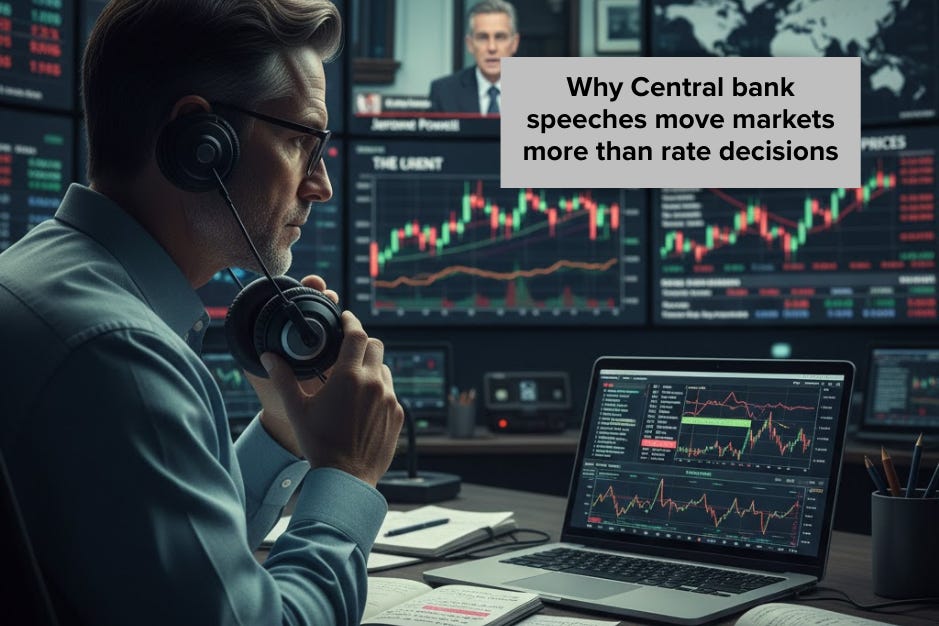
You’re refreshing your portfolio app, waiting for the Fed’s rate decision. Your group chat is debating whether it’ll be 25 or 50 basis points. Meanwhile, institutional bond desks already repositioned three weeks ago—because they parsed Jerome Powell’s adjective choice in a university Q&A, caught a regional Fed president’s rhetorical slip at a business roundtable, and decoded what Christine Lagarde didn’t say at a Munich panel discussion.
Here’s the contrarian truth: By the time the rate decision hits your screen, sophisticated money has often already moved. The real alpha comes from reading central banker tone, word choice, and strategic pivots during February’s speech circuit—when officials are most unscripted, most pressured by live questions, and most likely to signal directional shifts before they show up in official policy statements.
This isn’t about having a Bloomberg terminal. It’s about developing a skill most retail investors ignore: qualitative analysis of central bank communication.
🔔 Don’t miss out!
Add winvestacrisps@substack.com to your email list so our updates never land in spam.

🗓️ What’s happening every February
February is the central bank communication season on steroids. The Fed Chair typically delivers semi-annual monetary policy testimony to Congress around this time—historically one of the most unscripted, Q&A-heavy events on the Fed calendar. The Munich Security Conference is held in mid-February and frequently hosts senior European policymakers, including ECB President Christine Lagarde, whose geopolitical discussions often spill into monetary policy. By month’s end, the Personal Consumption Expenditures (PCE) data release provides markets with the inflation gauge that Fed officials have specifically flagged in recent speeches as their preferred metric.
But here’s what you’re missing: The real insights aren’t in the rate decision or the PCE print. They’re in:
Q&A session evasions and pivots — When Powell says “we’ll be guided by incoming data” for the fourth time, he’s buying optionality, not answering the question.
Terminology shifts from prior communications — “Transitory” becoming “persistent.” “Patient” becoming “data-dependent.” “Monitoring” becoming “attentive.” These aren’t stylistic choices—they’re coordinated messaging.
What gets emphasised vs deflected in live questioning — Direct answers signal conviction. Evasion signals uncertainty.
Regional Fed president speeches that contradict the official line — When a hawkish regional president gives a speech two days after a dovish FOMC decision, the consensus is weaker than it appears.
Strategic vocabulary changes — (”progress on inflation” → “monitoring inflation expectations”)
Between official FOMC meetings, you typically have six to eight weeks of silence on rate decisions. But in that same window, there are typically 15–25 speeches, interviews, and panel appearances by voting and non-voting Fed officials. Each one drops breadcrumbs about internal debates, data dependencies, and threshold conditions for policy pivots.
Deadline urgency: These signals often get priced in within days to weeks. You typically have a narrow window to act on qualitative insights before the next meeting confirms them.
📦 Why Central bank speeches move markets quietly but powerfully
Rate decisions are binary. Speeches are probabilistic roadmaps.
Wall Street’s rates desks don’t just track numbers—they’re tracking narrative shifts. When the Fed raises rates by 50 basis points, markets react to the number. When Powell uses the word “expeditiously” in the press conference, markets reprice the entire path of future hikes. The first is a data point. The second is forward guidance that reshapes positioning across tens of trillions of dollars in the Treasury market.
When a central banker changes language from “patient” to “attentive,” that’s a signal. When a Fed governor gets defensive about inflation projections during a Q&A, that’s a signal. When Powell suddenly references “inflation expectations” after months of discussing “inflation progress,” that’s a loud signal.
The research backs this up: Academic work—including studies on “open-mouth operations” by Guthrie & Wright and Demiralp & Jorda—has found that central bank communication can move longer-term yields and other asset prices at least as much as the mechanical rate decision itself. Research on FOMC member speeches shows that information extracted from speech text helps explain changes in volatility and risk in both equity and bond markets, with Chair speeches having an outsized impact. Studies also find that asset returns react more strongly to Fed and ECB communication in the run-up to meetings where changes are likely.
Why? Because rate decisions tell you where you’ve been. Central bank communication tells you where you’re going.
Someone shared this with you? Get your own insider updates directly—no middleman needed.
🗣️ Reading the signals: Tone and subtext

Central bankers communicate in layers, and learning to read them is like learning a second language.
Layer 1: The prepared remarks — Usually dovish, balanced, emphasising data-dependency. Markets have already seen these via advance copies. They’re lawyered, committee-reviewed, and politically sanitised. Useful for identifying official positions but rarely containing surprises.
Layer 2: The Q&A responses — This is where central bankers improvise under pressure. Watch for hesitations, repeated phrases, and questions they don’t answer directly.
What to listen for:
Certainty vs hedging: “We will maintain our restrictive stance” vs. “We expect to adjust our stance as data evolves, potentially.” One is confident. One is covering their options.
Ownership language: “I believe the data supports...” vs. “The Committee has noted...” Active voice shows conviction. Passive voice shows distance.
Question dodging: When asked about rate cuts, does Powell address it directly or pivot to talking about “data dependency”? Pivots reveal anxiety.
Rhetorical questions as framing devices: When a central banker asks “Is inflation really under control?” during a speech, it’s a reasonable analytical heuristic that they’re pre-framing an argument—suggesting they’re worried it isn’t. (This is an interpretive framework, not a guaranteed tell, but experienced Fed-watchers treat it as a useful signal.)
Layer 3: The dissents and alternative voices — When a regional Fed president gives a hawkish speech two days after a dovish FOMC decision, they’re signalling internal debate. Academic work confirms that markets weigh statements differently by role—the Chair’s words carry more weight than a non-voting regional president, but dissenters often signal where consensus is heading.
Layer 4: The meta-communication — “We’re not thinking about thinking about raising rates” (Powell, 2020) became a meme because it revealed the Fed’s communication strategy: manage expectations through linguistic gymnastics. Spontaneous phrasing like this reveals what officials are actually focused on internally.
🔍 Case studies: February signals that predicted big moves
February 2016: Draghi and the “helicopter money” trial balloon
Around February 2016, ECB President Mario Draghi discussed unconventional tools—including the concept of “helicopter money”—in the context of what the ECB might deploy if conditions worsened. Markets reacted sharply, with European equities rallying in the neighbourhood of 3% over a couple of days and EUR/USD moving by roughly 250–280 pips on expectations of radical stimulus. The actual policy change didn’t come until the following month, but the language trial balloon moved markets well before implementation.
The signal: This wasn’t exploratory musing. This was a deliberate test of market appetite for radical easing.
February 2019: Powell’s “patience” pivot
Powell’s early-2019 communication pivoted sharply from December 2018’s “autopilot” balance sheet language to emphasising “patience” regarding further rate hikes during his Congressional testimony and surrounding speeches. The S&P 500 rallied approximately 4% that week. The Fed didn’t actually cut rates until July 2019—five months later—but the pivot signal in February was the trade.
The signal: The Fed was done hiking. Investors who caught the tone shift had months of positioning advantage before the first cut materialised.
February 2023: RBA’s Philip Lowe holds the hawkish line
In early 2023, Reserve Bank of Australia Governor Philip Lowe delivered speeches emphasising the need to keep policy restrictive amid persistent inflation, even as market pricing signalled cuts. The Australian dollar strengthened in the range of 1–2% over several days. Lowe was replaced as governor later in 2023—reflecting broader criticism of RBA communication and forecasting, not just one speech—but his February communications correctly telegraphed policy continuity that markets had mispriced.
The signal: When a central banker pushes back explicitly against market pricing, they have often been closer to the realised near-term path than the market was.
Note: These case studies are illustrative examples where central bank communication tone aligned with later market moves—not backtested proofs. The approximate return and pip figures are drawn from observed market behaviour around these events, not precise single-cause attributions. Many factors drive asset prices.
Share this essential guide with someone who’s still chasing yesterday’s headlines!
📰 Why press releases often mislead investors
The committee writes the official FOMC statement. It’s designed for consensus, not clarity.
Every word is negotiated between doves and hawks. Every phrase balances competing agendas. The result is language so hedged it becomes meaningless: “The Committee seeks to achieve maximum employment and inflation at the rate of 2 per cent over the longer run.”
What does that actually mean for your portfolio positioning? Nothing actionable.
What gets buried in official communications:
Hawkish risks are downplayed in paragraph five to maintain “balanced” framing. Dissenting views get compressed into a single sentence. Forward guidance is deliberately vague to preserve optionality. And the statement reflects where consensus recently settled—not where the internal debate is currently heading.
Compare that to Powell’s unscripted answer during the February 2019 Q&A: “I think we can be patient about future policy changes.” Clear. Directional. Tradeable.
As a practitioner rule of thumb, official statements tend to lag the actual direction of internal policy thinking—often by several weeks. They represent where consensus was, not where the debate is. By the time something makes it into the statement, it’s already been telegraphed in speeches, minutes, and regional Fed president interviews.
Press releases optimise for not moving markets. Speeches reveal what central bankers actually think. Conference Q&As reveal it even more, because officials are tired, pressured, and answering questions they can’t fully control.
🏭 The sectors where Central bank rhetoric matters most
Financials: Bank stocks trade on net interest margin expectations. When Powell uses “higher for longer” language, regional banks have historically repriced meaningfully—sometimes in the range of 8–12%—within days before any actual rate decision. (The magnitude depends heavily on context and starting valuations; these are illustrative episode ranges, not stable averages.)
Utilities and REITs: Rate-sensitive sectors that move inversely to hawkish rhetoric. A dovish speech in February has historically triggered notable rallies in utility ETFs ahead of the March meeting, with moves of 5–7% observed in some episodes.
Technology/Growth: Long-duration assets that discount future cash flows. When the Fed signals rate cuts are “on the table,” unprofitable tech stocks can rally 15–20% on multiple expansion alone—though this varies significantly by cycle.
Commodities: Inflation expectations embedded in central bank speeches directly impact gold, oil, and commodity positioning. When the ECB discusses “imported inflation” versus “demand-driven inflation,” it signals tolerance thresholds.
Currency markets: EUR/USD, USD/JPY, and GBP/USD have moved 100–200 pips on single speech phrases about “divergence” in monetary policy paths between regions.
Note: These percentage ranges are drawn from notable historical episodes, not stable averages. The direction of impact is well-established; the exact magnitude varies by market context.
The sectors with the longest duration and highest rate sensitivity move first on rhetoric, before the underlying fundamentals change.
🧭 How to distil signals into actionable insights
1. Build a speech calendar: Track all Fed, ECB, BOE, and BOJ speaking engagements. Focus on Q&A sessions, university speeches, and panel discussions—not prepared Congressional testimonies. The alpha lives in unscripted moments.
2. Create a terminology tracker: Build a simple spreadsheet of key phrases used over time. When “monitoring inflation” becomes “combating inflation,” that has historically tended to be a forward signal of hawkish shifts within the next few meetings. (Treat this as a pattern observed in past cycles, not a fixed rule.)
3. Map speakers to policy positions: Know which Fed presidents are structurally dovish (historically Chicago, Minneapolis) versus hawkish (St. Louis, Kansas City). Weigh their speeches accordingly. Academic work confirms markets do this—statements from the Chair carry more weight than non-voting members.
4. Watch the dissents: When someone dissents from an FOMC decision, read their subsequent speeches carefully. Historically, dissenters have often signalled where consensus was heading over the following two to three quarters.
5. Cross-reference with market pricing: If speeches are turning hawkish but Fed funds futures still price cuts, that’s a potential mispricing opportunity. In past cycles, the speeches have tended to win—markets just hadn’t caught up yet.
6. Compare central banker vs central banker tone: Is the Chair sounding more cautious than the governors? Are regional presidents more hawkish than the official statement? Divergences often predict where the next statement’s language will shift.
📈 Why markets reward early readers disproportionately
Information cascades drive modern markets. Institutional investors parse speeches → they adjust positions → their trades move prices → media covers the move → retail investors react.
By the time you read the Bloomberg headline, you’re at the end of the cascade.
The typical progression when Powell gives a notable speech (this is a widely used stylised model among practitioners, not a scientifically fixed horizon):
Hour 1–2: Algo traders and wire-reading quant funds move first on keyword recognition.
Hour 3–12: Institutional desks analyse transcripts, adjust positioning.
Day 2–3: Slower fundamental funds update their Fed models and rebalance.
Week 2–4: Retail investors read about it in newsletters and financial media.
The core insight holds: if you’re reading the speech transcripts yourself on Day 1, you’re ahead of the vast majority of market participants. The opportunity isn’t in the immediate algo spike—it’s in the multi-day institutional repricing that follows.
But here’s your edge: Most of these speech transcripts are publicly available. The Federal Reserve posts transcripts and video on its website. ECB speeches are published the same day. You have access to the same raw material as institutional investors—you just need to know what to listen for.
Time arbitrage opportunity: Sophisticated investors dedicate analysts to parsing this content immediately. You can capture much of the same insight by spending 2–3 hours per week during February’s speech season on the central banks relevant to your portfolio.
The disproportion is beautiful: small time investment and asymmetric information advantage.
📅 The February speech season calendar: Week-by-week playbook
Understanding the rhythm helps you position yourself ahead of the crowd.
Week 1 (Early Feb): Pre-testimony positioning
Fed officials often deliver speeches that set the stage for the Chair’s testimony. Watch for: New terminology, framework shifts from January’s FOMC presser.
Action: Establish your baseline—what language is the Fed currently using?
Week 2 (Mid-Feb): Powell’s Congressional testimony
The semi-annual testimony typically features prepared remarks (released the night before) followed by extensive Q&A. Watch for: Questions Powell deflects rather than answers directly; evasion signals uncertainty; directness signals conviction.
Action: Compare prepared remarks to Q&A responses—trust the Q&A when they diverge.
Week 3 (Mid-to-Late Feb): European and global central bank speeches
Munich Security Conference, ECB panels, and BOE communications create a global picture. Watch for: “Divergence” language between the Fed and ECB; any shift in how European officials discuss imported inflation.
Action: Cross-reference Fed rhetoric with ECB positioning for currency implications.
Week 4 (Late Feb): Pre-PCE positioning speeches
Fed officials often give speeches in the week before major data releases. Watch for: Officials “pre-walking” the data by explaining why one month doesn’t matter—a sign they’re worried it will matter.
Action: If speeches and data align, confidence in the current path is high. If they diverge, repositioning opportunities emerge.
February 28 (PCE release): Compare the actual data to what central bankers said in the prior two weeks. Did they preview the number? That confirms data-dependence. Were they surprised? That suggests they’re behind the curve.
⚠️ When this strategy doesn’t work
No edge works 100% of the time. Here’s when qualitative signal-reading from central bank speeches fails:
Black swan events override everything. A geopolitical shock, financial crisis, or pandemic can render all communication analysis irrelevant overnight. March 2020 made every January and February speech meaningless within days.
Central bankers can be wrong about their own economy. The Fed described inflation as “transitory” for months—with genuine conviction—until the data proved them wrong. Confidence in rhetoric isn’t the same as accuracy.
Confirmation bias is real. If you’re positioned for rate cuts, you’ll hear dovishness everywhere. If you’re positioned for hikes, every hedge sounds like hawkish panic. Build your terminology baseline before forming a thesis.
Some central bankers are better communicators than others. Certain officials are exceptionally polished at making hawkish decisions sound dovish—cross-reference tone with hard data and market pricing.
The “unusual divergence” can persist. If you notice tension between what officials say and what the dot plot shows—as some market commentators have flagged in recent months—that divergence can take quarters to resolve, not days. Don’t assume fast convergence.
The signal-to-noise ratio varies by context. This approach works better when the Fed is near a policy inflexion point than when they’re on a well-telegraphed autopilot path.
The goal isn’t prediction perfection—it’s tilting the odds in your favour over many decisions.
⚖️ Prepared remarks vs Q&A sessions: Which to trust?

Prepared remarks are heavily scripted. Central bankers have polished language, anticipated questions, and legal review. They’re valuable but sanitised.
Q&A sessions are where the real information lives. Officials are under pressure from pointed Congressional questioning or sharp analyst follow-ups, questions come from unexpected angles, and the setting forces candour. When Powell is on his third hour of testimony, answering questions from a sceptical senator who won’t accept “data-dependent” as an answer, you get authenticity.
The winner? Q&A sessions for forward-looking insight. Prepared remarks for understanding the official party line.
Pro move: Read the prepared testimony first to understand the official framing, then watch the Q&A to see where the real thinking diverges. That gap—between what the Fed wants you to think and what it actually thinks—is where the tradable information lives.
🔮 A note on February 2025 and current signals
Some market commentators have noted what appears to be divergence between relatively dovish Fed rhetoric and a still-elevated dot-plot path—though the Fed has experienced similar language/dots gaps at several points historically (2015–2022). Additionally, several Fed officials appear to have shifted emphasis from “progress on inflation” to “monitoring inflation expectations,” which some analysts interpret as previewing possible mid-year policy adjustments.
These are interpretive reads and forward-looking theses, not settled facts. They fit with how central bank communication has historically been used to preview upcoming decisions, but they could also reflect normal variation in official language. Use them as hypotheses to test against incoming speeches and data—not as trading signals in isolation.
👂 Key takeaways
February speeches have historically signalled policy paths several months ahead—markets move on signals, not on implementation, giving attentive readers meaningful positioning advantages.
Q&A sessions reveal more than prepared remarks — improvisation under pressure exposes the actual thinking of central bankers rather than committee-sanitised messaging.
Terminology shifts are leading indicators — when “monitoring” becomes “combating” or “transitory” becomes “persistent,” policy changes have historically followed within the next few meetings in past cycles.
Regional Fed presidents provide early warning — dissents and alternative voices have often signalled where consensus was heading before official statements reflected it.
Rate-sensitive sectors reprice on rhetoric alone — financials, REITs, and growth tech can move meaningfully on speech language before any actual rate decisions materialise.
The February 28 PCE data will dominate headlines. But by then, Powell’s testimony and the surrounding speech circuit will have already told you whether the Fed thinks that number matters or whether they’re looking past it. The institutions’ reading speeches aren’t guessing about the next meeting—they’re positioning for two to three quarters ahead right now.
This February, stop waiting for rate decisions. Start reading transcripts. The alpha is in the subtext, and the subtext is available today for anyone willing to read beyond the headlines.
Your move.
Want to spot these signals yourself? Join 60,000+ investors on the Winvesta app.
Disclaimer: This article is for informational purposes only and does not constitute investment advice. Always conduct your own research and consider seeking professional financial advice before making any investment decisions.