



You’re watching NVIDIA’s stock price tick up on earnings beats. Your friend texts about an analyst upgrade. Meanwhile, institutional investors already repositioned three weeks ago—because they read between the lines at the JPM Healthcare Conference, parsed the CES keynotes, and decoded what executives didn’t say in their prepared remarks.
Here’s the contrarian truth: By the time earnings numbers hit your screen, sophisticated money has often already moved. The real alpha comes from reading management tone, body language, and strategic pivots during the January conference circuit—when executives are most candid, most caffeinated, and most likely to signal directional shifts before they show up in quarterly results.
This isn’t about having insider information. It’s about developing a skill most retail investors ignore: qualitative analysis of management communication.
🔔 Don’t miss out!
Add winvestacrisps@substack.com to your email list so our updates never land in spam.
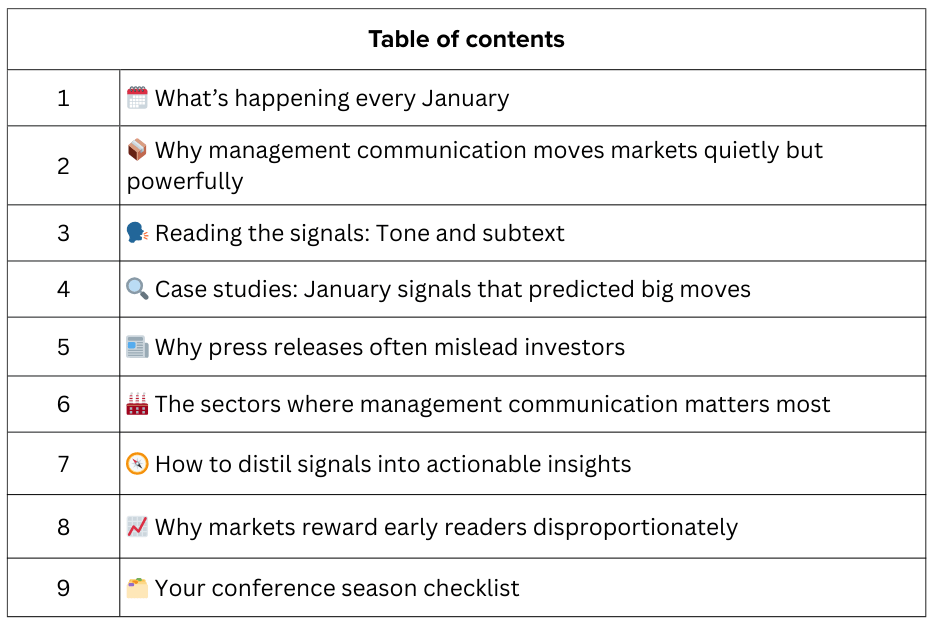
🗓️ What’s happening every January
January is conference season on steroids. The JPM Healthcare Conference typically runs in mid-January in San Francisco, where hundreds of healthcare companies present to institutional investors. CES wraps in Las Vegas with thousands of exhibitors showcasing tech roadmaps. Earnings season kicks off with major financials reporting.
But here’s what you’re missing: The real insights aren’t in the prepared remarks or press releases. They’re in:
Q&A session evasions and pivots
Management tone shifts from prior quarters
What gets emphasised vs. buried in slide decks
Executive body language during tough questions
Strategic vocabulary changes (”exploring” → “committed to”)
Deadline urgency: These signals often get priced in within weeks. You typically have a narrow window to act on qualitative insights before quantitative results confirm them.
📦 Why management communication moves markets quietly but powerfully
Wall Street analysts attend hundreds of these presentations yearly. They’re not just tracking numbers—they’re tracking narrative shifts.
When a CEO changes language from “cautiously optimistic” to “accelerating investments,” that’s a signal. When a CFO gets defensive about capital allocation questions, that’s a signal. When management suddenly name-drops competitors they previously ignored, that’s a loud signal.
The data backs this up: Multiple academic studies—including research from Stanford and other business schools—have found that tone and linguistic patterns in earnings calls contain predictive information about future stock returns, even after controlling for the headline numbers and analyst forecasts. Hesitation, word choice, and sentiment shifts often matter more than the actual figures.
Why? Because numbers tell you where you’ve been. Management communication tells you where you’re going.
Someone shared this with you? Get your own insider updates directly—no middleman needed.
🗣️ Reading the signals: Tone and subtext

Executives are trained to stay on message. But under pressure—especially during live conference Q&As—cracks appear.
What to listen for:
Certainty vs. hedging: “We will expand margins” vs. “We expect to potentially see margin improvement.” One is confident. One is covering their ass.
Ownership language: “I believe this positions us...” vs. “The board has decided...” Active voice shows conviction. Passive voice shows distance.
Question dodging: When asked about competitive threats, does the CEO address it directly or pivot to talking about their “unique value proposition”? Pivots reveal anxiety.
Speed and energy: Does management sound excited about their growth initiatives or like they’re reading a legal disclaimer? Energy betrays belief.
Spontaneous examples: Prepared stats are polished. When executives offer unscripted customer stories or operational details, they’re revealing what they’re actually focused on internally.
🔍 Case studies: January signals that predicted big moves

January 2016: Netflix’s “global expansion” emphasis
At CES 2016, Netflix CEO Reed Hastings didn’t just announce international expansion—he spent a significant portion of his presentation detailing country-specific content strategies. Analysts noted his unusual specificity about local partnerships.
The signal: This wasn’t exploratory. This was operational confidence.
The result: Netflix stock rallied strongly in Q1 2016 as international subscriber growth crushed estimates. But sophisticated investors entered positions in January, not after the earnings beat.
January 2019: Apple’s sudden “services” pivot
At a January 2019 Goldman Sachs conference, Apple CFO Luca Maestri mentioned “services” repeatedly—far more than in previous appearances. He got animated discussing Apple Pay and App Store recurring revenue, topics he’d glossed over in prior presentations.
The signal: Apple was preparing investors for an iPhone sales slowdown by redirecting attention.
The result: When Apple reported weak iPhone sales in late January, the stock held up better than many expected because the services narrative had already been seeded. Investors who caught the tone shift in early January were better positioned.
January 2023: JPMorgan’s “fortress balance sheet” drumbeat
In early 2023, CEO Jamie Dimon gave interviews emphasising JPM’s “fortress balance sheet” with unusual repetition. He sounded defensive about banking sector stability—months before regional bank failures.
The signal: JPM was positioning itself as a safe haven before the crisis emerged.
The result: When Silicon Valley Bank collapsed in March 2023, JPM shares held up far better than many peers. Early readers of Dimon’s tone had time to reposition accordingly.
Note: These case studies are illustrative examples where management tone aligned with later price action—not backtested proofs. Many factors drive stock prices.
📰 Why press releases often mislead investors

Corporate communications teams craft press releases for legal compliance and brand management—not investment insight.
What gets buried:
Negative metrics are hidden in paragraph seven
Executive departures announced late Friday
Product delays are framed as “strategic repositioning”
Margin pressure obscured by revenue growth headlines
Example: A SaaS company announces “35% revenue growth“ (headline), but their press release mentions “expansion of sales and marketing by 60%“ (paragraph five). Do the math: customer acquisition costs are exploding. That’s not growth—that’s buying revenue.
Conference presentations reveal these tensions because executives face live questions they can’t control.
Share this essential guide with someone who’s still chasing yesterday’s headlines!
🏭 The sectors where management communication matters most
Technology: Strategic pivots happen fast. When management shifts language from “AI-enhanced” to “AI-native,” that’s a roadmap change worth tracking.
Healthcare/Biotech: Trial language matters. “Promising early data” vs. “statistically significant endpoints” is the difference between hope and FDA approval.
Consumer: Brand executives telegraph competitive pressure through defensive language about “market share dynamics” or sudden emphasis on “value positioning.”
Financial Services: Tone on credit quality, loan demand, and regulatory environment predicts sector rotations quarters in advance.
Energy: Watch for shifts in capital discipline language. “Returning cash to shareholders” (shareholder-friendly) vs. “strategic growth investments” (dilution risk).
🧭 How to distil signals into actionable insights
1. Create a tone baseline: Listen to the last three earnings calls or presentations. What’s the normal communication pattern for this executive team? Deviations from baseline matter more than absolute statements.
2. Track linguistic changes quarter-over-quarter: Build a simple spreadsheet. Count how many times management says “growth,” “investment,” “efficiency,” and “headwinds.” Vocabulary shifts predict strategic shifts.
3. Compare CEO vs. CFO tone: CEOs are aspirational. CFOs are operational. When they diverge in optimism—particularly when the CFO sounds more cautious—take note.
4. Watch for question avoidance patterns: If three different analysts ask about the same concern and management gives three different non-answers, that concern is real.
5. Cross-reference with peer companies: Is this management team sounding more optimistic or pessimistic than competitors facing the same market? Outlier positioning often predicts stock divergence.
📈 Why markets reward early readers disproportionately
Information cascades drive modern markets. Institutional investors attend conferences → they adjust positions → their trades move stock prices → media covers the move → retail investors react.
By the time you read the Bloomberg headline, you’re at the end of the cascade.
But here’s your edge: Most of these conference presentations are publicly available. Transcripts, webcasts, and recordings live on investor relations websites. You have access to the same raw material as institutional investors—you just need to know what to listen for.
Time arbitrage opportunity: Sophisticated investors dedicate analysts to parsing this content immediately. You can capture much of the same insight by spending 2-3 hours per week during the January conference season on select companies in your portfolio.
The disproportion is beautiful: Small time investment, asymmetric information advantage.
🗂️ Your conference season checklist
This week:
[ ] Identify 3-5 portfolio companies presenting at conferences this month
[ ] Download or bookmark their presentation recordings
[ ] Listen to their last earnings call to establish a tone baseline
During presentations:
[ ] Note word frequency: “growth,” “pressure,” “confident,” “monitoring”
[ ] Mark moments where executives sound defensive or evasive
[ ] Compare optimism levels to prior quarter and competitor presentations
After presentations:
[ ] Ask yourself: Did management sound more or less certain than three months ago?
[ ] Identify what they emphasised vs. what analysts asked about (mismatches matter)
[ ] Cross-check insights against your investment thesis—confirm or challenge?
📅 The conference season calendar: Week-by-week playbook
Understanding the rhythm of the January conference season helps you position yourself ahead of the crowd.
Week 1 (Jan 1-7): CES kicks off
Tech roadmaps revealed, AI narratives set
Watch for: Buzzword shifts, competitive mentions, supply chain commentary
Action: Note which companies sound confident vs. hedging on guidance
Week 2 (Jan 8-14): JPM Healthcare Conference
Hundreds of healthcare/biotech companies present
Watch for: Trial language, pipeline emphasis, M&A hints
Action: Compare tone to the previous year’s presentations
Week 3 (Jan 15-21): Earnings season begins
Financials report first, setting market tone
Watch for: Cross-reference conference commentary with actual numbers
Action: Validate or challenge your conference-season hypotheses
Week 4 (Jan 22-31): Institutional positioning wraps
Many large allocators complete Q1 positioning
Watch for: Volume patterns, sector rotation signals
Action: Signals from weeks 1-3 start getting priced in—act before, not after
⚠️ When this strategy doesn’t work
No edge works 100% of the time. Here’s when qualitative signal-reading fails:
Black swan events override everything. A pandemic, geopolitical shock, or sudden policy change can render all management tone analysis irrelevant overnight.
Management can be wrong about its own business. Executives sometimes genuinely believe their own optimistic narratives—until the numbers prove them wrong. Confidence isn’t the same as accuracy.
Confirmation bias is real. If you’re bullish on a stock, you’ll hear confidence everywhere. If you’re bearish, every hedge sounds like panic. Build your baseline before forming a thesis.
Some companies are better at spin than others. Certain management teams are exceptionally polished communicators who can make bad news sound neutral. Cross-reference tone with hard data.
The signal-to-noise ratio varies by sector. This approach works better in sectors where narrative matters (tech, biotech, consumer) than in commodity-driven businesses where prices are set externally.
The goal isn’t prediction perfection—it’s tilting the odds in your favour over many decisions.
⚖️ Earnings transcripts vs. conference presentations: Which to trust?
Earnings calls are heavily scripted. Management has prepared remarks, anticipated questions, and legal review. They’re valuable but sanitised.
Conference presentations are losers. Executives are tired from back-to-back meetings, questions come from different angles, and the setting encourages candour. When a CEO is on their fifth coffee of the day, answering questions from a sceptical hedge fund manager, you get authenticity.
The winner? Conference presentations for forward-looking insight. Earnings calls for numerical precision.
Pro move: Listen to the conference presentation first to understand strategic direction, then use the earnings call to validate with hard data.
👂 Key takeaways
January conference season often offers an information edge before insights price into stocks—use this window aggressively
Management tone, word choice, and communication patterns predict strategic pivots more reliably than backwards-looking numbers
Question evasion, linguistic shifts, and CEO/CFO tone divergence are higher-signal than prepared remarks or press releases
Conference presentations are more candid than earnings calls because executives face unpredictable questions in fast-paced settings
You have access to the same presentations as institutions—the edge comes from knowing what linguistic and tonal signals to track
By mid-February, many of these January signals will be reflected in prices. The healthcare companies that seemed cautiously optimistic at JPM will have reported earnings. The tech firms that dodged competitive questions at CES will have updated guidance. The window closes faster than you’d think.
Your move: Pick three companies you own. Find their January presentation recordings. Spend 45 minutes per company listening—not for what they said, but for how they said it. That tone shift, that vocabulary change, that defensive pivot? That’s your signal.
Want to spot these signals yourself? Join 60,000+ investors on the Winvesta app.
Disclaimer: All content provided by Winvesta India Technologies Ltd. is for informational and educational purposes only and is not meant to represent trade or investment recommendations. Investing in securities involves risk, including potential loss of principal. Past performance is not indicative of future results. Remember, your capital is at risk. Terms & Conditions apply.