


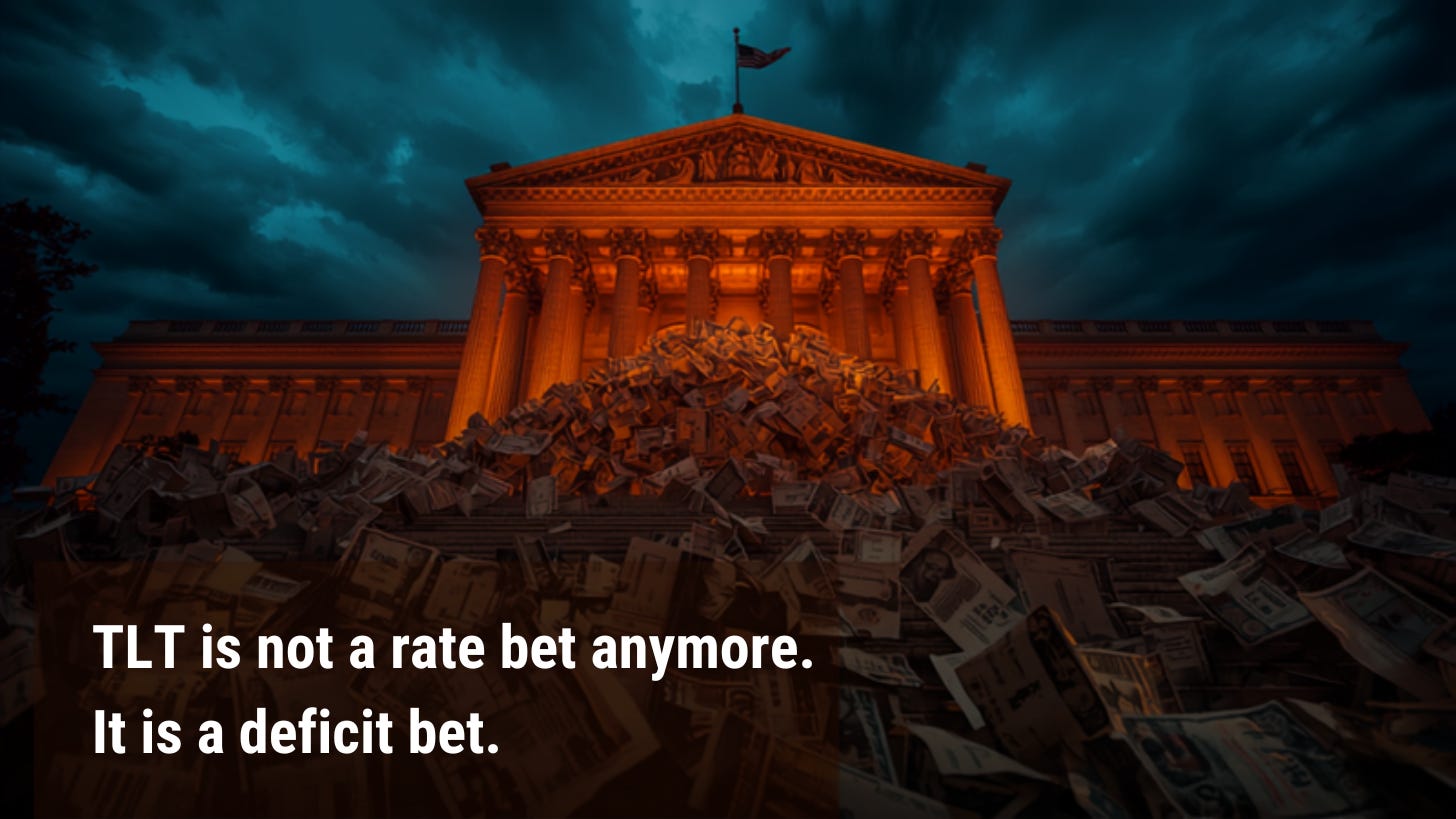
The old way to own a long Treasury fund was simple. Yields go up, you buy, you wait for the Fed to cut, and you get paid twice. That trade has stopped working, and not because the Fed is running late. The 30-year Treasury yield closed at 5.31% on Monday, its highest since 2007, in the same fortnight that traders were pricing out a September rate hike. Policy expectations got easier and the long end sold off anyway. That's why we built Winvesta Crisps, to decode what's actually moving the funds you own, in plain language, before the consensus catches up. 60,000+ investors from all over India are already in. What about you?
🔔 Add winvestacrisps@substack.com to your email list so our updates never land in spam.
Most investors holding a long-duration Treasury ETF believe they own a bet on the Federal Reserve. The curve says they own something else entirely. The 30-year yield hit 5.31% on 17 August, a level last seen in 2007, per CNBC. The 10-year sat near 4.68% on the same day. That gap of roughly 0.63 percentage points is not a story about the next FOMC meeting, because the fed funds target range has been parked at 3.50% to 3.75% since 29 July, per the Federal Reserve's own statement, and the odds of a September hike have been falling, not rising. Fed funds futures were pricing a hike at roughly 82% in late July. After the July jobs report showed the US economy shedding jobs, that collapsed to about one in three by mid-August, per CME FedWatch as reported by CNBC. Short-rate expectations turned dovish. The long bond sold off regardless. When those two move in opposite directions, the long end has stopped trading on policy and started trading on supply, and every fund built to harvest a Fed pivot is now positioned against the wrong variable.
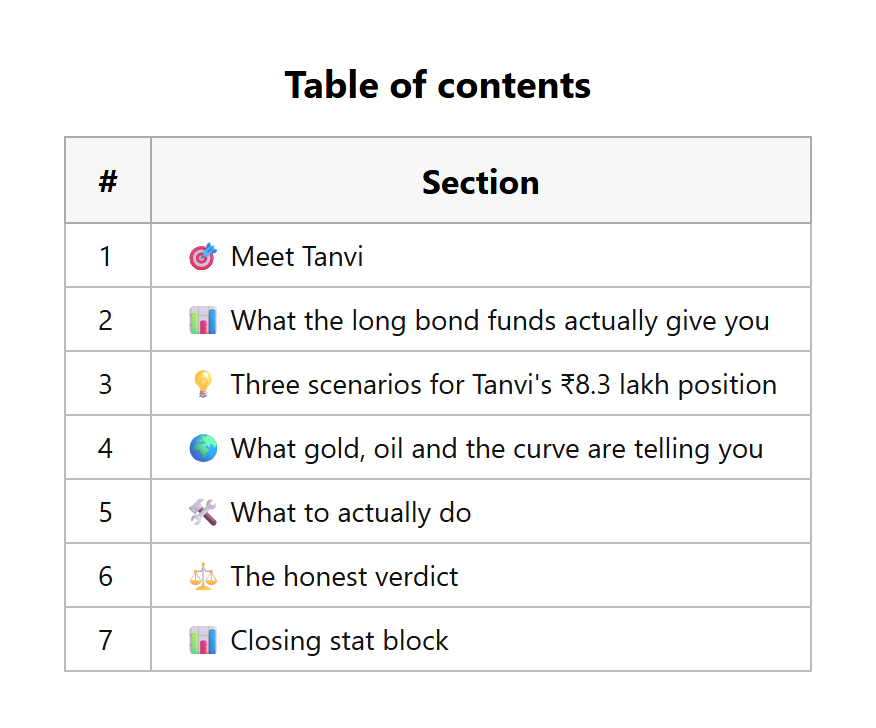
🎯 Meet Tanvi
Tanvi, 35, engineering manager at a fintech, Hyderabad. Portfolio: ₹64 lakhs across US markets. She bought her first slice of TLT in January on reasoning that every headline supported at the time. Yields were high, the Fed would have to cut eventually, and a fund holding 20-year-plus Treasuries would capture the whole move when it came. She added twice on the way down, both times calling it averaging in. The position is now roughly ₹8.3 lakh, about 13% of her US book.
Here is what Tanvi thinks she owns: a safe government bond fund that pays her about 4% while she waits for the trade to work.
Here is what she actually owns. TLT carries an effective duration of roughly 16.5 years, per iShares fund data. Duration is not a risk rating, it is a multiplier. Every 0.10 percentage point move in long yields moves her position by about 1.65% in the opposite direction. Her 13% allocation contributes more interest rate risk to her portfolio than the entire remaining 87%, because equities do not respond to a 30-year yield with anything like that leverage. The word "safe" is doing an enormous amount of work here. A US Treasury carries no credit risk worth pricing. It carries every unit of the rate risk, and TLT concentrates the most sensitive segment of the curve into one ticker.
Her second problem is the one she has not priced. TLT closed at $81.68 on Monday against a 52-week range of $81.66 to $92.19. She is not near the bottom of that range, she is sitting on it. A round trip from the top of the range to Monday's close is about 11.4%, which on her position is roughly ₹95,000 of price value, against a distribution yield of about 4.36% collected along the way. Eight months of income, erased by three months of term premium.
📊 What the long bond funds actually give you
Start with flows, because they frame the crowding question. Before the table, a caveat that matters: flow figures vary by data provider and reporting window, so treat direction as the signal and magnitude as an estimate.
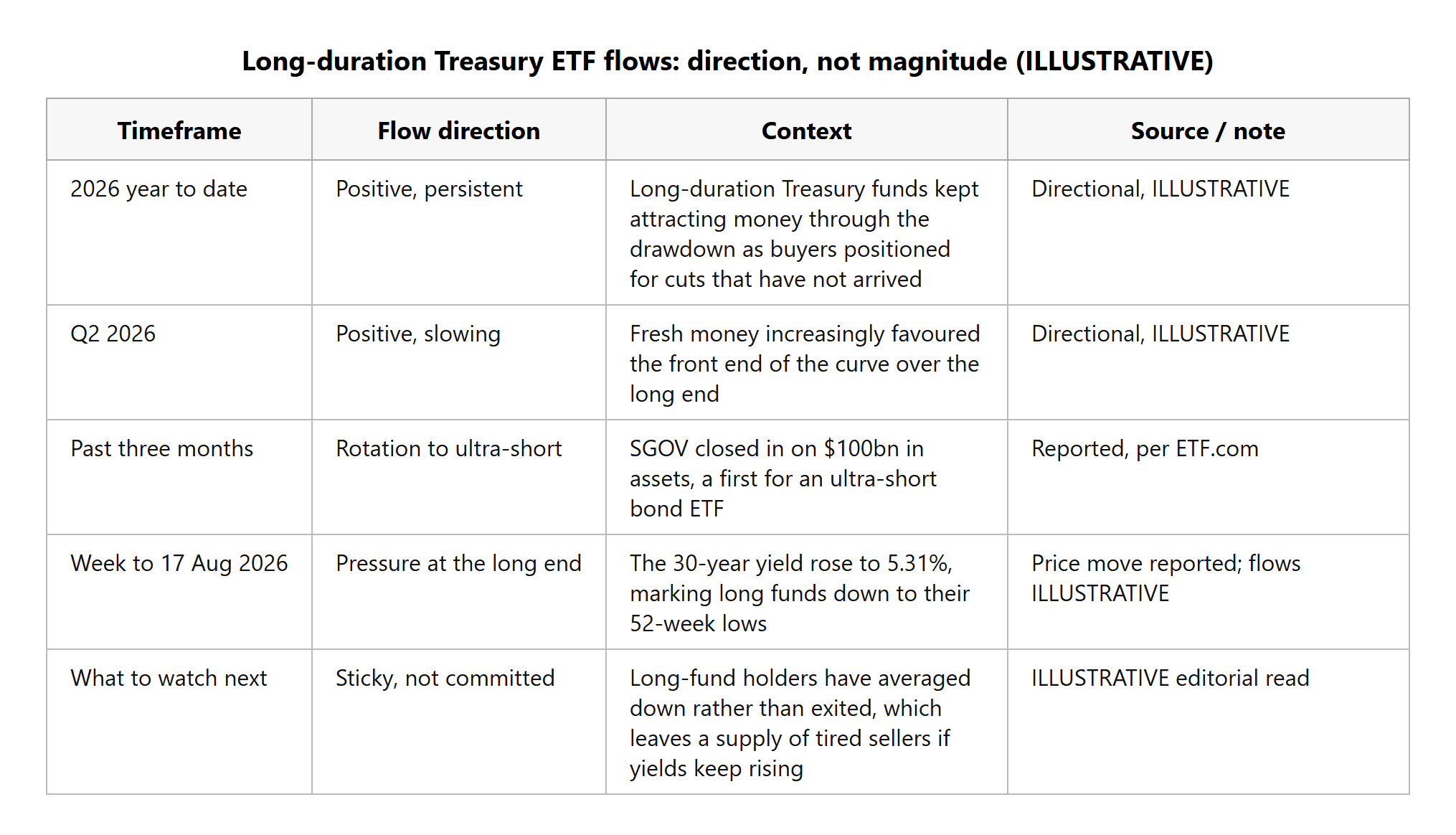
The row worth sitting with is the third one. SGOV, the iShares 0-3 Month Treasury Bond ETF, has been closing in on $100 billion in assets, a first for an ultra-short bond fund, per ETF.com. Money has not left Treasuries. It has moved to the end of the curve where the Fed still sets the price, and away from the end where the Treasury's issuance calendar does. That is the market voting with its cash, and it is voting against Tanvi's position.
Now the funds themselves, because "Treasury ETF" describes four very different risk profiles.
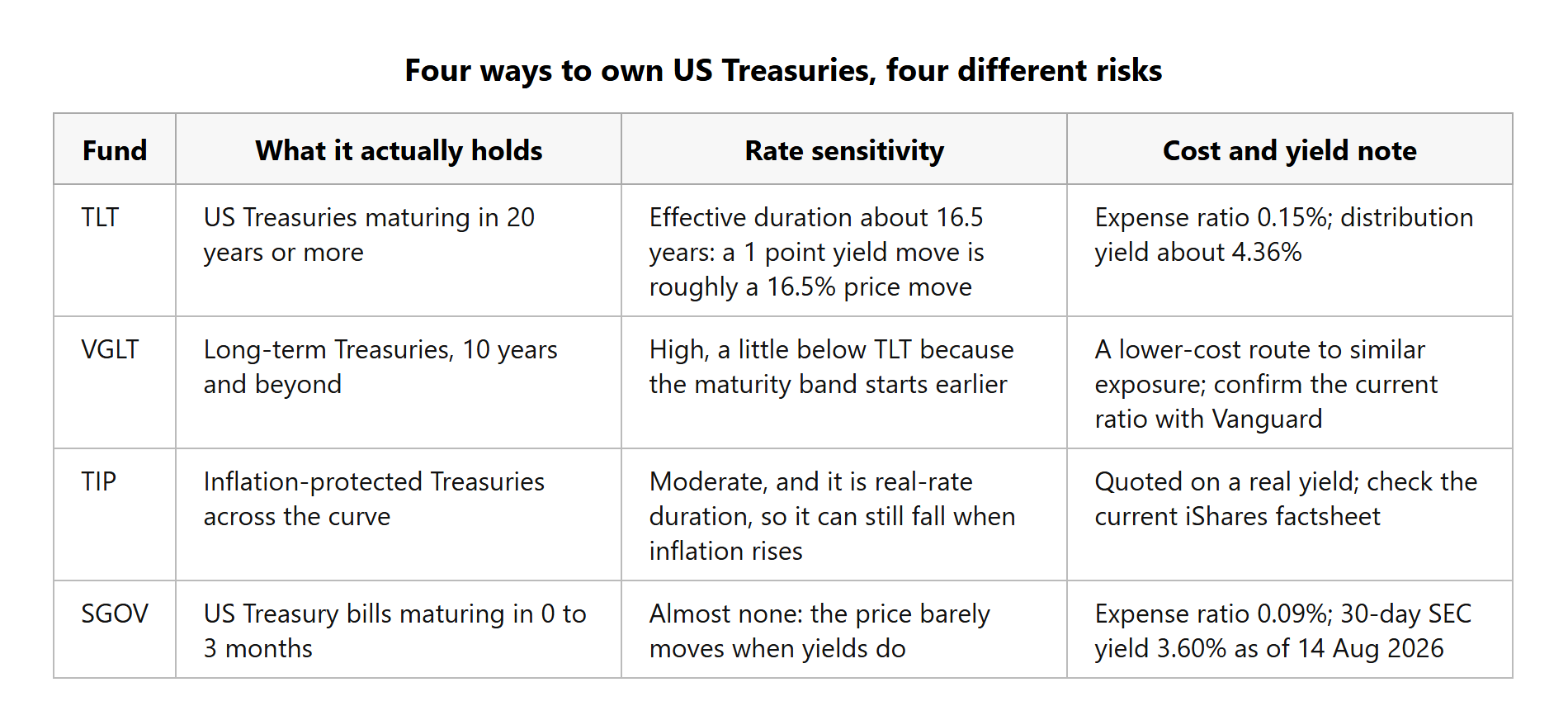
The uncomfortable arithmetic for an Indian investor sits underneath all of it. Tanvi is taking 16.5 years of US duration risk, in a foreign currency, for a distribution yield of about 4.36%. The Indian 10-year G-sec yielded around 6.78% in August, with the RBI repo rate held at 5.25%, per TradingEconomics and RBI policy reporting. She is accepting a lower yield and far higher rate sensitivity, in an asset denominated in a currency she does not spend. The rupee weakening past ₹95 to the dollar has quietly rescued a chunk of her return, which is worth knowing, because it means part of what she reads as a bond thesis working is actually a currency move she never chose to make.
🚀 Want to hold TLT, SGOV or TIP in your portfolio? Trade them directly from India on the Winvesta app. No US bank account needed! Join 60,000+ investors, become a paying subscriber or download the Winvesta app and fund your account to get insights like this for free!
💡 Three scenarios for Tanvi's ₹8.3 lakh position
These are illustrative stress tests built on assumed yield moves and subjective probabilities over roughly the next six months. They are an editorial model, not forecasts, market consensus, or any guarantee of what happens next.
Scenario 1: "The long end finds a buyer", 25% probability
Set up conditions: the labour market keeps softening after July's job losses, which pulls the hike question off the table entirely. Energy retreats as Middle East tension cools, taking the 14.7% annual energy CPI increase down with it. The Treasury shifts issuance towards bills rather than bonds. Pension and insurance buyers step in at 5% plus yields, which is the level at which long-dated liabilities actually get funded. The 30-year drifts back towards 4.85%.
Portfolio impact: a 0.46 percentage point fall in long yields against 16.5 years of duration is roughly a 7.6% price gain, plus about half a year of carry. Tanvi's ₹8.3 lakh moves to roughly ₹9.05 lakh, an illustrative +9%.
Why only 25%: this scenario needs three things to cooperate at once, and the deficit is not one of the things that can cooperate. Issuance is set by the fiscal position, not by the bond market's mood.
Gut check: if this is what you are positioned for, you are betting the US labour market deteriorates enough to matter. Ask yourself whether the rest of your portfolio survives that.