Owning Apple meant betting on iPhone units and letting Services compound quietly in the background. Not anymore. Apple just reported its strongest June quarter in history, on the same call that marked Tim Cook’s 90th and final earnings report as CEO, and the stock still fell more than 7% the next session. The reason sits half a world away, in the fabs of Samsung and SK Hynix, where an AI-driven memory chip shortage has now reached all the way into every Mac and iPad Apple sells. That’s why we built Winvesta Crisps, to decode what’s actually driving the companies you own, in plain language, before the consensus catches up. 60,000+ investors from all over India are already in. What about you?
🔔 Don’t miss out!
Add winvestacrisps@substack.com to your email list so our updates never land in spam.
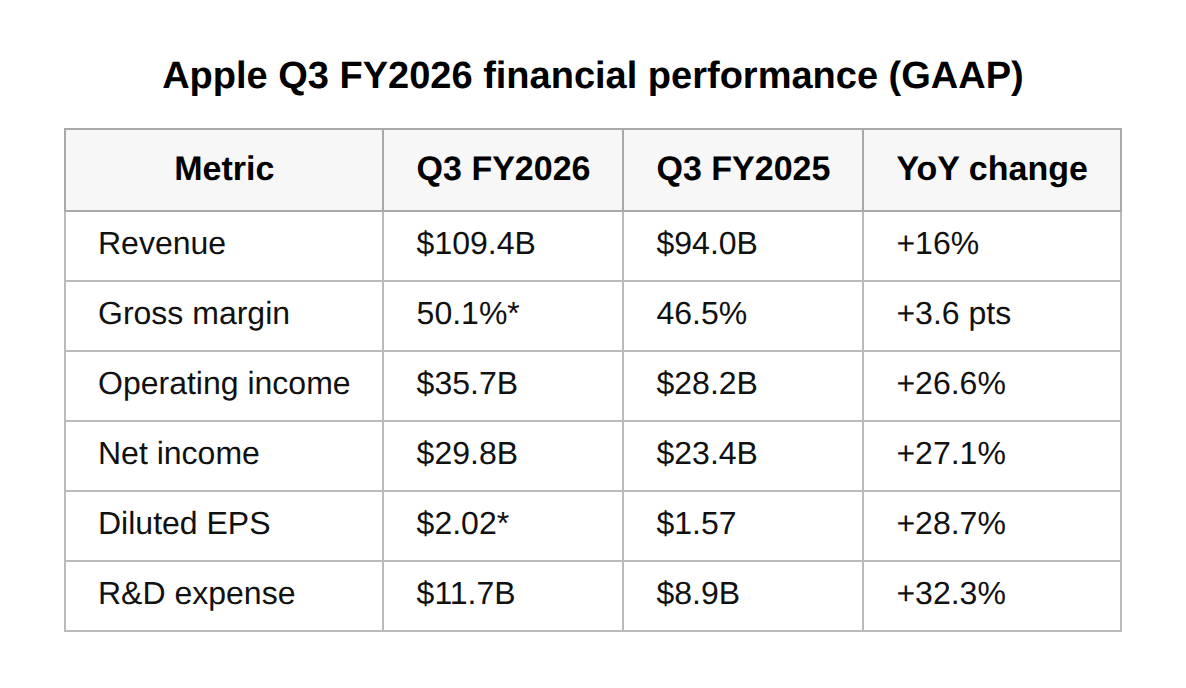
Most investors will read Apple’s headline numbers and stop there: revenue of $109.4 billion, up 16% year over year, the strongest June quarter the company has ever posted. Diluted EPS came in at $2.02, up 29%, and iPhone revenue hit a record $54.3 billion, up 22%. The stock fell 7.35% the next trading day anyway, closing at $308.91 and wiping out roughly $360 billion in market value in a single session, because two numbers buried inside that beat, a Services growth rate that slowed to 12% from 16% the prior quarter, and Greater China revenue that missed consensus by nearly $700 million, told investors a different story. Layer in a global memory chip shortage that just forced Apple to raise Mac and iPad prices by as much as $1,000, on the exact call where Cook handed the reins to incoming CEO John Ternus, and Apple’s record quarter looks less like a routine beat and more like a hinge point.
🔥 Top movers
Apple touched an all-time high close of $340.08 on 28 July 2026, the same session it briefly crossed a $5 trillion market capitalisation, becoming only the second company after Nvidia to reach that level. Two trading days later, after reporting fiscal third-quarter results on 30 July, the stock closed at $308.91 on 31 July, down 7.35% on the day and roughly 9% below that high, per CNBC and MacroTrends data. Analyst price targets scattered in every direction afterwards: TD Cowen raised its target to $400, Wells Fargo lifted its target to $350, while Barclays cut its target to $245 and GF Securities downgraded the stock to Hold. That kind of split, on a quarter that beat consensus on both revenue and earnings, is the story worth understanding.
📦 What actually grew, and what didn’t
Apple’s own numbers, filed with its consolidated financial statements for the quarter ended 27 June 2026, show a company growing everywhere except the two lines investors watch most closely. iPhone revenue reached $54.3 billion, up 22% year over year and a June-quarter record, powered by the iPhone 17 lineup. Mac revenue grew even faster in percentage terms, up 29% to $10.4 billion, its best June quarter ever. Wearables, Home and Accessories rose a more modest 6.5% to $7.9 billion. iPad was the one product line in outright decline, down 5.9% year over year to $6.2 billion, the category most exposed to the same memory price spike now working through Apple’s cost base.
Services revenue reached $30.7 billion, up 12% year over year, still a record for the category but a clear deceleration from the 16% growth rate Apple posted in its fiscal second quarter. CFO Kevan Parekh attributed most of that sequential slowdown to foreign exchange, with mobile gaming softness and changes to the App Store’s business model, following a US court ruling on link-out payments that Apple is now appealing to the Supreme Court, adding further drag. Geographically, Cook said Apple achieved double-digit growth in every region it reports, yet Greater China revenue of $18.8 billion still missed Wall Street’s roughly $19.5 billion estimate, a reminder that regional growth rates and absolute dollar misses can both be true in the same quarter.
Gross margin came in at 50.1%, boosted by an estimated 2 percentage points from one-time US tariff refunds, a benefit that also added $0.11 to the $2.02 GAAP diluted EPS figure. Strip that one-off item out and Apple’s underlying profitability picture is still strong, but noticeably softer than the headline suggests, which is exactly the kind of detail that gets lost when a stock is trading at record highs going into the print.
🌀 The memory supercycle just walked into Cupertino
The mechanism behind Apple’s weakest guidance in years has almost nothing to do with iPhone demand and almost everything to do with a global memory chip shortage that started in AI data centres. Hyperscalers building out AI infrastructure have been buying up high-bandwidth memory and server-grade DDR5 at a pace that is forcing Samsung, SK Hynix and Micron, the three companies that control more than 95% of global DRAM production, to reallocate fab capacity away from the consumer-grade chips that go into phones, tablets and laptops. TrendForce and Counterpoint data through the first half of 2026 point to DRAM contract prices rising somewhere in the range of 55% to 90% quarter on quarter at various points this year, with some analysts, including those at Bank of America, pushing their expectation for when this “supercycle” ends out to 2027 or later.
Apple is now living that shortage in real time. On the earnings call, Cook described the memory pricing environment in three words: a “100-year flood.” He said costs rose sharply through the June quarter and are expected to rise again in September, and Parekh quantified that memory cost increases explain more than the entire sequential decline in gross margin, both the one Apple just reported and the one built into its guidance for the September quarter. Apple’s response has been to raise prices reluctantly, by roughly $100 to over $1,000 depending on the Mac or iPad configuration, while leaning on carry-in inventory and a more favourable non-memory cost mix to soften the blow. Cook also confirmed that Apple is evaluating options to diversify beyond a DRAM market with only three primary suppliers, though nothing concrete has been announced.
Apple’s parallel move was to launch Apple Upgrade, a device leasing programme run with Klarna, in the US just two days before the $5 trillion milestone. Turning a $1,000-plus price increase into a monthly instalment is a reasonable way to protect unit volumes without discounting the sticker price, and it is worth watching whether Apple extends the programme internationally as memory costs keep climbing.
The supply story compounds the pricing story. Cook told analysts the real constraint this year is not a conventional shortage but what he called a demand forecast problem: iPhone and Mac both sold ahead of Apple’s own planning assumptions, and the advanced semiconductor nodes needed to build more of them are booked out. Parekh said supply constraints will increase significantly in the September quarter and will affect iPhone, Mac and iPad simultaneously, which is the single biggest reason Apple guided September quarter revenue growth to 9% to 11% year over year, well below the roughly 12% analysts had modelled.
There is a second layer to why this quarter matters more than a routine beat-and-guide-down. Apple spent the first seven months of 2026 rallying specifically because it stayed out of the AI infrastructure spending war that pressured Meta, Microsoft, Amazon and Alphabet’s cash flow and margins. Instead of building hundreds of billions of dollars of data centres, Apple signed a reported $1 billion-a-year, multi-year licensing deal with Google in January to run a custom 1.2 trillion parameter Gemini model inside Siri, launched publicly at WWDC 2026 as a rebuilt, more personal Siri AI. That decision to rent frontier AI rather than build it is precisely why investors rewarded Apple with a run to $5 trillion even as its Magnificent Seven peers absorbed capex-driven sell-offs. The irony is that the memory shortage squeezing Apple’s margins right now is a direct byproduct of the same AI buildout Apple chose not to join.
Want to add Apple to your portfolio? Trade $AAPL directly from India on the Winvesta app. No US bank account needed!
🚀 Join 60,000+ investors, become a paying subscriber or download the Winvesta app and fund your account to get insights like this for free!
💰 Financial performance