


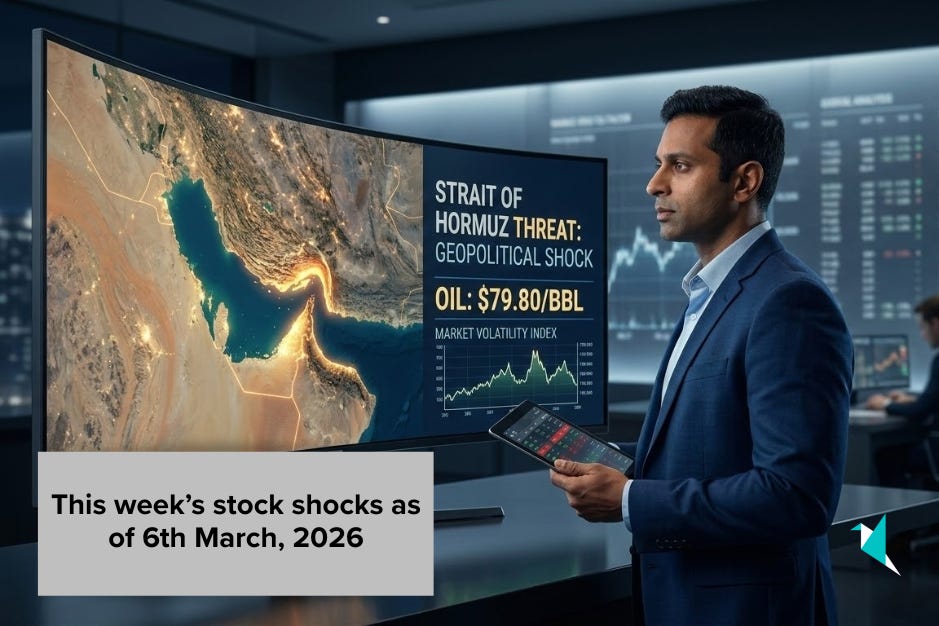
Most investors woke up this week to oil prices and war headlines—and had no idea what it meant for their portfolio. Meanwhile, energy stocks were surging, defence names were catching bids, and the Strait of Hormuz was suddenly the most important phrase in finance. The information was everywhere. The context was nowhere.
That’s why we built Winvesta Crisps—to break down the week’s real market movers, in plain language, before the consensus catches up.
60,000+ investors from all over India are already in. What about you?
🔔 Don’t miss out!
Add winvestacrisps@substack.com to your email list so our updates never land in spam.
The first week of March answered the question nobody wanted to ask: What happens to markets when bombs start falling on the world’s most important oil chokepoint? The answer arrived in real time. The S&P 500 swung violently—falling roughly 2% at Tuesday’s intraday lows before clawing back by Wednesday, only to slide again on Thursday. The Dow shed hundreds of points across the week. The Nasdaq, somehow, ended roughly flat. The VIX surged into the 20s, well above February’s complacent readings. And oil pushed past $79 a barrel as Iran threatened to shut down the Strait of Hormuz.
This wasn’t a week of earnings jitters or policy debates. It was a geopolitical shock layered on top of an already fragile market. The U.S.-Iran military conflict, now in its second week, forced a repricing of energy risk, defence spending, and the entire timeline for Fed rate cuts. Meanwhile, the Epic Games-Google settlement grabbed tech headlines—Tim Sweeney signed a non-disparagement clause that bars him from criticising Google’s app store policies until 2032. But make no mistake: the war dominated this week’s tape. Stock-picking mattered, but so did geography.
Market recap 📊
The week’s price action told a story in four acts: resilience, panic, relief, and relapse.
Monday opened with surprising composure. The S&P 500 finished at 6,881.62, essentially flat, even as the Iran conflict entered its fourth day. Energy stocks surged—the Energy Select Sector SPDR (XLE) jumped roughly 2%—while tech and defence names held firm. The Nasdaq added 0.4%. Markets seemed to be pricing in a contained conflict.
Tuesday shattered that illusion. Reports emerged that Iran’s Revolutionary Guard had struck an American oil tanker in the Persian Gulf, and threats to block the Strait of Hormuz—through which roughly 20% of global oil flows—sent crude prices surging. The Dow cratered more than 1,200 points intraday before staging a dramatic recovery after President Trump posted that the U.S. Navy would escort tankers through the Strait “if necessary.” The S&P closed down 0.94% at 6,816.63—ugly, but a fraction of the intraday carnage.
Wednesday was the bounce. Oil pulled back, ADP reported stronger-than-expected private payrolls for February, and the ISM Services PMI came in strong. The S&P rallied 0.78% to 6,869.50, the Nasdaq surged 1.29%, and the Dow snapped a three-day losing streak. Tech led the recovery, with chip names posting strong gains. Moderna jumped sharply on a patent litigation settlement.
Thursday brought the relapse. Oil pushed back above $77 as hostilities continued. The S&P dipped 0.57% to 6,830.68, and the Nasdaq slipped just 0.26%. But the Dow took a harder hit, dragged lower by Caterpillar and Goldman Sachs, which led the declines. A late-session relief rally in tech names cushioned the blow for the broader market.
The message? Markets are pricing a war, not a recession. Every dip got bought—until it didn’t.
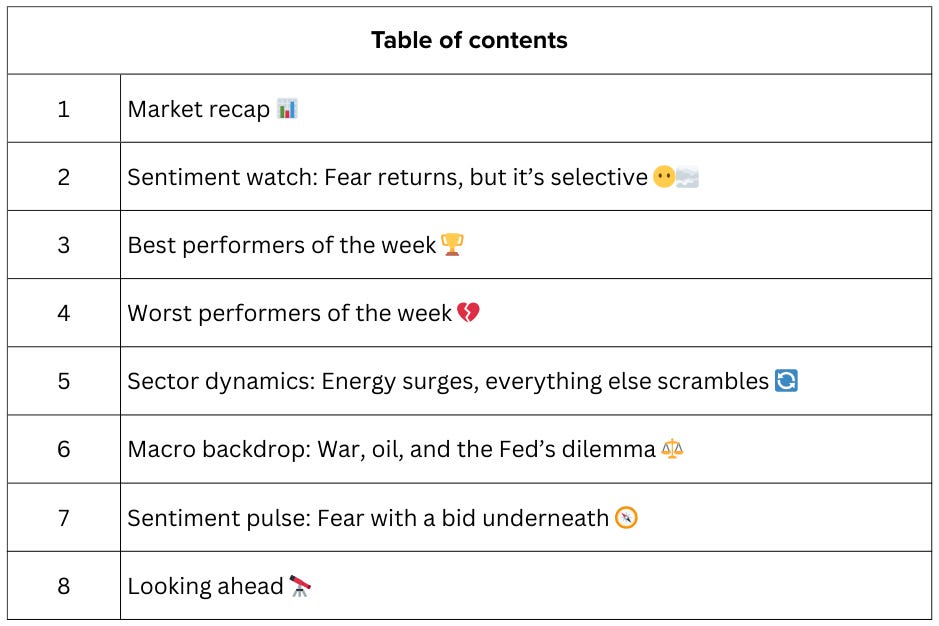
Sentiment watch: Fear returns, but it’s selective 😶🌫️
Sentiment shifted decisively this week. The CNN Fear & Greed Index moved into fear territory, and the VIX jumped sharply—well above February’s complacent readings. That’s a meaningful shift from the low-volatility calm that had defined the prior weeks.
But the fear wasn’t uniform. Energy and defence stocks traded like it was 2022 all over again—the XLE has posted strong year-to-date gains, outpacing every other sector by a wide margin. Meanwhile, small caps took an outsized hit: the Russell 2000 dropped sharply on Tuesday, the usual penalty for thinner margins and more refinancing risk.
The volatility spike tells you hedging demand surged. But the intraday recoveries tell you dip-buyers haven’t disappeared. That tension—fear at the surface, opportunism underneath—defined the week.
🚀 Join 60,000+ investors—become a paying subscriber or download the Winvesta app and fund your account to get insights like this for free!