


Watching US markets week to week without context is just noise. This week, new Fed Chair Kevin Warsh got exactly what he asked for: a “good family fight.” Three regional presidents dissented in favour of a rate hike, the most policy dissent in a decade, and Wall Street didn’t much like the ambiguity. The Dow had its worst day since April 2025. That’s why we built Winvesta Crisps, to cut through the noise and tell you what actually moved markets and why. 60,000+ investors from all over India are already in. What about you?
🔔 Don’t miss out!
Add winvestacrisps@substack.com to your email list so our updates never land in spam.
Kevin Warsh said he wanted a “good family fight” among Fed policymakers, and this week he got one. Three regional Fed presidents dissented in favour of raising rates, the most hawkish revolt at a Fed meeting since 2016, even as the central bank held steady. Bond markets didn’t take it well. The 30-year Treasury yield pushed to its highest level since 2007, and the Dow shed over 1,150 points in a single session, its worst day in more than a year. Layer in a fresh escalation in the Iran war, a soft GDP print, and a Microsoft-versus-Meta split screen on AI spending, and you have one of the more consequential weeks of 2026.
📊 Market recap
Monday opened with markets digesting a weekend pause in the US-Iran conflict. The Dow added a modest 262.83 points (0.51%) to close at 52,210.08, while the S&P 500 barely moved, up just 0.02% to 7,413.18, per CNBC. The Nasdaq Composite slipped 0.18% to 24,932.08, weighed down by a roughly 5% drop in Nvidia as chip stocks broadly sold off even as they trimmed steeper early losses. Chinese chipmaker CXMT’s blockbuster Shanghai IPO briefly lifted the space before investors rotated back out, and capital instead found its way into crypto-linked names.
Tuesday brought the week’s clearest theme: a rotation out of semiconductors and into old-economy earnings winners. The Dow jumped 537.24 points (1.03%) to 52,747.32, its third straight winning day, powered by Sherwin-Williams (+8.3% on an earnings beat and raised guidance) and Coca-Cola (+5.3% to fresh record highs on a beat-and-raise quarter), per Benzinga and CNBC. The S&P 500 added a modest 0.21% to 7,428.78, but the Nasdaq dipped 0.22% to 24,876.91 as the memory-chip complex cratered. SanDisk, 2026’s best-performing S&P 500 stock heading into the month, is now down more than 50% from its peak, with Micron, Western Digital, Seagate, and peers all sliding as investors reassessed the sector following CXMT’s debut and the Fed’s approaching decision. Also on Tuesday: Apple briefly touched a $5 trillion market capitalisation, a day after overtaking Nvidia as the world’s most valuable company, per CNBC and Yahoo Finance.
Wednesday was the week’s defining session. The Federal Reserve held its benchmark rate at 3.5%-3.75% for a fifth straight meeting, but the 9-3 vote included dissents from Cleveland’s Beth Hammack, Minneapolis’s Neel Kashkari, and Dallas’s Lorie Logan, all of whom wanted a quarter-point hike, per CNN and CNBC. Warsh called it a “good family fight” and stressed there is “no soft inflation target,” a hawkish tilt that spooked a bond market already unsettled by a fresh escalation in the Iran war (Iran reportedly launched a ballistic missile attack on US forces, per CNBC). Oil jumped on the news, with Brent up 6.6% to $89.61 and WTI up 6.4% to $84.31. The Dow tumbled 1,153.18 points (2.19%) to 51,594.14, its worst day since April 2025. The S&P 500 fell 1.52% to 7,316.15, and the Nasdaq Composite dropped 1.74% to 24,442.94, briefly entering correction territory (more than 10% below its all-time high). The 10-year Treasury yield rose 7 basis points to above 4.67%, while the 30-year jumped 10 basis points to above 5.2%, its highest since 2007. After the close, Microsoft and Meta reported: Microsoft’s Azure business topped $100 billion in annual revenue for the first time and the stock surged, while Meta’s free cash flow fell roughly 91% on ballooning AI capex and the stock slid.
Thursday saw futures stage a sharp rebound as Microsoft jumped as much as 9% in premarket trading and semiconductors bounced alongside it, while Meta fell roughly 9% on a soft revenue forecast, per CNBC and Yahoo Finance. The morning brought a data-heavy release: Q2 GDP grew just 1.5% (against a 1.8% consensus), decelerating from Q1’s 2.1% pace, while June’s PCE inflation gauge came in broadly in line, up 0.1% month-on-month with core PCE holding at 3.7% and 3.3% year-on-year respectively. Fresh overnight US strikes on Iranian targets kept geopolitical risk elevated even as oil held roughly steady. Apple and Amazon were both due to report after Thursday’s close, alongside Mastercard, Shell, and Bristol-Myers Squibb, setting up one more data point for Friday’s open.
Friday carries the weight of Thursday night’s Apple and Amazon results, the Bank of England’s rate decision, and whatever the bond market makes of a week that saw the Fed hold, dissent hard, and watch the 30-year yield hit an 18-year high anyway.
😶🌫️ Sentiment watch
The CNN Fear & Greed Index sat at 37, in Fear territory, as of Wednesday’s close, having drifted down over the course of the week as the Fed decision and Iran escalation weighed on risk appetite. The VIX told the same story more sharply: it closed Wednesday at roughly 20.7, up more than 13% on the day from a prior close near 18.2, a level that reflects real hedging demand without yet being a crisis reading.
That combination, fear without panic, is consistent with a market that respects the uncertainty Warsh has deliberately introduced but hasn’t concluded the worst case is coming. The Fed’s own decision to strip out forward guidance means investors have fewer signals to lean on between meetings than they’re used to, and that alone appears to be adding a volatility premium.
The stocks moving markets this week are all tradeable from India on the Winvesta app. No US bank account needed!
🚀 Join 60,000+ investors, become a paying subscriber or download the Winvesta app and fund your account to get insights like this for free!
🏆 Best performers
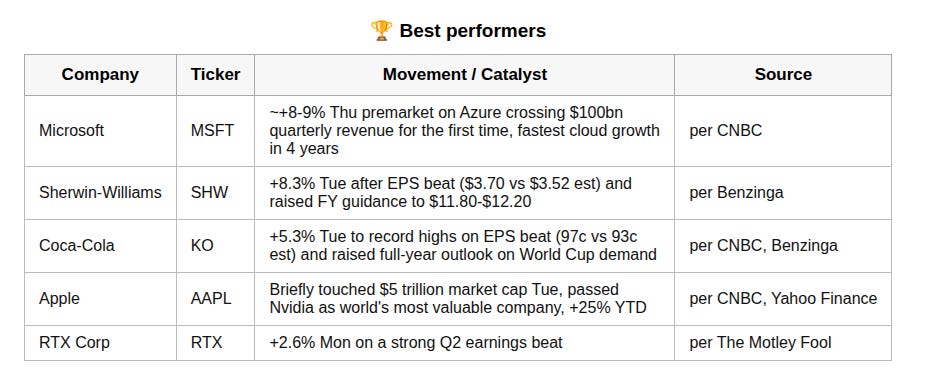
Tuesday’s rotation out of chips and into old-economy earnings winners produced the week’s cleanest gains. Sherwin-Williams and Coca-Cola both beat estimates and raised guidance, exactly the kind of unglamorous, execution-driven story the market rewarded all week. Microsoft’s Thursday premarket surge was the more consequential move: Azure crossing $100 billion in annual revenue gave the bulls a concrete AI-monetisation data point just as scepticism toward Meta’s spending was peaking. Apple’s brief $5 trillion market cap moment, meanwhile, capped a stretch in which investors have rewarded the one Magnificent Seven name that deliberately kept its AI capital spending low.