The week of 16th–20th March delivered one of the most complex trading environments of 2026. Three forces collided simultaneously: escalating Middle East conflict raising Strait of Hormuz disruption risks, Nvidia’s landmark GTC conference lighting up AI optimism, and the Federal Reserve holding rates steady whilst signalling caution on inflation.
The result was a volatile but partially resilient week. Markets clawed back from near four-month lows on Monday, found a brief footing on Tuesday, then sold off sharply on Wednesday after the Fed’s press conference, before stabilising on Thursday. Oil prices and geopolitics remained the dominant variables that investors could not ignore.
🔔 Hey, don’t miss out!
Add winvestacrisps@substack.com to your email list so our updates never land in spam
Market recap 📊
Wall Street staged a meaningful recovery this week after three consecutive weeks of losses. The S&P 500 rebounded sharply on Monday, rising approximately 1% as oil prices retreated from recent highs and Nvidia’s GTC conference injected fresh AI optimism into the tech sector. The Dow Jones added roughly 0.8%, and the Nasdaq gained around 1.2% — with semiconductors and AI-linked names leading the charge.
The momentum carried into Tuesday, with the S&P 500 adding another 0.25% to close at approximately 6,716 and the Nasdaq climbing around 0.47%. Volatile oil prices and fallout from the Middle East continued to influence sentiment, though markets held firm. Consumer discretionary was notably stronger, lifted by travel names including Expedia Group and Booking Holdings.
Wednesday brought a sharp reality check. The Federal Reserve held rates steady as expected, but Chair Jerome Powell’s press conference rattled markets. His acknowledgement that the central bank was “not making as much progress on inflation as it had hoped” sent the Dow sliding over 600 points at its session low, with the S&P 500 closing at 6,624.70 — a drop of approximately 1.4% on the day. Brent crude futures spiked toward $109–110 a barrel during the session, adding to inflationary anxiety.
Thursday proved similarly difficult initially, but markets partially recovered. US equity indices pared significant session losses, with the S&P 500 and Nasdaq ending down around 0.2% each, whilst the Dow declined approximately 0.3%, following a recovery from intraday lows. Diplomatic signals around the Strait of Hormuz helped ease some of the day’s earlier stagflation fears. Boeing and McDonald’s were the Dow’s biggest drags, whilst Chevron, Cisco, and Goldman Sachs were among the few gainers.
Overall, the week ended broadly flat to modestly lower after the strong Monday rebound was offset by post-Fed selling. The S&P 500 sits a few per cent below its January 2026 record high and remains roughly flat year-to-date.
Someone shared this with you? Get your own insider updates directly — no middleman needed.
Fear & greed index: Extreme Fear 😱
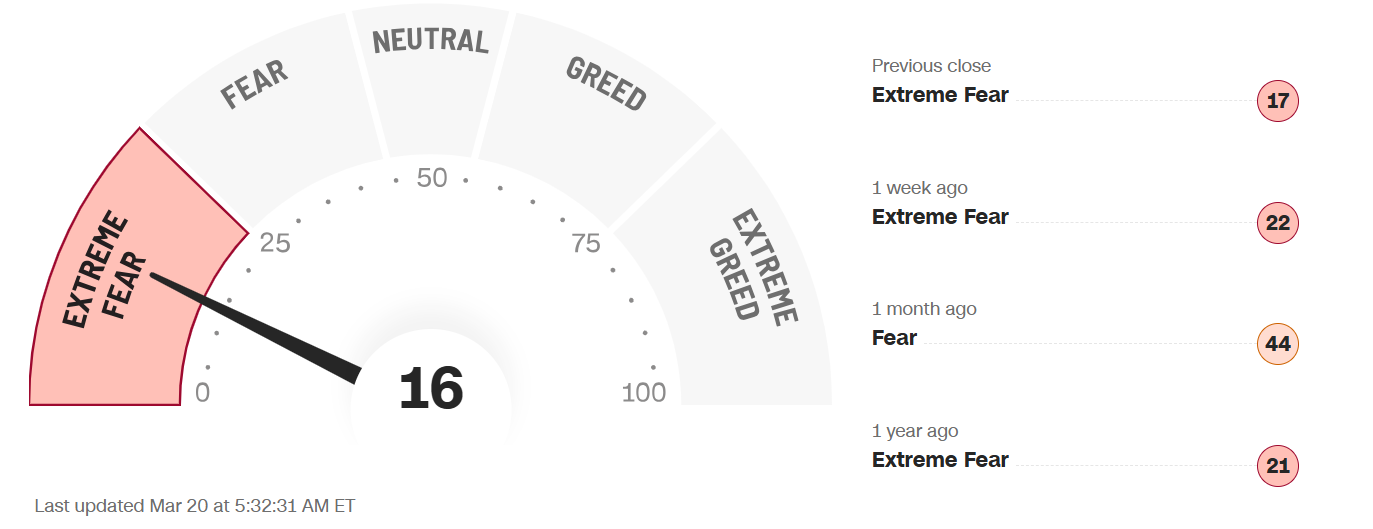
The CNN Fear & Greed Index closed the week at 16 — Extreme Fear (last updated 20th March at 5:32 AM ET). To put that in context: a week ago it sat at 22, a month ago it was at 44 (Fear), and a year ago it was at 21. The direction of travel is unambiguous — sentiment has deteriorated sharply and consistently through March 2026.
A reading of 16 is not just “cautious.” It signals that investors are in active capital-preservation mode. Safe-haven demand has surged — gold continued to trade near historic highs, around $4,700 per ounce, whilst bond inflows accelerated. The VIX remained elevated at approximately 25, confirming that investors are actively purchasing downside protection.
The historical context is important for Indian investors to understand: Extreme Fear readings have often preceded strong medium-term recoveries in US markets — but they can persist for weeks before sentiment turns. The mood right now is one of genuine anxiety, not a brief wobble. For long-term investors, this is a moment to stay the course rather than react; for those with dry powder, it is worth watching closely.
😱 Okay, so the Fear & Greed Index just hit 16. Historically, that’s when long-term investors in US markets get interested. So, if you want to invest in US stocks from India?
Download the Winvesta app and start in minutes.
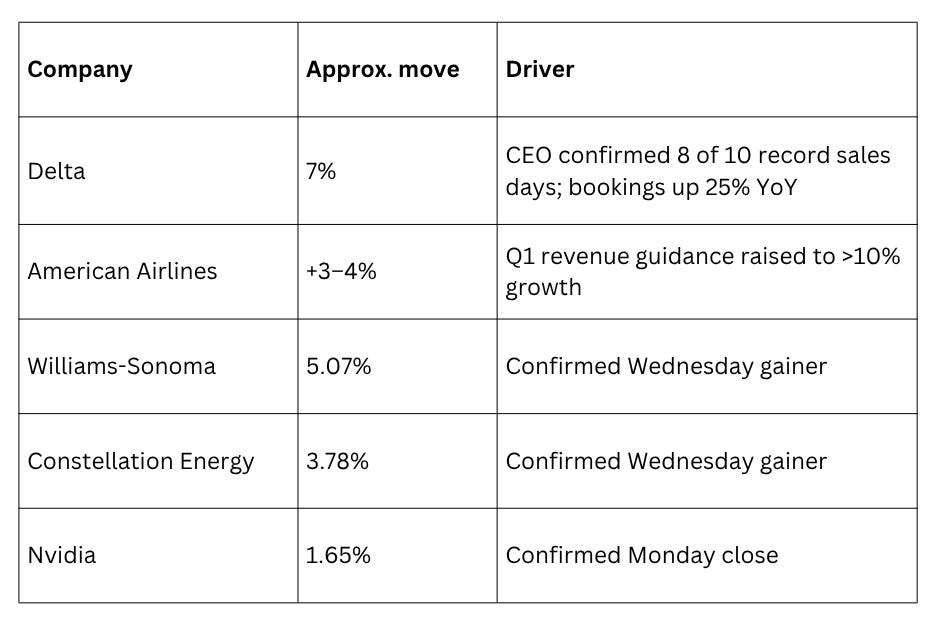
Best performers of the week 🏆
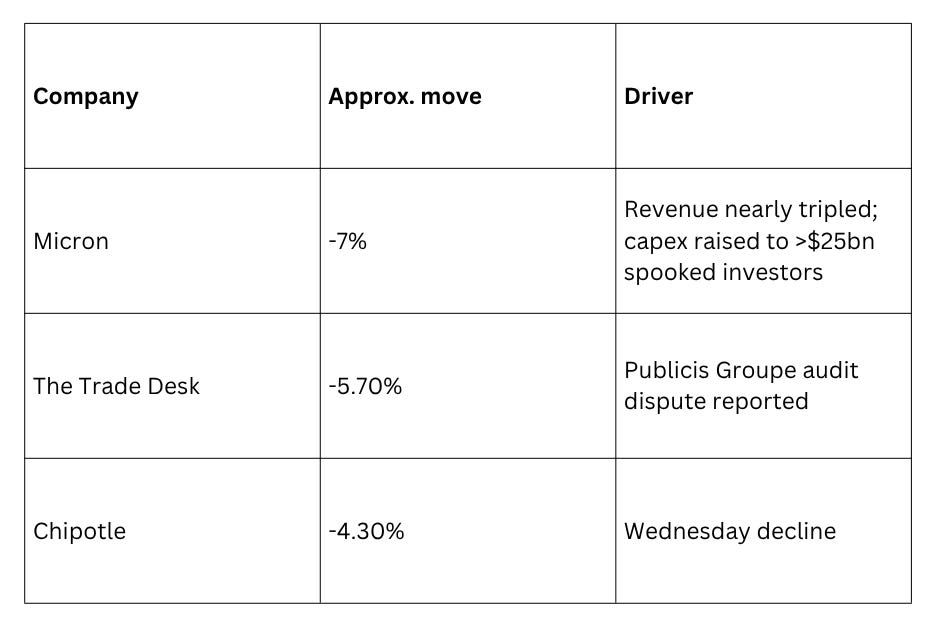
Worst performers of the week 💔