


Hot inflation data, a widening shipping war in the Gulf and a memory-chip stock wobble all hit Wall Street in the same week, and the S&P 500 barely blinked. That is not calm. That is a market choosing which risks to price and which to ignore. That's why we built Winvesta Crisps, to decode every shift reshaping the companies you own, in plain language, before the consensus catches up. 60,000+ investors from across India are already in. What about you?
🔔 Don't miss out!
Add winvestacrisps@substack.com to your email list so our updates never land in spam.
Wall Street spent this week pricing three separate shocks, a scorching September inflation print, an escalating tanker war in the Strait of Hormuz, and a China-driven wobble in memory-chip stocks, and still finished within a few points of record territory. Big bank earnings added a fourth complication: Citigroup and Goldman Sachs blew past forecasts while Wells Fargo and JPMorgan stumbled, the clearest split verdict of the earnings season so far.
📊 Market recap
The week's price action read in two acts: a quiet start that gave away nothing, and a Wednesday inflation shock that gave away quite a lot. The S&P 500 spent Monday and Tuesday pinned in the high-7,700s to high-7,800s, within a whisker of the record levels it printed the previous week, before Wednesday's hot CPI reading knocked it back into the high-7,600s to low-7,700s. The Dow and Nasdaq told the same story from different angles: the Dow ground along near 51,700 on thin conviction, while the Nasdaq was dragged by a deepening chip-stock selloff even before the inflation data landed.
Monday was a non-event by design. US markets traded through the Columbus Day holiday on thin volume and the major indices barely moved: the Dow added about 0.38% to roughly 51,850, the Nasdaq slipped about 0.44% to around 27,246, and the S&P 500 closed almost exactly flat at 7,807, per market reports citing Reuters data. The real action was underneath the index level. A scattered, catalyst-light rally in small and mid-caps, FIGS, FICO and CCC Intelligent Solutions were all up double digits on no clear news, per Tapeboard, sat next to a sharp, concentrated selloff in chip and optical-networking names: Cerebras, Semtech, Ciena and Lumentum were all down close to 10% as investors began rotating out of 2026's most crowded hardware trade.
Tuesday brought the bank earnings and the first hard evidence that the AI hardware trade was cracking. Citigroup and Goldman Sachs opened earnings season with results that beat decisively: Citi's Q3 net income jumped roughly 40% year on year to about $5.2 billion on its best third-quarter revenue in a decade, while Goldman's revenue of around $18.7 billion ran nearly $2 billion ahead of consensus. Wells Fargo and JPMorgan told the opposite story. Wells Fargo's net interest income missed estimates for a sixth straight quarter, and JPMorgan posted its first earnings miss in more than a year, dragged down by weak fixed-income trading and $658 million in investment-securities losses, even as its equity trading revenue surged 49%. JPMorgan's shares fell as much as 3% in premarket trading before recovering to close higher once investors absorbed the bank's raised 2026 net interest income guidance. Away from the banks, China's CXMT disclosed plans to push into high-end server memory with a denser chip design, a direct shot at Micron's core business. Micron fell about 5% and SanDisk, which has barely any server-memory exposure, fell about 4% in sympathy. The Philadelphia Semiconductor Index logged its fifth straight losing session, a monthly low.
Wednesday was the week's pivot. September's CPI print landed hot: headline inflation at 3.7% year on year and core at 2.6%, both above where the Fed would like to see them. The ten-year Treasury yield spiked as high as 5.32% intraday on the release before easing back. Equities took the data badly: the S&P 500 fell 1.1% on the day, and semiconductor stocks, already weakened by the CXMT news, dropped a further 4.5%.
Thursday and Friday were about absorbing the shock rather than adding to it. The ten-year yield eased back to around 5.11%, a three-week low, as Fed officials offered a genuinely split read on the inflation print. San Francisco Fed president Mary Daly said rates will likely have to rise again, though not necessarily at the 27 to 28 October meeting. Governor Michelle Bowman said she would rather wait. Chicago Fed president Austin Goolsbee called the CPI print "discouraging." Markets pared back bets on an October hike after the comments, though UBS is now pencilling in a third hike for March 2027. The chip-stock weakness spilled into Asia overnight: South Korea's Kospi fell about 8% and Japan's Nikkei dropped around 5.1%, while Nasdaq 100 futures pointed roughly 1% lower heading into Thursday's US session. Fed chair Kevin Warsh was due to speak late Thursday evening US time, just hours before this went to print in India, so his remarks are a live input the market has not fully absorbed yet.
😶🌫️ Sentiment watch
A precise, verified Fear and Greed reading for Friday was not available before this went to print, so treat the mood read as directional rather than exact. The VIX, Wall Street's own volatility gauge, moved from about 15.3 on Tuesday to 16.87 by Thursday, a jump of more than 10% on the week but still well inside what traders call a calm market, nowhere near the readings in the mid-20s and above that usually mark genuine fear.
That is the tell for this week. A hot inflation print, a widening Gulf shipping war and a chip-stock wobble together pushed volatility up by only a few points. Markets are not panicking. They are mildly more alert than they were seven days ago, and arguably should be more alert than that.
The stocks moving markets this week, from the big banks to the chipmakers caught in the China memory fight, are all tradeable from India on the Winvesta app. No US bank account needed!
🚀 Join 60,000+ investors, become a paying subscriber or download the Winvesta app and fund your account to get insights like this for free!
🏆 Best performers
The week's clearest winners were catalyst-light momentum names and one direct beneficiary of the Gulf shipping disruption, not the earnings season's actual headline beats.
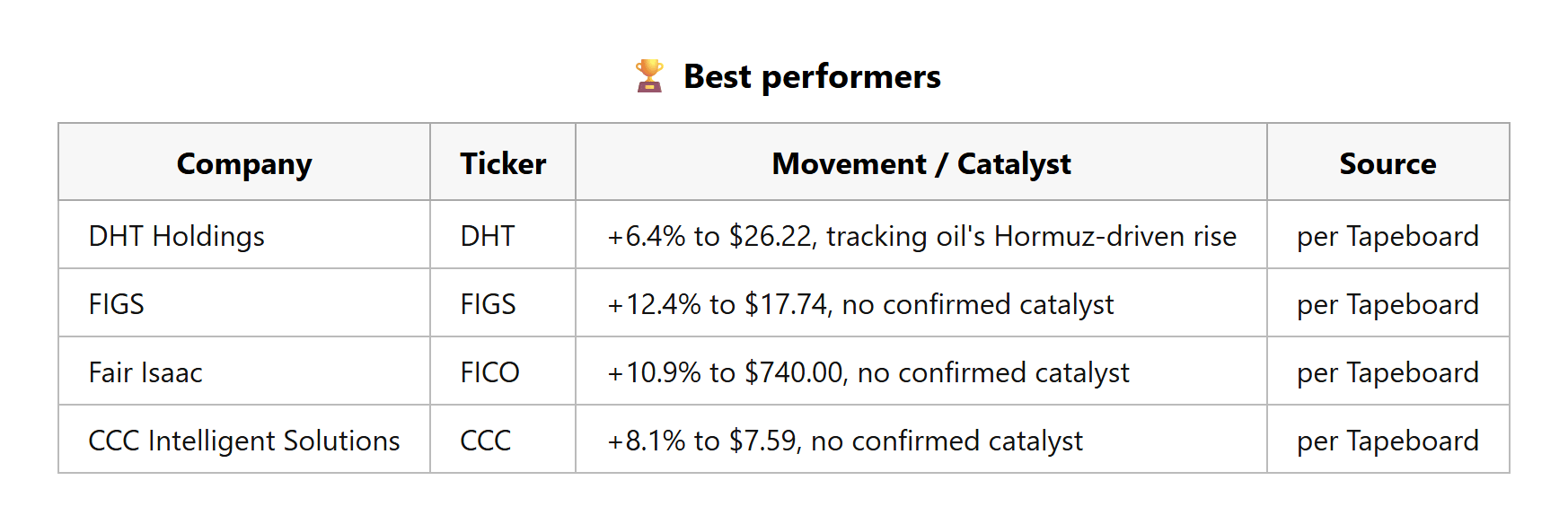
DHT Holdings, a crude tanker operator, was the one gainer with an obvious story: oil's climb through the week on Hormuz supply fears lifted freight economics directly. The rest of the list, FIGS, FICO and CCC Intelligent Solutions, moved on volume too thin and news too absent to call a trend. Per Tapeboard's own reporting, none of the week's biggest single-day percentage gainers had a confirmed company-specific catalyst attached.