


For most of this year the argument about US interest rates has been how much higher they go, not how much lower. This week two inflation prints landed soft inside 48 hours, the market's odds of a September rate rise collapsed, and the S&P 500 closed at a record. That is why we built Winvesta Crisps, to cut through the noise and tell you what actually moved markets and why. 60,000+ investors from all over India are already in. What about you?
🔔 Don't miss out!
Add winvestacrisps@substack.com to your email list so our updates never land in spam.
The story of this week was not the record close, although there was one. It was that inflation stopped being the argument. July consumer prices eased to 3.4% and July producer prices came in flat, and between them they took the implied odds of a September rate rise from roughly 55% at the start of the month to about 35% by Thursday, per CME FedWatch pricing cited by AP. The S&P 500 and the Nasdaq clawed back two days of losses and went to a record. The Dow did not, and one stock is most of the reason why.
📊 Market recap
The week arrived in two halves: two sessions of oil-led drift, then two sessions of data-led relief.
Monday was a slow leak. All three major indices slipped from the prior Friday's highs, each by around 0.1% to 0.3%, per Associated Press tallies. Crude was the culprit. Traders read mixed signals out of Washington and Tehran on when the Strait of Hormuz would actually reopen, and oil firmed on the uncertainty. Intel supplied the day's other drag, announcing a $15bn common stock offering, its first public share sale since listing in 1971, to fund a foundry capital spending plan it has now guided above $20bn for 2026, per Bloomberg and Intel's own release. The stock fell on the dilution. Berkshire Hathaway went the other way after beating on profit.
Tuesday extended the drift and hardened the cause. The indices fell for a second straight session, with the S&P 500 off about 0.3% and the Nasdaq about 0.6%, per AP. US and Iranian positions on war compensation stiffened, which pushed a Hormuz reopening further out, and Brent rose about 1.4% to just under $89 after swinging between $87 and $90. Alphabet, Apple and Amazon all finished lower as investors trimmed risk ahead of the inflation print. One number did not fit the pattern: the Russell 2000 rose about 0.3%, the first hint that the week's real story was going to be rates rather than growth.
Wednesday was the turn. July CPI rose 0.1% on the month and 3.4% on the year, down from 3.5%, with core at 0.2% and 2.5%, per CNBC and the Bureau of Labour Statistics. Both were as expected, and shelter was still doing roughly two-thirds of the work in the headline. Treasury yields eased. But the bigger equity story was earnings from the AI build-out, where the numbers were not incremental: CoreWeave rose about 19% and Nebius about 23% on results and guidance, Super Micro added around 13%, and Lumentum reported FQ4 revenue that more than doubled to about $1.01bn, per Bloomberg and Reuters. The Nasdaq gained about 0.5%. The Dow still finished marginally red.
Thursday was the payoff. July producer prices came in flat on the month against an expected 0.2% rise, and the annual rate dropped to 4.7% from 5.5%, well under the 4.9% consensus, per AP. That was the week's single most important number. Oil broke lower with it, Brent settling down about 2.1% near $87, and the 10-year Treasury yield eased to around 4.65% while the two-year fell about 6 basis points to 4.13%. The S&P 500 rose about 0.7% to a record close just under 7,800, having cleared 7,800 intraday for the first time, per Bloomberg and TheStreet. Breadth backed it up, with advancers beating decliners by roughly 1.8 to 1. Rate-sensitive names led, and mortgage rates fell for the first time in six weeks. The Dow managed only about 0.1%, because Cisco fell roughly 9% and took around 64 Dow points with it, per Motley Fool.
Add the four sessions up and the S&P 500 was ahead by roughly half a per cent on the week, the Nasdaq Composite by a little less, and the Russell 2000 by over 1%. The Dow was down about 0.4%. Note that this recap closes with Thursday's session, because Friday's US market has not opened as this reaches you, and July retail sales land at 6pm IST on Friday.
😶🌫️ Sentiment watch
CNN's Fear and Greed Index read 62, in Greed territory, as of Thursday 13 August, up from 61 the day before and a clear move up from the Neutral reading it carried at the start of the month, per Benzinga's daily summary.
The VIX is the number worth pausing on. It sat in the mid-14s on Thursday, the lowest since January, with options pricing an implied daily move of roughly 0.9% on the S&P 500. Read that against what is actually unresolved. The Strait of Hormuz is still not reliably open. The Federal Reserve held rates five weeks ago on a 9 to 3 vote in which all three dissenters wanted a rise, not a cut. Volatility at seven-month lows is not a statement that those risks have gone away. It is a statement that the market has decided they will not be settled in the next 30 days, and that is a different and more fragile claim.
The stocks moving markets this week are all tradeable from India on the Winvesta app. No US bank account needed!
🚀 Join 60,000+ investors, become a paying subscriber or download the Winvesta app and fund your account to get insights like this for free!
🏆 Best performers
Two very different trades produced this week's winners: a takeover rumour, and an AI infrastructure earnings season that keeps beating.
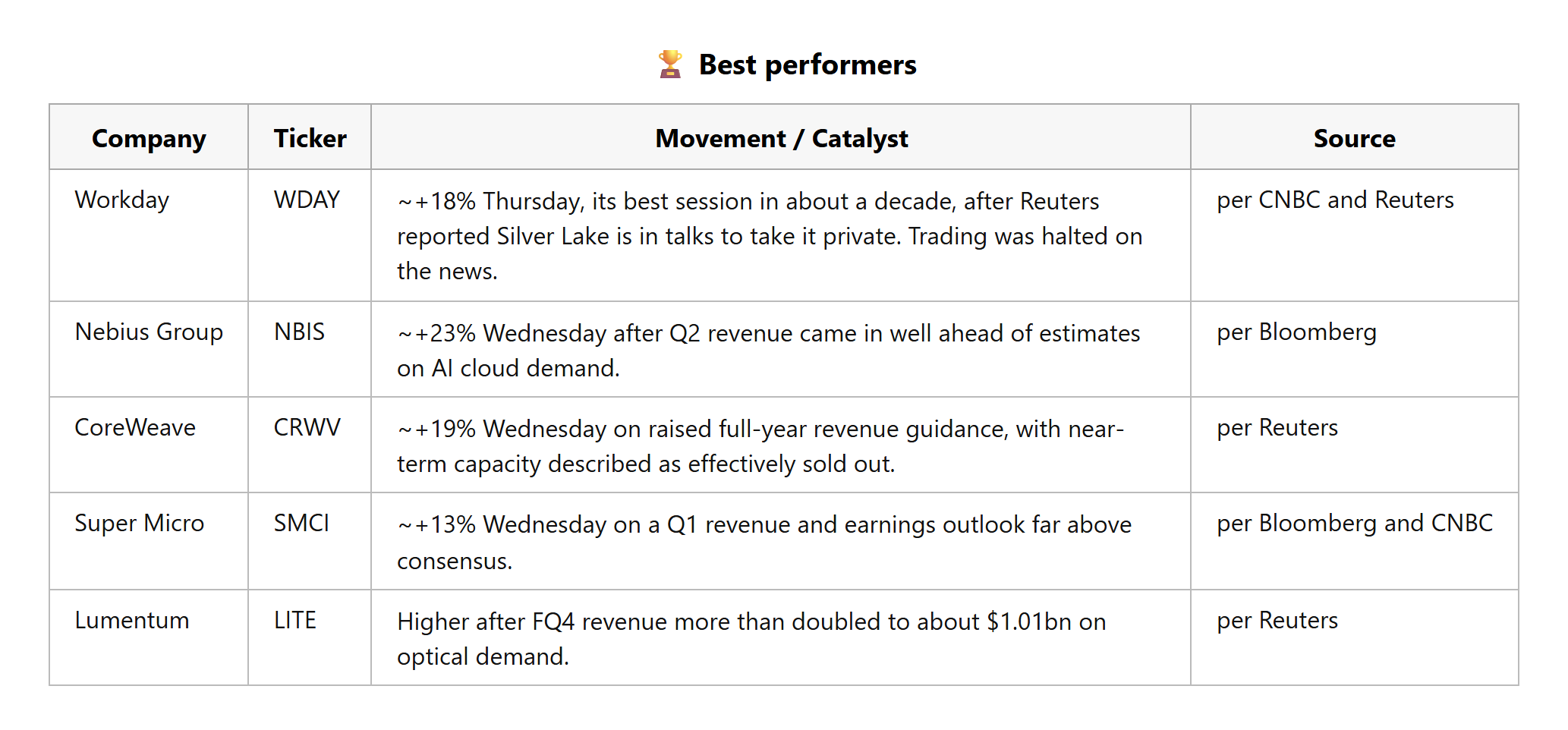
Four of those five moved on their own results, and in every case it was the forward guide rather than the quarter that did the work. CoreWeave's line that near-term capacity is effectively sold out matters more than the revenue beat, because it says pricing power, not just demand.