Before we begin,
5 years ago, checking the S&P 500 once a week and assuming your portfolio was fine may have worked. Not anymore. A war in the Gulf is moving oil past $100, fertiliser stocks are the new shortage trade, and the Pentagon is recruiting Wall Street bankers for defence deals.
If you’re still reading markets through last month’s lens, you’re already behind. That’s why we built Winvesta Crisps—to break down what’s actually moving the companies you own, in plain language, before the consensus catches up. 60,000+ investors from all over India are already in. What about you?
🔔 Don’t miss out!
Add winvestacrisps@substack.com to your email list so our updates never land in your spam folder.
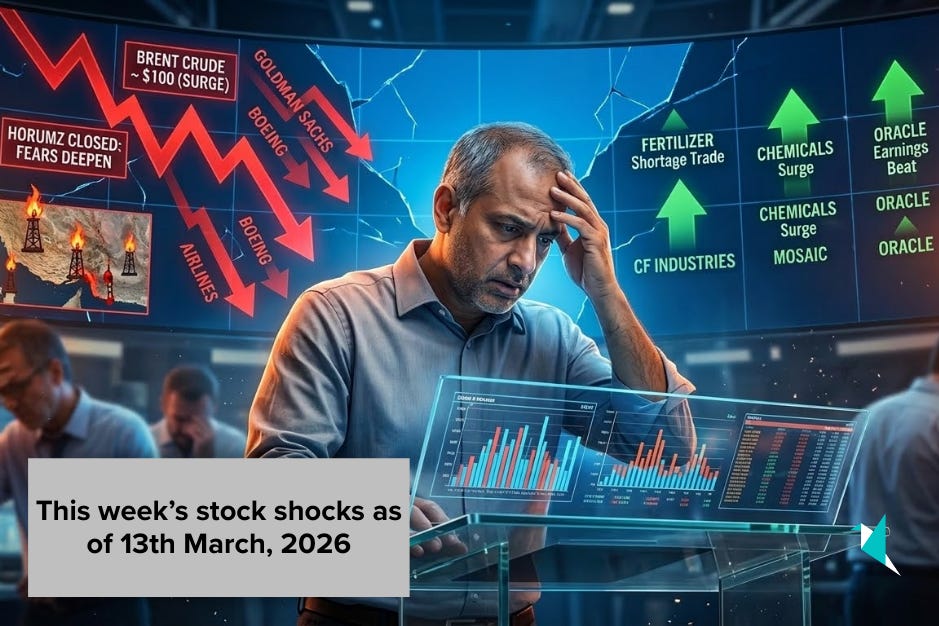
The week opened with Monday’s stunning intraday reversal still fresh in traders’ minds—and then promptly got worse. Multiple days of declines erased that comeback as Iran’s new Supreme Leader vowed to keep the Strait of Hormuz shut, and Brent crude settled around $100 a barrel for the first time since 2022. By Thursday’s close, all three major indices had posted sharp losses, with the S&P 500, Dow, and Nasdaq all falling well over 1% on the session alone, per CNBC. The Dow broke below key support levels, and the S&P 500 hit its lowest close in months.
This wasn’t a sideways week. It was a market being dragged lower by war, oil, and the growing realisation that there’s no quick fix for any of it. The Pentagon’s headline-grabbing move to recruit Wall Street bankers for an “Economic Defence Unit” added intrigue but couldn’t offset the damage. Fertiliser and chemical stocks surged on Hormuz supply fears. Everything else bled.
Market recap 📊

As of the week ended March 13, 2026, based on live quotes and news flow available at the time.
The week’s price action told a story in three acts: reversal afterglow, CPI calm, and oil-driven collapse.
Monday was a carryover from the weekend’s drama. After US-Israeli strikes on Iran sent crude surging on Sunday night, the Dow plunged sharply at its lows before staging a furious intraday reversal. Trump told CBS News the war is “very complete, pretty much,” adding that Iran has “no navy, no communications… no Air Force.” Markets ripped higher on the comments—all three indices closed solidly in the green, per CNBC, in one of the most dramatic intraday reversals of 2026. It felt like the bottom was in.
It wasn’t. Tuesday brought a modest pullback, and Wednesday’s session was mixed. The latest inflation report came in roughly in line with expectations, per the Bureau of Labour Statistics—normally a relief. But three vessels came under fire in the Strait of Hormuz on Wednesday morning, per Reuters, sending crude prices climbing again. The dollar strengthened notably. Meanwhile, Semafor broke news that the Pentagon is headhunting bankers from Goldman Sachs and JPMorgan for a new “Economic Defence Unit”—a roughly 30-person team to deploy about $200 billion in defence deals over three years, per Reuters. The story generated buzz but couldn’t move the needle against oil’s gravitational pull.
Thursday was devastating. Iran’s new Supreme Leader, Mojtaba Khamenei—appointed just days earlier—declared that the Strait of Hormuz should “remain shut” as a “tool to pressure the enemy,” per CNBC. WTI crude surged sharply, settling in the mid-$90s, while Brent closed around $100. The selloff was broad and brutal: all three major indices fell by more than 1%, with the Nasdaq hit hardest, per CNBC. Most US issues declined. The International Energy Agency agreed to a record coordinated release of emergency oil reserves, but the market largely shrugged it off as insufficient. Morgan Stanley shares sank after the firm capped withdrawals from large private credit funds, per CNBC.
Monday’s reversal now looks like a false dawn. The war isn’t over, Hormuz isn’t open, and oil isn’t going back to $80 anytime soon.
Sentiment watch: Fear, and deepening 😶🌫️

The CNN Fear & Greed Index has slid into fear territory in early-to-mid March, with readings approaching near-extreme fear levels, per MarketWatch—a far cry from the neutral readings of a few weeks ago. Volatility gauges have remained elevated, consistent with a market experiencing genuine geopolitical stress rather than garden-variety choppiness.
Translation? This isn’t cautious optimism anymore. It’s defensive positioning. Monday’s reversal briefly sparked hope, but Thursday’s collapse pushed sentiment right back into fear. The market isn’t just nervous—it’s bracing for something worse.
🚀 Want to trade the names moving markets—energy, defence, and more? Join 60,000+ investors on the Winvesta app.
Best performers of the week 🏆