


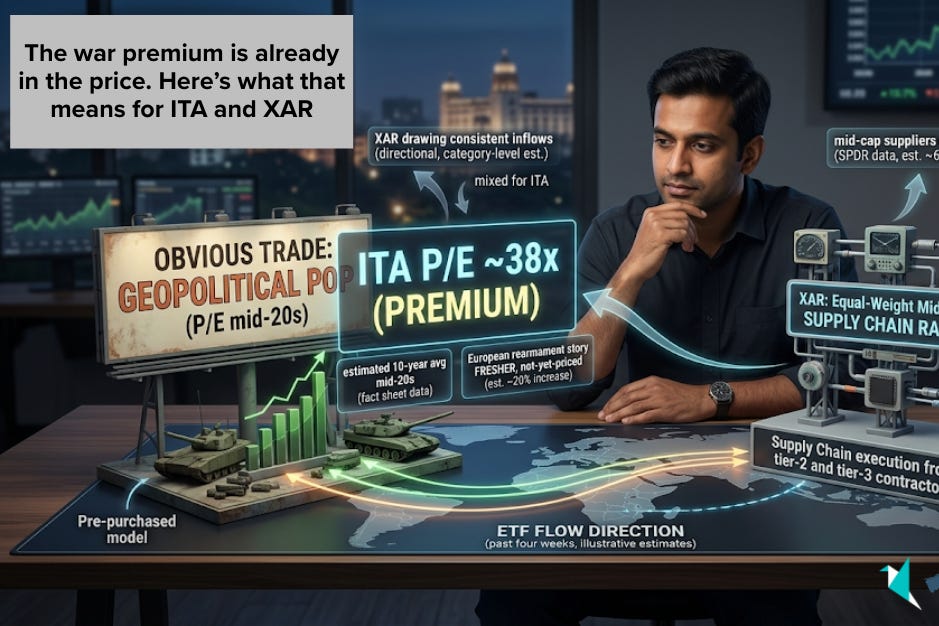
Buying a defence ETF after a geopolitical flare-up was practically a free trade. Tensions rise, stocks pop, repeat. Not anymore. The world has spent three years rewriting defence budgets from the ground up. NATO allies have agreed to reach total defence and security spending of 5% of GDP by 2035, with at least 3.5% on core defence and up to 1.5% on broader security-related areas, and Trump’s FY2027 budget requests around $1.5 trillion in total national defence resources. The thesis is not a secret. It is a billboard.
That’s why we built Winvesta Crisps, to tell you when the obvious trade is already priced in and what actually to do about it. 60,000+ investors from all over India are already in. What about you?
🔔 Not subscribed yet? Hit the button below and get every edition straight to your inbox.
Global defence spending reached approximately $2.89 trillion in 2025, per SIPRI data, the 11th consecutive annual rise. Every NATO ally, for the first time in the alliance’s history, met the 2% of GDP commitment. European nations raised their collective defence budgets by 20% in a single year. Trump has proposed around $1.5 trillion in total national defence resources for FY2027, roughly 50% above the FY2026 baseline. And at the centre of it all are two ETFs that Indian investors can own today through their Winvesta app: ITA and XAR.
Most investors see the headlines and think: defence is obviously the place to be. But the data tells a more complicated story. ITA was trading at a recent P/E of around 38x as of March 2026, per the iShares fact sheet, a steep premium to an estimated 10-year average in the mid-20s range based on third-party analysis. The structural tailwinds are real. The question is how much of it has already been priced into the funds you are about to buy.
That is exactly the dilemma sitting in Vikram’s portfolio right now.
🪖 Meet Vikram
Vikram is a 36-year-old product manager in Pune. He has been building a US equity portfolio on Winvesta for two years. He owns VOO as his core holding, a small position in QQQ, and recently added some GLD after the gold rally caught his attention.
Last week, a colleague mentioned that defence stocks had been on a tear. Vikram pulled up ITA’s 1-year chart. It had returned roughly mid-to-high 40s per cent over the prior year as of early 2026, per iShares data. He also found XAR, which returned roughly 55-60% over the prior year as of early 2026, per SPDR data and sector commentary, one of the strongest one-year performances among major defence ETFs.
His internal monologue is now running at full speed:
“NATO is spending more than ever. Trump just proposed $1.5 trillion in defence. There’s a shooting war backdrop with Iran and the ongoing Russia-Ukraine war. This is a structural super-cycle. Am I already late?”
Vikram has not bought yet. He is doing what a thoughtful investor should: asking whether the thesis is still worth the entry price, or whether he is about to buy the poster after the concert ends.
This article is for him.
🔍 What’s actually inside these funds
There are three main ways for the US asset to own US defence through Winvesta: ITA, XAR, and DFEN. They are not the same trade.
ITA (iShares US Aerospace & Defence ETF) is the giant. $13.5 billion in assets, tracking the Dow Jones U.S. Select Aerospace & Defence Index. It is heavily concentrated at the top: GE Aerospace (~19%), RTX (~16%), and Boeing (~8%) together account for nearly half the fund. If you buy ITA, you are essentially making a concentrated bet on a handful of mega-prime contractors. Expense ratio: 0.38%.
XAR (SPDR S&P Aerospace & Defence ETF) is the equal-weight alternative. 42 holdings are spread roughly evenly, giving meaningful weight to mid-tier suppliers, avionics makers, and emerging players alongside the primes—$ 5.7 billion in assets. The equal-weight structure means mid-cap suppliers get real influence over returns, which historically benefits XAR during ramp-up cycles when primes need to expand their supply chains. Expense ratio: 0.35%.
DFEN (Direxion Daily Aerospace & Defence Bull 3X) is the leveraged version. 3x daily exposure. Not a buy-and-hold instrument. For Vikram and most Indian retail investors building long-term portfolios, this is speculative and unsuitable unless you genuinely understand leveraged decay.
ETF flow direction, past four weeks (ILLUSTRATIVE, directional estimates only)
Note: The table below reflects directional estimates and is not drawn from a single audited dataset. Cross-reference with Bloomberg, ETF.com, or TrackInsight before acting.
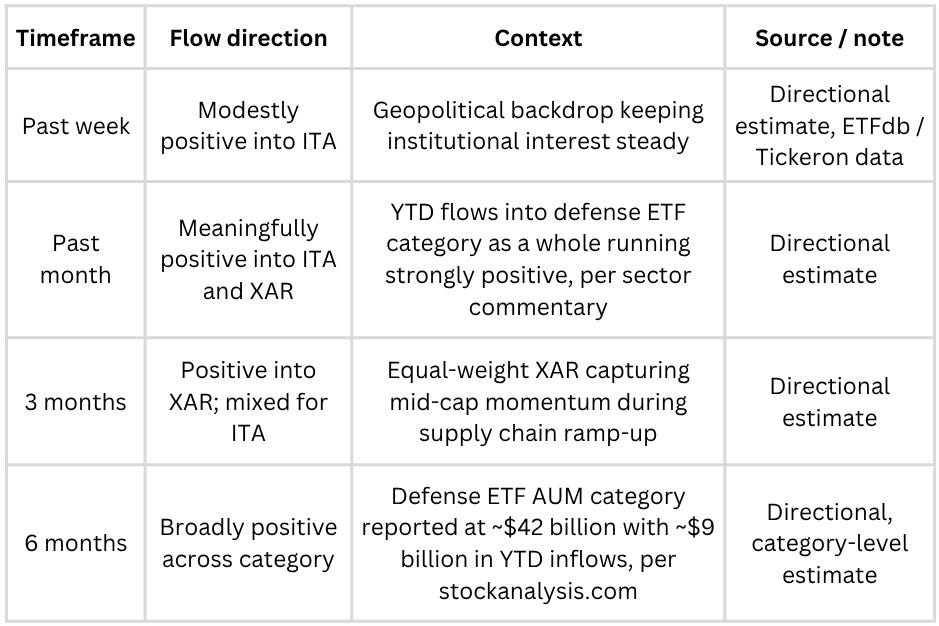
The flow signal worth noting: XAR has been drawing relatively more consistent near-term inflows than ITA over the recent window, which aligns with its stronger 1-year return. When flows chase the better-performing equal-weight fund rather than the flagship, it typically signals that institutional money believes the mid-cap supply chain story has more runway than the mega-cap concentration story.
🚀 Want to add ITA or XAR to your portfolio? Trade US defence ETFs directly from India on the Winvesta app. No US bank account needed!
Join 60,000+ investors, become a paying subscriber or download the Winvesta app and fund your account to get insights like this for free!
💡 Three scenarios for Vikram’s portfolio
Let’s model what actually happens to Vikram’s full portfolio if he adds ₹2 lakh into ITA today, alongside his existing VOO (₹6L), QQQ (₹2L), and GLD (₹2L) — a total ₹12L US portfolio. The following scenarios, probabilities, and return estimates are illustrative stress tests based on assumed returns and subjective probabilities. They are not forecasts, market consensus, or guarantees of future performance.