


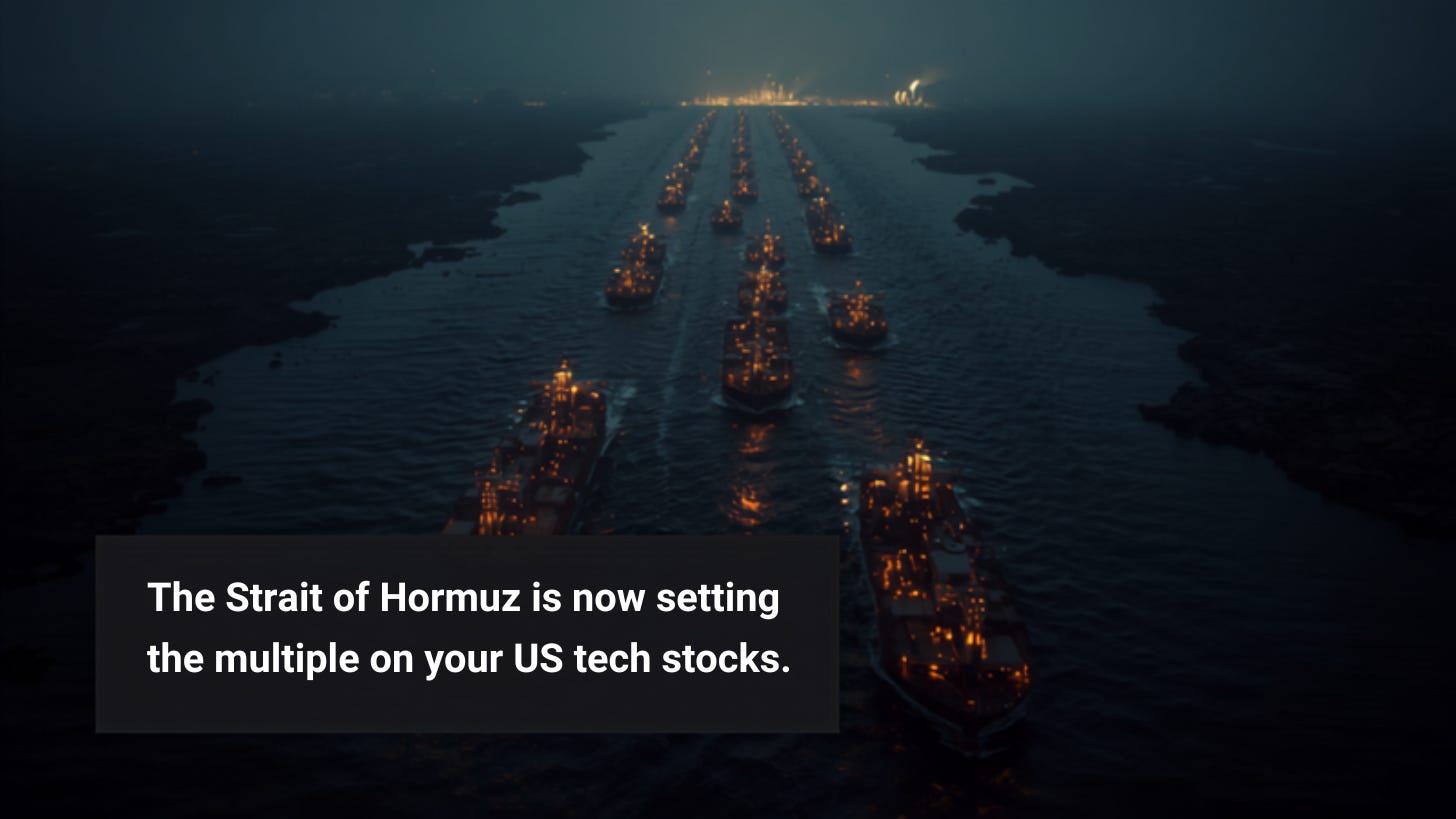
Five trading days ago the S&P 500 closed at a record. Since then Brent crude has risen for four straight sessions, the 30-year US Treasury yield has hit its highest level since 2007, and the Nasdaq has fallen three days running. Nothing changed at Nvidia or Microsoft in those five days. What changed was the traffic through one shipping lane in the Gulf. That's why we built Winvesta Crisps: to break down what's actually moving markets, in plain language, before the consensus catches up. 60,000+ investors from all over India are already in. What about you?
🔔 Don't miss out!
Add winvestacrisps@substack.com to your email list so our updates never land in spam.
Most investors think of the oil price as an energy story. It shows up in the pump price, it helps oil producers, it hurts airlines, and if you own neither it is somebody else's problem. That framing has stopped working. Brent traded near 92 dollars on Wednesday, up about 37 per cent over twelve months per Trading Economics, and the position it damaged most in the past week was not an airline. It was the part of your portfolio you probably think of as the safest long-term bet: large-cap US technology. The route from a blocked shipping lane to a compressed price-to-earnings multiple runs through the bond market, and it is shorter than most people realise.
🛢️ What is actually happening in the Gulf
The Strait of Hormuz is the highest-volume oil chokepoint on the planet. In the first half of 2025, roughly 20.9 million barrels a day moved through it, about 20 per cent of global petroleum liquids consumption and around a quarter of all seaborne oil trade, per the US Energy Information Administration.
That flow has been broken since late February 2026. During the first quarter of this year, crude and petroleum liquids through the strait fell almost 30 per cent year on year to 14.6 million barrels a day, per EIA data. The position now is worse than the quarterly average suggests. Commercial transits have fallen to a handful a day against the hundred-plus that used to pass before the conflict, and roughly 3,200 vessels, including around 800 tankers and cargo carriers, are idling west of the waterway waiting for it to clear.
The insurance market tells the same story in money. War risk cover for a transit ran at about 0.25 per cent of hull value before the war. It has since been quoted in the range of 3 to 10 per cent, which turns a 100 million dollar tanker's premium from roughly 250,000 dollars into several million per trip. At that price, a shipowner does not need the strait to be formally closed to stop using it.
The immediate trigger for this week's move was diplomatic. The memorandum of understanding signed in June, intended to give both sides 60 days to negotiate, expired on Monday, and President Trump said he was not interested in extending it. Iran's foreign ministry has said the US naval blockade must be lifted before the strait reopens fully. Iran and Oman are talking about an arrangement for managing shipping, without US participation. None of that is a settlement, and the oil market has priced it accordingly.
⚙️ How a barrel of oil reaches a technology stock
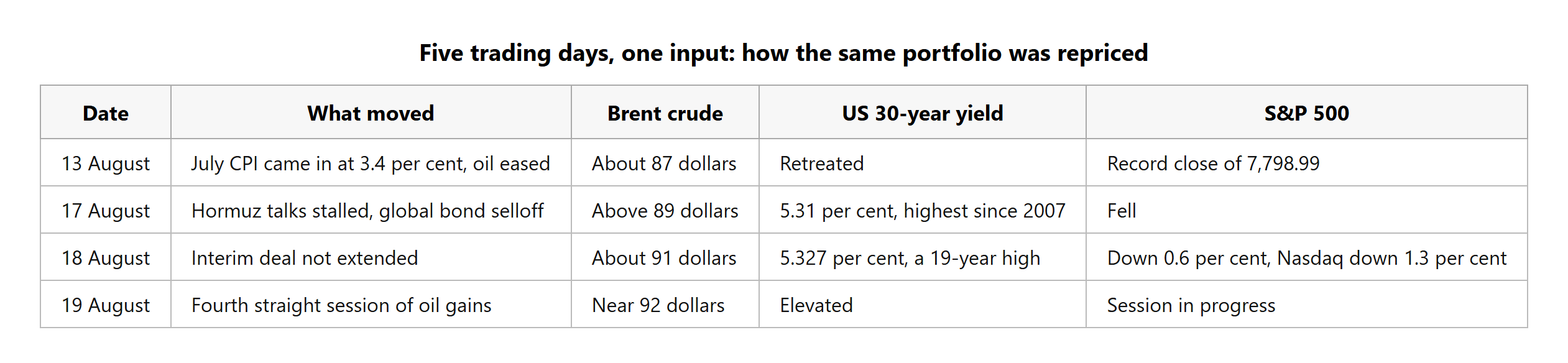
The chain has four links, and each one is mechanical rather than a matter of sentiment.
The first link is the obvious one. Oil is an input to freight, plastics, fertiliser, power generation and the cost of moving every physical good, so a sustained rise in crude raises headline inflation. The July US CPI report showed this working with a lag: energy prices fell 1.5 per cent for the month, but were still up 14.7 per cent over the year, with petrol up 24.6 per cent and fuel oil up 39.1 per cent, per the Bureau of Labor Statistics.
The second link is where it gets interesting. Higher and more volatile inflation changes what lenders demand for parting with money for thirty years. That extra compensation is called the term premium, and it is the piece that has actually moved. The Federal Reserve's target range is 3.50 to 3.75 per cent after it held rates on 29 July. The 30-year Treasury yield touched 5.327 per cent on 18 August, its highest since 2007. The long end sits well above the policy rate, and the gap is not a forecast of Fed hikes. It is the price of uncertainty about inflation over decades, and an oil supply shock is exactly the kind of event that widens it.
The third link is the one most retail investors have never had explained to them. A share price is the value today of profits a company will earn in the future, and the long government bond yield is the base rate used to discount them. Raise that rate and every future rupee of profit is worth less today. The arithmetic is unforgiving for anything long-dated. A dollar of profit expected in ten years is worth about 9 per cent less when discounted at 5.3 per cent instead of 4.3 per cent. Push the same dollar out to thirty years and it loses about 25 per cent of its present value. Nothing about the company has to change for that to happen.
The fourth link is portfolio concentration. The companies whose value sits furthest in the future are high-multiple software and semiconductor businesses, and those are precisely what Indian retail portfolios in US equities are concentrated in. Technology alone accounted for 37.2 per cent of the S&P 500 as at 14 August, per S&P Dow Jones Indices. The sector that benefits from expensive oil, energy, was 3.4 per cent of the index at the end of July. The natural hedge is roughly a tenth the size of the exposure.
There is a fifth point that is not a link in the chain but explains why it keeps operating. The Federal Reserve cannot fix this. A supply shock raises prices and lowers output at the same time, so cutting rates worsens the inflation and raising them worsens the growth hit. That is why the July meeting produced a hold with dissents rather than a decision, and why markets are split, with CME FedWatch pricing roughly a 30 per cent chance of a September hike while prediction markets put the odds of at least one hike this year near a coin flip. When the central bank is boxed in, the oil price sets more of the discount rate than the central bank does.
The dynamics covered in this article affect every US stock in your portfolio. Trade from India on the Winvesta app. No US bank account needed!
🚀 Join 60,000+ investors, become a paying subscriber or download the Winvesta app and fund your account to get insights like this for free!
🏆 Winners and losers when oil sets the discount rate
The pattern is not the one the textbook suggests. Directions below are illustrative and directional, not forecasts.
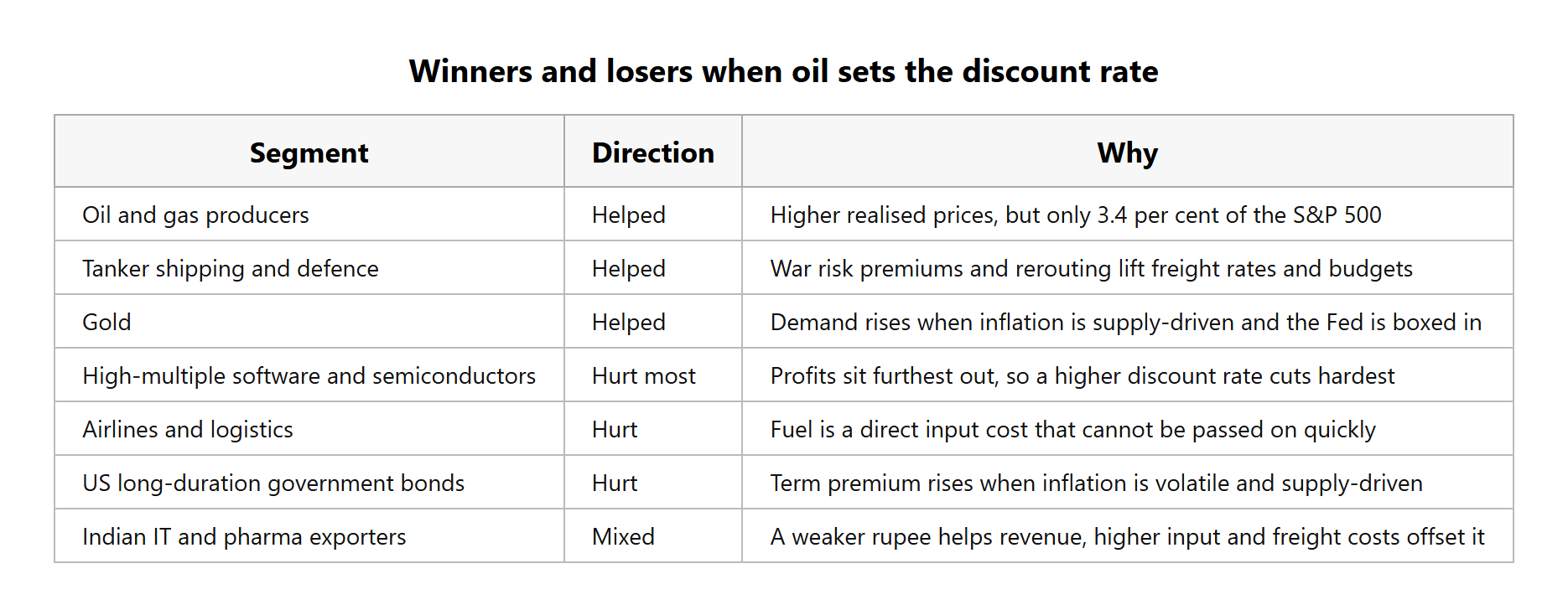
Two of those rows deserve a note. Owning energy stocks as an oil hedge sounds sensible and works badly at index level, because 3.4 per cent of the portfolio cannot offset a repricing of 37.2 per cent of it. And long-dated government bonds, the asset most people hold as protection against equity falls, are being hurt by the same force at the same time. On 18 August the S&P 500 fell 0.6 per cent, the Nasdaq fell 1.3 per cent, and the 30-year yield rose to a 19-year high. Stocks and bonds fell together, which is what happens when the shock is to inflation rather than to growth.
🇮🇳 What this means for Indian investors holding US equities
Every Indian investor holding US equities is exposed to this twice, and the second exposure is the one nobody accounts for.
The first is the one described above. Your Nasdaq holdings get repriced by the US long bond yield, which is being pushed up by an oil shock. The second is that India is the most oil-exposed large economy in the world on the import side. India's crude import dependency ran at 88.7 per cent in FY 2025-26 against consumption of about 5.5 million barrels a day. The crude oil import bill rose 61.2 per cent year on year to 49.8 billion dollars in the April to June quarter alone. When the strait closed, the Indian crude basket went from around 70 dollars to above 120, reaching 113.57 dollars on 11 March per petroleum ministry data.
That flows into the rupee, which is why the currency layer compounds rather than cancels. The rupee sat around 95.7 to the dollar on Wednesday, a three-week low, down about 0.7 per cent over the month and roughly 10 per cent over the year, with higher oil, higher US yields and a risk-off mood all pulling the same way, per Trading Economics. A weaker rupee flatters the rupee value of your US holdings, which is the one piece of good news here. It also raises the cost of every subsequent dollar you remit under LRS to buy those holdings, and it feeds domestic inflation through the same import bill. Estimates of the sensitivity vary by method: a 10 dollar move in crude is put at 30 to 40 basis points of GDP on the current account deficit, and somewhere between 20 and 50 basis points on CPI depending on how much is passed through to retail fuel prices.
India has done more about the supply side than most people give it credit for. Sourcing has moved from around 27 countries a decade ago to more than 40, and the share of crude arriving outside Hormuz has risen from roughly 55 per cent to about 70 per cent, per the petroleum ministry in March. What diversification cannot change is the price. Crude is a global market, so rerouting protects delivery, not cost. LPG is the harder exposure, with close to 90 per cent of imports historically transiting the strait, and more than half of LNG imports as well.
The practical response is not to trade this. Positioning a portfolio for a ceasefire is a bet on a negotiation between two governments that have missed their own deadline. What the situation does argue for is knowing your actual duration. If your US exposure is concentrated in high-multiple technology, you own a leveraged bet on long-term interest rates whether or not you think of it that way, and this is the year to find out how much. Broad index exposure through a systematic monthly investment keeps buying through a repricing rather than guessing at the end of it. And if the entire US position is unhedged tech while the rupee also sits on the wrong side of the same shock, that is a concentration decision, not a diversification one.
🔭 What to watch from here
Transit counts through the strait are the cleanest real-time signal available, and they are public. Lloyd's List Intelligence, Windward and NBC's tracker all publish traffic data. A sustained return towards pre-war levels would do more for equity multiples than any earnings season.
War risk insurance premiums matter more than the headlines about talks. Shipowners commit money, not statements. Premiums easing from the current 3 to 10 per cent of hull value back towards 1 per cent would tell you the market believes a settlement before any communiqué does.
The 30-year Treasury yield is the transmission channel to watch, not the Fed funds rate. Yields have now spent their longest continuous stretch above 5 per cent since before the financial crisis. A move back below 5 per cent while oil stays high would mean the term premium story is fading. Both staying high together is the combination that keeps compressing multiples.
The September FOMC meeting is where the boxed-in problem gets tested. Pay attention to how the statement treats energy prices. A Fed that describes oil inflation as transitory has room to wait, and one that does not has to choose between two bad options.
For the India side, the crude basket price and the monthly import bill are the numbers that decide how much of this reaches domestic inflation and the rupee. The RBI has been intervening daily through dollar sales, which limits volatility but does not change the underlying arithmetic.
If this changed how you read an oil headline, pass it on.
🏁 The bottom line
The oil price is no longer just an input cost. With the Fed unable to offset a supply shock, crude is doing much of the work of setting the long bond yield, and the long bond yield sets the discount rate on every future profit your portfolio owns. That makes high-multiple US technology, the most popular holding among Indian retail investors in US equities, the most oil-sensitive position most of them own, and the energy exposure that would offset it is a tenth of the size. Five trading days took the S&P 500 from a record close to three consecutive falls, without a single company reporting anything. The lesson is not to trade the Gulf. It is to know that a portfolio built entirely on profits arriving in the 2030s is a bet on interest rates, and that a shipping lane currently gets a vote on those.
📊 By the numbers
20.9 million barrels a day: oil flows through the Strait of Hormuz in the first half of 2025, about 20 per cent of global petroleum liquids consumption and a quarter of seaborne oil trade, per the EIA
14.6 million barrels a day: the same flow in the first quarter of 2026, down almost 30 per cent year on year, per the EIA
3 to 10 per cent of hull value: war risk insurance for a Hormuz transit, against about 0.25 per cent before the war
Near 92 dollars: Brent crude on 19 August, a fourth straight session of gains and up about 37 per cent over twelve months, per Trading Economics
5.327 per cent: the US 30-year Treasury yield on 18 August, its highest since 2007, against a Fed funds target range of 3.50 to 3.75 per cent
37.2 per cent versus 3.4 per cent: technology's weight in the S&P 500 as at 14 August, against energy's weight at the end of July, per S&P Dow Jones Indices
7,798.99: the S&P 500's record close on 13 August, followed by three consecutive falls
88.7 per cent: India's crude oil import dependency in FY 2025-26, on consumption of about 5.5 million barrels a day
49.8 billion dollars: India's crude oil import bill for April to June 2026, up 61.2 per cent year on year
Around 95.7: rupees per dollar on 19 August, a three-week low, roughly 10 per cent weaker over twelve months, per Trading Economics
Disclaimer: All content provided by Winvesta India Technologies Ltd. is for informational and educational purposes only and is not meant to represent trade or investment recommendations. Remember, your capital is at risk. Terms & Conditions apply.
The chain you describe is exactly what I see with salaried clients whose US SIPs are concentrated in tech.
The rupee layer is the one they consistently miss — LRS remittance costs plus import-driven CPI compounds the repricing.
Duration awareness and systematic investing beat any attempt to time a ceasefire.