


Nearly a third of what an Indian investor made on US stocks this year came from the rupee, not from the stocks. The Reserve Bank has just spent four months building a wall to stop that from happening again, and it raised 136 billion dollars doing it. Knowing which half of your return is the market and which half is the currency is the difference between reading the next year and being confused by it. That's why we built Winvesta Crisps: to break down what's actually moving markets, in plain language, before the consensus catches up. 60,000+ investors from all over India are already in. What about you?
🔔 Don't miss out!
Add winvestacrisps@substack.com to your email list so our updates never land in spam.
On 8 June the Reserve Bank of India opened a special dollar-rupee swap window and told banks it expected to raise 50 to 60 billion dollars. By mid-August the internal estimate had been lifted to 80 billion. When the window shut on 31 August, a full month ahead of schedule, it had pulled in 136.37 billion dollars. Foreign exchange reserves hit a record 740.80 billion dollars in the week to 28 August, a ninth consecutive weekly rise, and the rupee, which had touched an all-time low of 96.82 on 20 May, was trading near 94.50 this week. Most coverage has read that as a good news story about a central bank winning. For anyone holding US equities from India it is something more specific: the machinery that quietly added several percentage points to your rupee returns every year has just been switched off, and the reason it was switched off is that somebody borrowed 136 billion dollars to do it.
🏦 How the rupee got to 96 and what the RBI pulled off the shelf
The rupee opened 2026 in the 89.85 to 90.00 range. Nothing in India's own numbers explains what happened next. Growth held up, inflation stayed inside the target band, and the RBI's August policy meeting actually raised its FY2026/27 growth forecast to 6.7 per cent from 6.6 per cent and trimmed its inflation forecast to 5.0 per cent from 5.1 per cent.
What broke the rupee was oil. When the West Asia conflict escalated in late February and US and Israeli strikes on Iran effectively closed the Strait of Hormuz, Brent went from around 80 dollars to 120 dollars a barrel in under a week. India imports the overwhelming majority of the crude it burns, and every dollar on the barrel is dollars that have to be bought with rupees. The currency broke 90 in late February, crossed 95 for the first time in late March, and set fresh all-time lows in five of seven sessions in the third week of May, bottoming at 96.82 on 20 May before closing at 96.20 the next day once the RBI intervened. That is close to an 8 per cent fall in under five months, driven almost entirely by something happening 2,000 miles away.
Central banks have two ways to defend a currency in that position. They can sell reserves, which works until the reserves run low and the market notices. Or they can go and get more dollars. The RBI chose the second, using a tool it had used exactly once before.
In 2013, with the rupee under similar pressure, Governor Raghuram Rajan opened a swap window that raised 34 billion dollars, of which about 26 billion came through Foreign Currency Non-Resident Bank deposits on three-year tenors. Banks got to swap those dollars into rupees with the RBI at a concessional 3.5 per cent a year, roughly 3 percentage points below the market rate at the time. It stabilised the currency and it is remembered as a success.
The 2026 version is the same idea, built more generously. Rather than offer a discounted rate, the RBI agreed to absorb the hedging cost entirely on fresh three to five year FCNR(B) deposits booked in the window, which works out to about a 3 percentage point subsidy against prevailing swap rates of 2.8 to 3.3 per cent for those tenors. Eligible deposits were also exempted from cash reserve ratio and statutory liquidity ratio requirements, so banks did not have to park a slice of the money with the RBI, and each carries a one-year lock-in. FCNR(B) rates on offer to non-resident depositors went as high as about 7 per cent as a result.
The response was four times what the RBI first asked for. FCNR(B) deposits alone crossed 100 billion dollars to reach 127.2 billion. Overseas foreign currency borrowings added 5.26 billion and external commercial borrowings 3.891 billion. The RBI closed the deposit window on 31 August instead of 30 September, leaving banks until 11 September to complete the swaps themselves.
⚙️ Why 740 billion dollars of reserves is not 740 billion dollars
Work through what actually happens in one of these transactions, because the accounting is where the story is.
A non-resident Indian parks 100,000 dollars in a three-year FCNR(B) deposit at an Indian bank. The bank now holds dollars but does almost all of its lending in rupees, so it has a currency mismatch it has to cover. Normally covering that costs it 2.8 to 3.3 per cent a year, and that cost comes straight out of the interest rate it can offer the depositor. Under this window, the bank hands the dollars to the RBI, receives rupees, and the RBI commits to reverse the trade at a pre-agreed rate when the deposit matures. The bank carries no currency risk and pays no hedging cost, so it can offer the depositor a far better rate. The RBI ends up holding the dollars.
Three things follow, and they pull in different directions.
The reserves number goes up, which is the point. A larger stack makes betting against the rupee more expensive, and traders price that in before the RBI has to spend a cent.
Rupee liquidity floods the banking system, which was not the point. Every dollar taken in released rupees into the system. Core banking liquidity was already above 8 trillion rupees by 15 August and was expected to cross 10 trillion rupees in September. Prasanna Tantri of the Indian School of Business puts the foreign-currency-driven contribution at roughly 7.7 lakh crore rupees, close to the Covid-era peak of about 9.5 lakh crore. That much surplus cash sitting in the system is an inflation problem waiting one to two years out, and it constrains what the RBI can do on rates in the meantime.
The dollars are borrowed, not earned, which is the part the headline reserves figure hides. A swap is a promise to give the dollars back. The RBI's net short forward dollar position hit a record 137 billion dollars in July, up from about 104 billion in June, and most of that jump is these longer-duration swaps. So the record 740.80 billion dollars of gross reserves sits alongside a 137 billion dollar forward obligation running against it. Tantri estimates India's external debt could rise from around 765 billion dollars towards 900 billion as a result, and the repayments cluster from 2029, when the three-year deposits mature.
Rajan's window is the useful precedent on the way out. When the 2013 deposits matured between September and November 2016, the RBI had pre-covered roughly 80 per cent of the 26 billion dollars through forward contracts, reserves had been rebuilt to 365 billion dollars over three quiet years, the net redemption after rollovers came to about 20 billion dollars, and the RBI injected 10,000 crore rupees of open-market bond purchases to smooth the liquidity squeeze. It was managed calmly and nothing broke. The FCNR(B) piece this time is nearly five times larger, and whether 2029 is as quiet as 2016 is not something anyone gets to know in advance.
The dynamics covered in this article affect every US stock in your portfolio. Trade from India on the Winvesta app. No US bank account needed!
🚀 Join 60,000+ investors, become a paying subscriber or download the Winvesta app and fund your account to get insights like this for free!
🏆 Winners and losers from a rupee that stops falling
Currency defence is not a neutral act. It moves money from one set of balance sheets to another, and the split is fairly predictable once you know who holds dollars and who owes them.
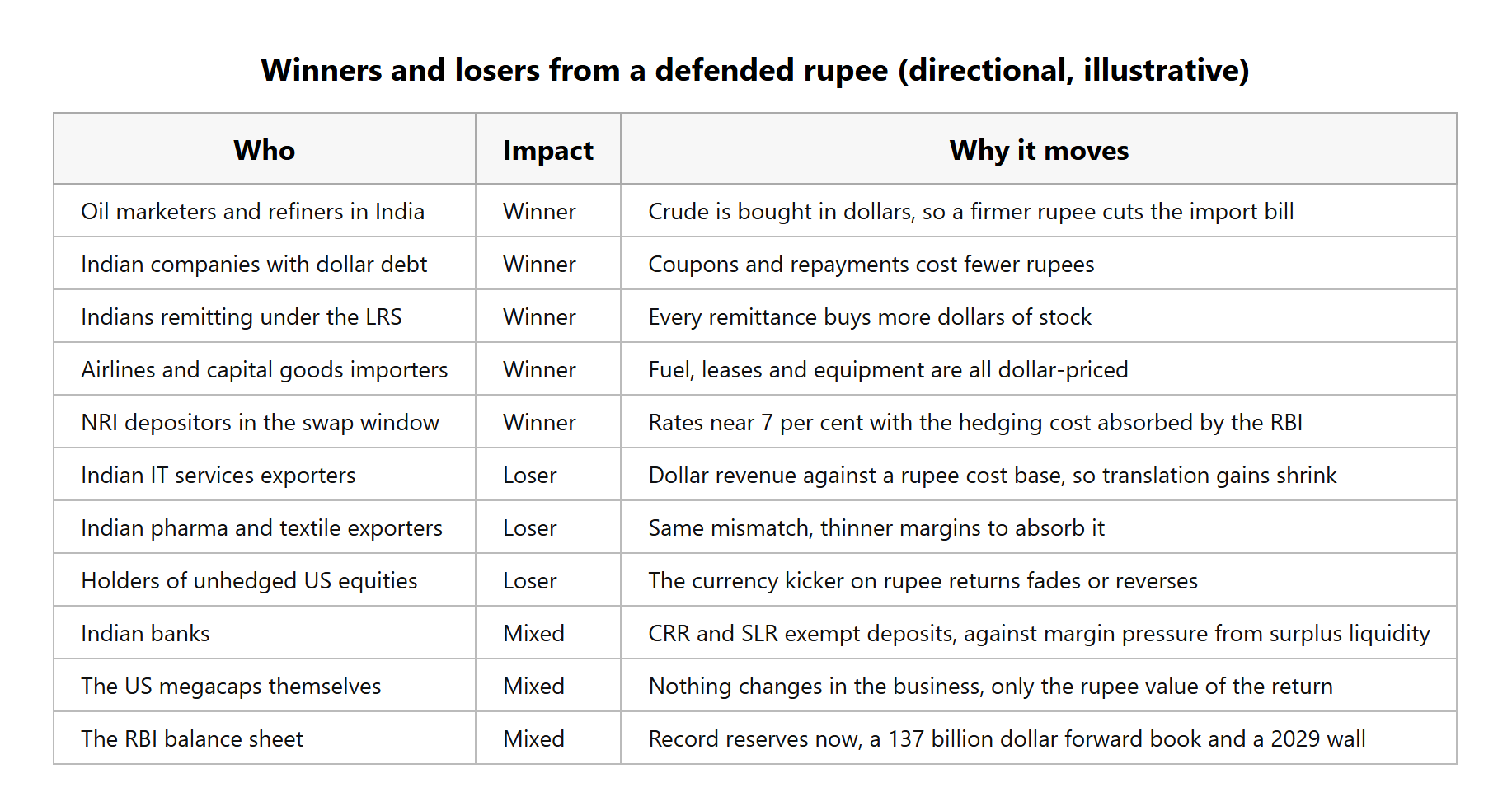
The pattern worth noticing is that the same policy sits on both sides of most Indian portfolios at once. An investor who owns Infosys and also owns an S&P 500 index fund has been paid twice by a falling rupee and now faces a mild headwind on both. That is not a reason to do anything dramatic. It is a reason to stop treating the two positions as independent bets.
🇮🇳 What this means for an Indian investor holding US equities
Every unhedged US stock position held from India is two positions. There is the stock, and there is a bet against the rupee that nobody consciously placed. Most of the time nobody notices, because the rupee's drift against the dollar is slow and in one direction. In a year like this one it stops being a footnote.
Run the numbers on 2026 so far. The S&P 500 is up about 12.3 per cent on price through 8 September, or 12.9 per cent including dividends. The rupee went from roughly 89.90 at the start of January to about 94.50 now, so a dollar buys 5.1 per cent more rupees than it did. Multiply the two and a rupee investor is up around 18 per cent on an index that gained 12.3 per cent.
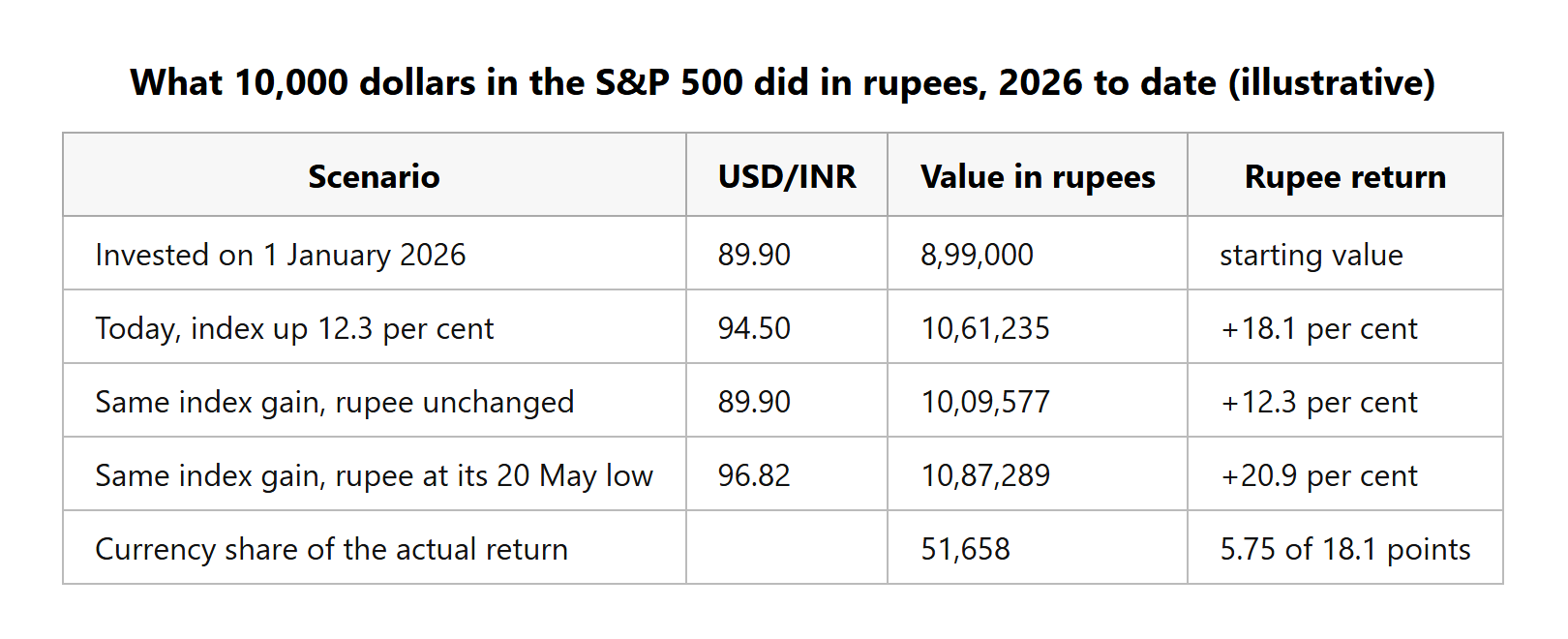
Nearly a third of that return had nothing to do with American companies. It came from India's oil import bill and a closed shipping strait.
Now run it the other way, which is what the RBI has just done. Had the rupee stayed at its 20 May low of 96.82 rather than recovering to 94.50, the same holding would be worth about 10.87 lakh rupees instead of 10.61 lakh. That is roughly 26,000 rupees, or 2.9 percentage points of return, that the successful defence of the rupee removed from the portfolio of someone who was already invested. There is no villain in that sentence. It is arithmetic, and it runs in reverse for anyone still buying.
Which points at the split that actually matters. If you are still adding to a US portfolio, a stable-to-stronger rupee is straightforwardly good: every remittance buys more dollars of stock. Indians have been doing exactly that at pace, with outward remittances under the Liberalised Remittance Scheme reaching 2.5 billion dollars in June, up nearly 20 per cent year on year, of which 456.7 million dollars went into equity and debt, more than double the year before. The April to June quarter alone put 1.06 billion dollars into overseas equity and debt, against 28.98 billion dollars of total LRS outflows across all of FY26. If you are done accumulating and simply holding, the same policy trims your rupee returns and the drag compounds quietly.
The one thing worth resisting is treating this as a reason to hedge the currency. Retail rupee hedges over multi-year horizons cost more than the volatility they remove for most portfolios, and the RBI's own 137 billion dollar forward book is a reminder that the party on the other side of that trade is very well informed. The better response is knowing the number: what share of your US returns to date is stock picking and what share is the rupee.
🔭 What to watch
Five things would tell you whether the wall holds, and each one is checkable.
The weekly reserves release, published by the RBI every Friday. The number to separate out is organic accumulation from swap-driven accumulation. With the swap window shut from 11 September, a reserves figure that keeps climbing means real inflows. One that stalls means the 740.80 billion dollar record was the peak of a one-off operation.
The core liquidity print and what the RBI does about it. If surplus liquidity crosses 10 trillion rupees this month, expect variable rate reverse repo auctions or open market bond sales to drain it. Aggressive draining signals that the RBI is worried about the inflation consequences, which changes the rate path regardless of what growth does.
The 94 and 96 levels on USD/INR. Analyst forecasts compiled over the past month mostly cluster near 94 over the next three to six months with a drift back toward 96 in 2027, and a 93 to 96 range for the rest of this year. A clean break below 94 says the defence is working better than expected. A move back through 96 says 136 billion dollars bought a few months.
Brent crude and the Strait of Hormuz, because that is the actual cause and nothing else has changed about it. Traffic through the strait ran at 4.9 million barrels a day in the second quarter against roughly 21.6 million before the conflict, per the US Energy Information Administration. Reopening would do more for the rupee than any swap window.
The Federal Reserve on 16 September. Markets have been pricing meaningful odds of a rise, which would widen the dollar-rupee rate gap and pull capital back towards the United States. That is the first serious test of a wall built in calm conditions.
If this changed how you read the next reserves headline, pass it on.
🏁 The bottom line
The RBI has done something defensible and expensive. Faced with an oil shock it could not control and a currency setting records in the wrong direction, it chose to borrow dollars from non-resident Indians on subsidised terms rather than burn reserves it had spent years accumulating. The rupee stopped falling, reserves hit a record, and the bill is dated 2029.
For an Indian investor holding US equities, the practical consequence is narrower than the policy debate. The currency tailwind that has flattered rupee returns on US portfolios for most of a decade is being actively fought by the institution best placed to fight it, and it has 136 billion dollars of ammunition plus a 740.80 billion dollar reserve stack behind that fight. None of that is an argument against owning US stocks, which you own for the earnings of companies India does not have. It is an argument for knowing that a good chunk of what you thought was investing skill in 2026 was the rupee, and for not budgeting for it again.
📊 By the numbers
136.37 billion dollars: total inflows through the RBI's special swap facility to 31 August, against an initial expectation of 50 to 60 billion, later revised to 80 billion
127.2 billion dollars: the FCNR(B) deposit share of that, with 5.26 billion from overseas foreign currency borrowings and 3.891 billion from external commercial borrowings
740.80 billion dollars: record foreign exchange reserves in the week to 28 August, up 11.47 billion on the week and up 49.70 billion since the end of March
137 billion dollars: the RBI's net short forward dollar position in July, a record, up from about 104 billion in June
96.82 and 94.50: the rupee's all-time low on 20 May and its level this week, from roughly 89.90 at the start of January
About 7.7 lakh crore rupees: the foreign-currency-driven addition to surplus banking liquidity, per Prasanna Tantri of ISB, against a Covid-era peak near 9.5 lakh crore
765 to 900 billion dollars: India's external debt now, and where Tantri estimates it heads as a result of this operation
5.75 percentage points: the share of a rupee investor's roughly 18 per cent gain on the S&P 500 this year that came from the currency rather than the index
2029: when the three-year deposits raised in this window come due
Disclaimer: All content provided by Winvesta India Technologies Ltd. is for informational and educational purposes only and is not meant to represent trade or investment recommendations. Remember, your capital is at risk. Terms & Conditions apply.