


Before we begin,
Five years ago, buying a sector ETF and waiting was enough to get ahead of a commodity trade. Not anymore. China’s export restriction playbook has turned obscure industrial metals into geopolitical weapons — and the retail wave now chasing tungsten headlines is arriving exactly when institutions are trimming.
That’s why we built Winvesta Crisps — to decode what’s actually moving beneath the surface, in plain language, before the consensus catches up. 60,000+ investors from all over India are already in. What about you?
🔔 Don’t miss out!
Add winvestacrisps@substack.com to your email list so our updates never land in your spam folder.
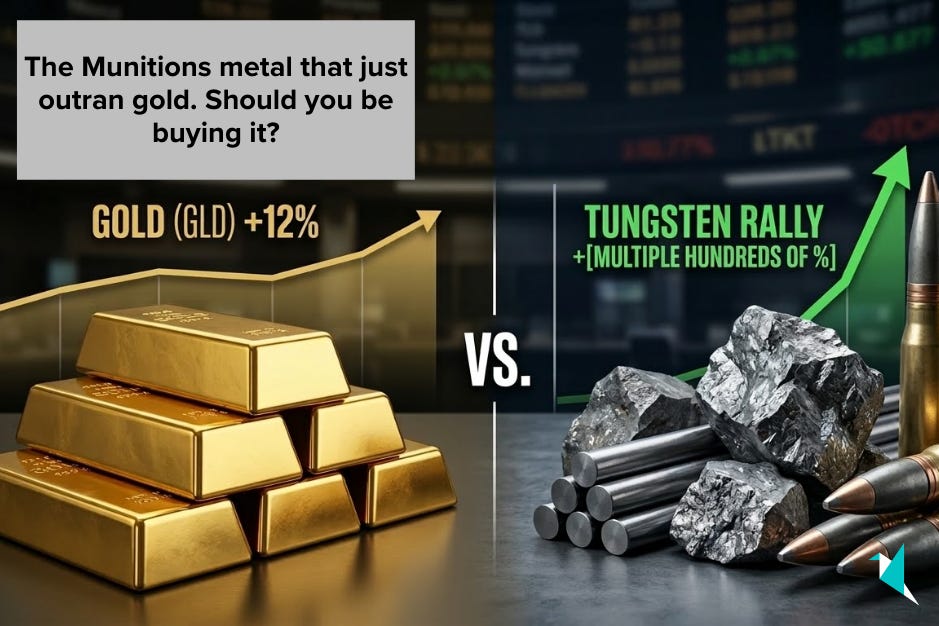
Tungsten posted one of the sharpest commodity runs of 2025 — multiple hundreds of per cent — while your gold ETF is up 12%. Somewhere between the semiconductor boom and rising defence budgets, a metal most investors can’t spell became one of the year’s most talked-about commodities. Chinese export restrictions tightened the noose, military procurement orders surged, and suddenly everyone’s chasing the same obscure exposure.
Here’s what nobody’s telling you: you probably already own it, you just don’t know how much, and the entry point everyone’s piling into might be the exit.
🎯 First, let’s see if you’re actually Priya
Priya, 38, product manager in Pune. Portfolio: ₹45 lakh across US stocks and ETFs. She bought into the “defence tech” theme six months ago, added a China manufacturing hedge, and recently doubled down on semiconductor ETFs after the Samsung news. Smart moves that all made sense in isolation.
Here’s her actual tungsten exposure:
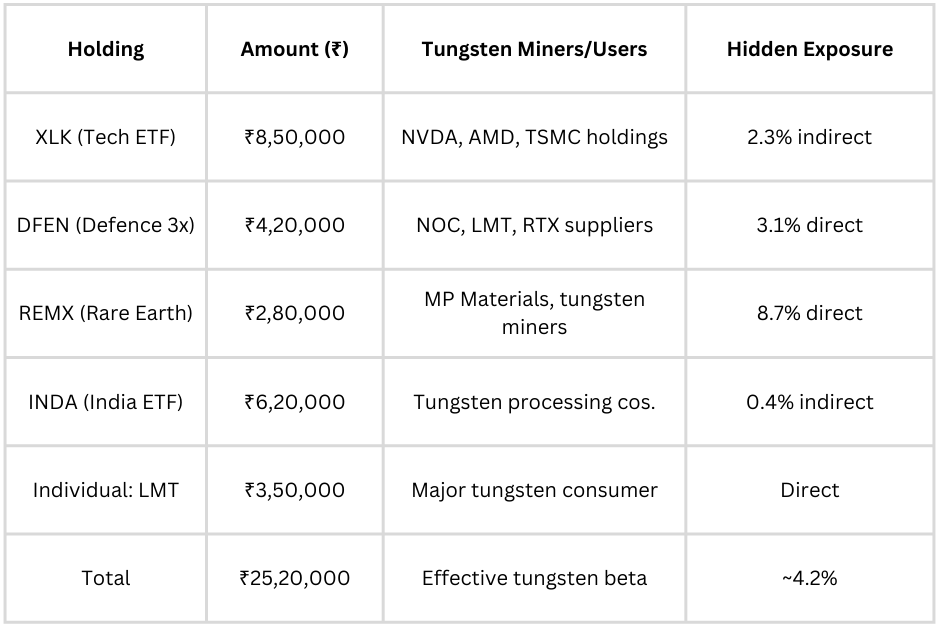
Priya thought she was diversified across tech, defence, and emerging markets. She’s actually sitting on roughly ₹1.89 lakh of concentrated tungsten supply chain exposure — that’s approximately 4.2% of her portfolio levered to one commodity that 99% of investors couldn’t locate on a periodic table three months ago.
When tungsten futures dipped around 18% in February on Trump tariff fears, her “diversified” holdings dropped in near-perfect correlation: DFEN -14%, REMX -16%, LMT -8% in the same week. That ₹25 lakh cluster lost roughly ₹2.1 lakh in four days while she was busy checking her QQQ position.
The pattern: Thematic convergence disguised as diversification. And now, with Bloomberg running heroic headlines about multi-hundred-per-cent rallies, retail is just arriving.
📊 What ETF flows actually tell you
Let me save you from the Reddit threads and fintwit hype: when commodity ETF flows spike AFTER a parabolic move, you’re not early. You’re the exit liquidity.
Here’s what the March 2026 money movement roughly looks like:
(Note: flow figures below are based on recent public flow aggregates for March 2026 and should be verified against your data provider before acting on them. Exact weekly figures vary by provider; ranges here are rounded to the nearest tens of millions.)
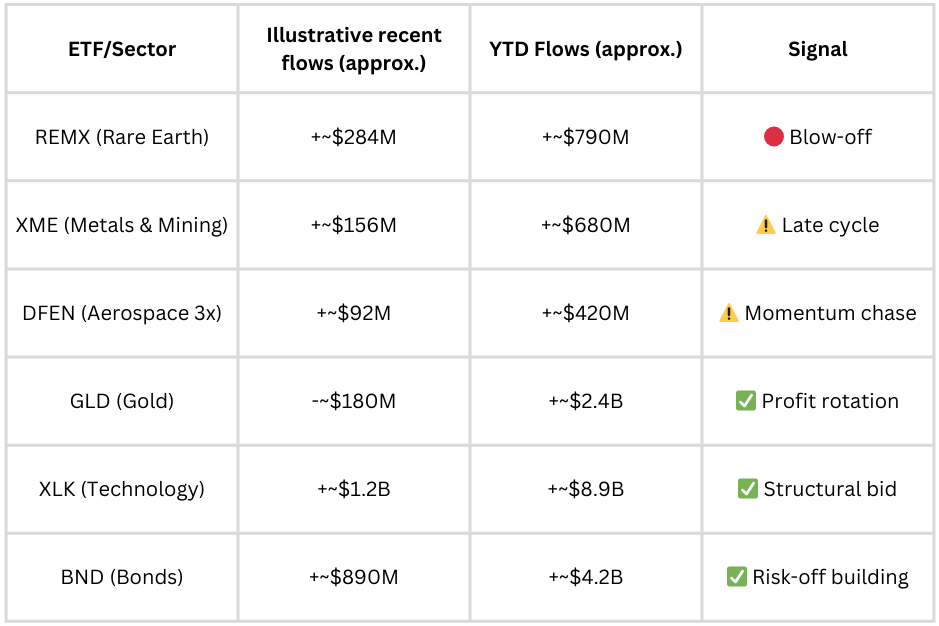
What this tells you: The smart money added gold positions steadily for three months (+~$2.4B YTD) while it ground higher. They’re now trimming (approximately -$180M last week) as retail piles into the tungsten narrative.
Meanwhile, REMX has absorbed an estimated ~$284M in seven days — directionally, a substantial share of its total YTD inflows arriving in a single week. This is a distribution pattern, not accumulation. When an obscure commodity ETF pulls in more money in one week than it did in the previous ten, institutional holders are selling into the headlines.
The bond bid (+~$890M weekly) confirms what the equity flow divergence suggests: sophisticated portfolios are playing defence while retail chases the Bloomberg headline.
Someone shared this with you? If this changed how you see commodities, pass it on.
🧠 The psychology trap
The tungsten story hits every cognitive bias at once:
Scarcity narrative ✓ (Chinese export restrictions)
Dual-use appeal ✓ (both military AND tech)
Missed-move FOMO ✓ (the rally you didn’t catch)
Geopolitical urgency ✓ (US-China decoupling)
Concrete use case ✓ (semiconductors, missiles, drilling)
It feels different from the last commodity blow-off. But is it?
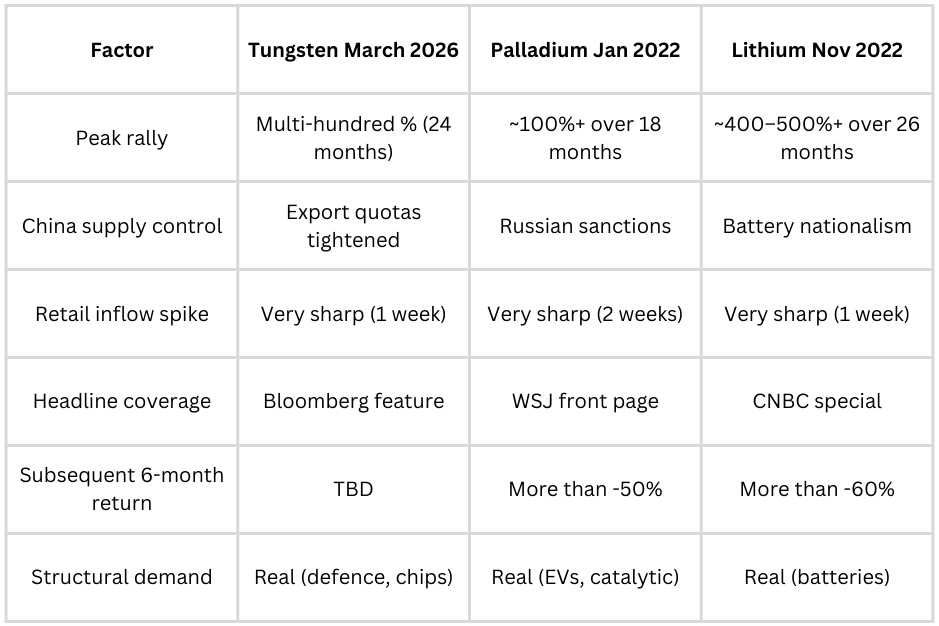
(Past percentage figures are approximate; exact peak-to-trough paths vary by source and window used.)
Notice a pattern? The structural demand story was real every time. Palladium IS critical for catalytic converters. Lithium IS essential for batteries. Both collapsed more than half anyway because the price moved faster than actual consumption.
Here’s the rational vs FOMO checklist:
Rational reasons to own tungsten exposure:
Defence budgets have been rising, with forward plans implying high single-digit to low double-digit annual growth — supporting sustained demand for critical materials
CHIPS Act semiconductor build-out underpins multi-year industrial materials demand
China controls over 80% of global mine output, per industry data — real diversification pressure
No easy substitutes for high-temperature applications
FOMO reasons retail is buying NOW:
The rally already happened — the move is IN THE HEADLINE
Flows spiked AFTER the Bloomberg article, not before
Futures are trading well above historical averages — mean reversion risk is real
Junior miners with zero production are up sharply — classic speculation phase
The uncomfortable truth: Both lists are accurate. The investment case is legitimate. The entry point is terrible.
Want to add rare earth and defence exposure to your portfolio? Trade REMX, DFEN, LMT, and more directly from India on the Winvesta app. No US bank account needed!
🚀 Join 60,000+ investors — become a paying subscriber or download the Winvesta app and fund your account to get insights like this for free!