


Most investors watch the Fed’s rate decisions and stop there, treating every meeting as a pure read on inflation and jobs. That stopped being the whole story sometime in the last twelve months. Since August 2025, the Fed has been through an attempted firing of a sitting governor, a chair transition under open White House pressure for lower rates, and a bond and gold market that has started charging a price, right now, for the possibility that future rate decisions stop being purely economic. That’s why we built Winvesta Crisps, to break down what’s actually moving markets, in plain language, before the consensus catches up. 60,000+ investors from all over India are already in. What about you?
🔔 Don’t miss out!
Add winvestacrisps@substack.com to your email list so our updates never land in spam.
On June 30, 2026, at a central banking conference in Sintra, Portugal, the chair of the Federal Reserve stood up and said something that used to go without saying. Kevin Warsh told the room that if businesses and households expected the Fed to tolerate inflation above 2%, they’d be disappointed, and that the Fed had been independent of politics for a very long time and intended to stay that way. A sitting Fed chair having to state this out loud, at an international forum, is itself the story worth paying attention to.
For most of the Fed’s history, its independence from the White House was assumed rather than argued for. It was priced into every bond, every dollar, every rate decision, without anyone needing to say it. That assumption came under direct, sustained pressure over the past year, in a way that has no precedent in the Fed’s 112-year history. And once a market stops assuming something, it starts pricing it. That’s exactly what has been showing up in gold, in long-term Treasury yields, and in the rupee you convert every time you fund or withdraw from a US brokerage account.
🏛️ Why the Fed’s independence is suddenly a market question
The Federal Reserve Act of 1913 built a specific kind of insulation into the American central bank. Governors serve 14-year terms, staggered so that no single president can appoint a majority of the board in one term. The chair serves a renewable four-year term. Governors can be removed only “for cause”, understood for over a century to mean serious misconduct, not disagreement over interest rate policy. No president had ever attempted to remove a sitting governor mid-term, until 2025.
The reasoning behind this design is straightforward once you see it. Elected officials face an obvious short-term incentive to keep money loose and rates low, especially heading into an election, because looser policy feels good in the near term even when it stores up inflation for later. Central bank independence exists specifically to take that incentive out of the room.
The clearest historical case of what happens when it doesn’t stay out of the room is Richard Nixon and Fed chair Arthur Burns. Nixon spent much of 1971 pressuring Burns, a friend and his own appointee, to loosen policy ahead of the 1972 election. Burns held out for a time, then shifted toward expansionary policy that autumn. Nixon won a landslide re-election in November 1972. Wage and price controls temporarily held inflation near 3.3% through 1972, but the underlying pressure didn’t disappear, it deferred. Inflation climbed through the rest of the decade and into double digits by the late 1970s. Breaking it took Paul Volcker pushing the federal funds rate above 19% in the early 1980s, and a deliberately induced recession that lasted years. Nothing about the Nixon-Burns episode looked like a crisis in real time. The bill simply arrived later, and it was large.
The current episode has moved much faster, and through a different mechanism. In August 2025, President Trump moved to fire Federal Reserve Governor Lisa Cook, citing mortgage fraud allegations from before her 2022 appointment that she has denied and has not been charged with. Cook sued, arguing the president lacks the authority to remove a governor without cause, and a federal court blocked her removal while the case proceeded. In June 2026, the Supreme Court ruled 5-4 that Trump could not remove Cook for now, though it stopped short of deciding whether a president ultimately has that power at all. The case continues.
In January 2026, separate reporting of an investigation touching then-Fed chair Jerome Powell rattled markets within hours, gold and silver jumped, and Nasdaq futures fell on fears of what commentators called a direct assault on Fed independence. Later that month, Trump nominated Kevin Warsh, a Fed governor from 2006 to 2011, to succeed Powell as chair. Warsh took office on May 22, 2026. His first FOMC meeting, held June 17-18, left rates unchanged at 3.50% to 3.75%, but the accompanying projections were hawkish: the median year-end 2026 rate forecast rose to 3.8%, up from 3.4% in March, with nine of the eighteen officials now projecting at least one hike this year rather than a cut. His Sintra remarks a fortnight later effectively ruled out the near-term cuts the White House has been requesting.
All of this is unfolding against a backdrop where the inflation data gives Warsh genuine cover to stay hawkish. May’s CPI came in at 4.2% year on year, a three-year high, with core PCE running at 3.4%, both well above the Fed’s 2% target. June payrolls added a modest 57,000 jobs, with unemployment ticking down to 4.2%. The Fed’s July 28-29 meeting, the one concluding as this goes out, was widely expected to hold rates steady, though markets had priced in roughly a one-in-three chance of a hike at this meeting and close to four-in-five odds of one by September.
⚙️ How markets actually price a political risk premium into interest rates
Pricing in a hawkish surprise or a soft jobs report is routine. What’s happening now is different in kind: markets are pricing the possibility that the entire process generating future rate decisions has become less anchored to economic data alone, and they are doing it before anyone knows how the Lisa Cook case, or the broader standoff, actually resolves.
The clearest channel is the term premium, the extra compensation bond investors demand for holding a long-dated Treasury instead of rolling over short-term paper. A 10-year Treasury yield is really two things stacked together: the market’s expectation of where short-term rates will average over the next decade, and this separate term premium for the risk that things don’t go as expected. For most of the 2010s, that term premium sat near zero, sometimes even negative, because investors trusted the Fed’s process enough that they didn’t feel they needed extra compensation for the uncertainty. It has been rising since 2022, and spiked above 0.8% in January 2025, its highest level since 2011, according to the New York Fed’s own term premium model, driven by fiscal and political uncertainty rather than a change in the Fed’s actual policy stance. The 10-year yield itself climbed to around 4.6-4.7% through late July 2026, its highest since January 2025, with tariff and Middle East oil concerns doing some of that work alongside the independence question.
Gold is the second channel, and here the story is unusually explicit. Gold has always responded to real interest rates and inflation expectations, but strategists at Goldman Sachs and elsewhere have gone further this cycle, tying part of the rally directly to Fed independence risk and arguing that even a small shift in demand away from Treasuries and toward gold, as insurance against policy error, could push prices meaningfully higher from here. Gold set an all-time high above $5,500 an ounce in late January 2026, spiking within hours of the Powell investigation reports, before easing back to the $4,000-4,100 range by late July, still up more than 20% year on year. That pattern, a sharp jump on independence-related headlines rather than on growth or inflation surprises, is the signature of a political risk premium rather than an ordinary inflation hedge.
The dollar is the messier third channel, and worth being honest about rather than tidying up. A currency that’s supposed to be the world’s ultimate safe haven doesn’t move in one clean direction just because investors start doubting the institution that manages it. Through parts of 2026 the dollar weakened on Fed-cut expectations and independence jitters together. At other points, hawkish repricing and oil-driven inflation fears from Middle East tensions pushed it back up, with the Dollar Index spending most of the year in the high-90s to low-100s range. Fed independence risk is one force acting on the dollar. It is not the only one, and cyclical or geopolitical forces can dominate it over any given month.
Turkey offers the sharpest contrast to the slow-burn Nixon-Burns story, and shows what the fast version of this problem looks like. President Erdogan fired four central bank governors between 2019 and 2021 over disagreements about interest rates. The most consequential firing was Naci Agbal, who stabilised the lira with aggressive hikes through late 2020 only to be dismissed in March 2021 for doing exactly that. The rate cuts that followed sent the lira into open crisis: it lost close to 30% against the dollar in November 2021 alone, and roughly 40% over two months, while inflation climbed past 20% on its way to far higher levels later. Restoring any credibility required Turkey’s central bank to raise its policy rate all the way to 42.5% by December 2022, a far more painful path than simply never firing Agbal in the first place would have been.
Neither case says the United States is anywhere near Turkey’s outcome. What both cases show, at opposite speeds, is the same underlying mechanism: once a market concludes that a central bank’s decisions might be political rather than purely economic, it doesn’t wait for proof. It reprices immediately, in yields, in gold, in the currency, and the cost of later proving that independence actually held tends to run far higher than the cost of never putting it in doubt.
The dynamics covered in this article affect every US stock in your portfolio. Trade from India on the Winvesta app. No US bank account needed!
🚀 Join 60,000+ investors, become a paying subscriber or download the Winvesta app and fund your account to get insights like this for free!
🏆 Who benefits and who’s exposed if the independence question stays live
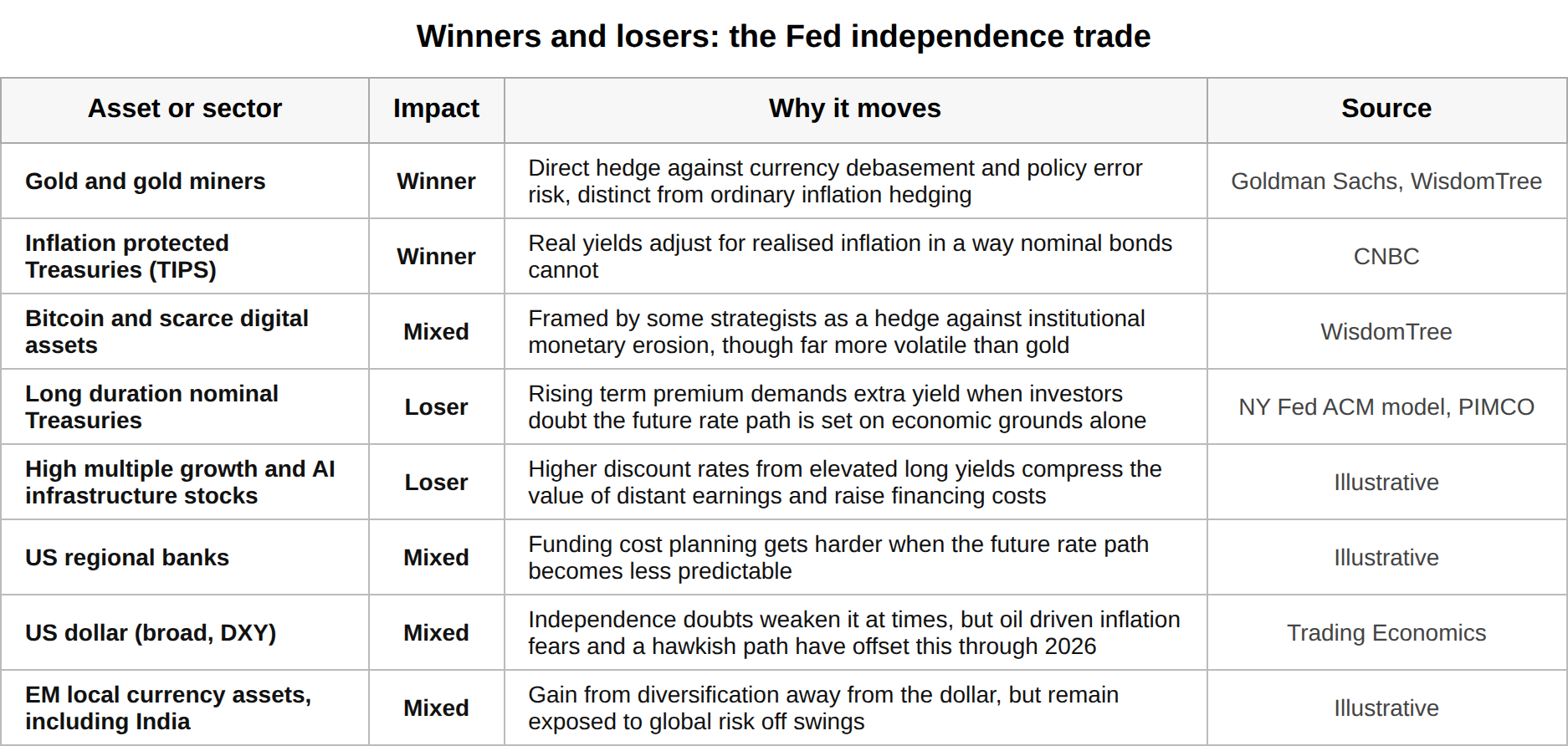
Not every asset class reacts to this story the same way, and some of the instinctive plays deserve a second look before you make them.
Gold sits at the centre of the trade for a specific reason beyond the usual inflation-hedge logic: it is one of the few assets that gains directly from doubts about the institution managing the currency itself, rather than from the ordinary business cycle. Inflation-protected Treasuries capture a related but distinct idea, since their payouts adjust for realised inflation in a way nominal bonds can’t, though they still carry duration risk if real yields move against you. Bitcoin and similar assets get framed by some strategists as a hedge against the same institutional risk, though the comparison to gold’s centuries of central bank demand and lower volatility only goes so far.
On the other side, long-duration nominal Treasuries carry the most direct exposure, since a rising term premium is effectively the bond market demanding a discount for uncertainty that has nothing to do with growth or inflation forecasts. High-multiple growth stocks and debt-financed AI infrastructure spending sit close behind, because a higher discount rate compresses the value of earnings that are years away and raises the cost of the capex those companies are committing to. Regional banks face a subtler version of the same problem: planning around funding costs gets harder when the future path of rates is less predictable for reasons unrelated to the economy they actually lend into.
🇮🇳 What this means if you’re an Indian investor holding US assets
The rupee is the most direct line from this story to your portfolio. It has weakened to levels near 96-97 to the dollar through July 2026, among the weakest on record, with the Reserve Bank of India intervening through state-run banks and dollar-mobilisation measures that have drawn in roughly $32 billion. A meaningful share of that pressure is coming from oil, given the Iran-related tensions around the Strait of Hormuz covered elsewhere in this newsletter. Fed independence risk adds a second, more structural layer underneath the oil story: every swing in how confident markets are about the Fed’s process shows up as added volatility in the exchange rate you convert through the moment you fund or withdraw from a US brokerage account.
If you hold any US Treasury exposure as the defensive sleeve of a US portfolio, it’s worth understanding why yields are elevated rather than just noting that they are. A term premium rising because of political uncertainty behaves differently from one rising because the Fed is genuinely fighting inflation, and it can persist even if growth slows, which changes how reliably that sleeve actually protects you in a downturn.
Gold ETFs accessible through platforms like Winvesta sit at the direct centre of this specific story, not as a generic defensive afterthought but as a position that responds to headlines about Fed governance the way it once mainly responded to recession fears or dollar cycles. That’s a different rationale from the de-dollarisation and stagflation framing covered in earlier editions of this newsletter, even though the asset is the same.
On the equity side, the AI capex names covered in an earlier edition carry a direct link here too. Businesses committing hundreds of billions to debt-financed infrastructure are more exposed to a persistently elevated term premium than businesses funding growth out of existing cash flow, regardless of how strong the underlying AI demand story is.
None of this argues for exiting US equities or abandoning dollar assets. It argues for treating Fed independence risk as its own distinct line item in how you think about currency exposure, bond duration, and gold allocation, separate from the ordinary cyclical calls on growth and inflation that this newsletter usually covers.
🧭 The signals that tell you whether this resolves or escalates
A handful of concrete developments will tell you more than the daily headline noise.
The Lisa Cook case remains the clearest legal signal. The Supreme Court’s June 2026 ruling kept her in her seat while the underlying question, whether a president can remove a Fed governor without cause, stays unresolved. A final ruling either way will matter more to the credibility of the institution than any single rate decision.
Each subsequent FOMC dot plot is worth reading for direction rather than the headline rate decision alone. Further hawkish drift, more officials projecting hikes rather than cuts even as growth cools, would suggest the committee is leaning into independence over accommodation. A sudden dovish reversal without a clear data justification would raise the opposite question.
Kevin Warsh’s public communications are a genuine leading indicator. Continued independence-asserting language in the mould of the Sintra remarks signals the institution is holding its ground. Any visible softening under pressure would be a meaningfully different signal.
The 10-year term premium itself, published by the New York Fed and freely trackable, is the cleanest quantitative gauge. A further rise with no corresponding change in growth or inflation data is close to a direct read of political risk pricing, separate from the economic cycle.
Gold’s relationship with real yields is worth watching for the same reason. Gold typically falls when real yields rise, since it pays no yield of its own. If gold keeps climbing even as real yields rise, that divergence is one of the more reliable tells that the political risk premium, not the ordinary inflation hedge, is doing the work.
Any further personnel moves, new board nominations, additional legal challenges to sitting governors, or proposals to alter the Fed’s structure, would be the next concrete escalation to track, well ahead of what shows up in the inflation data itself.
If this changed how you see Fed independence and what it means for your portfolio, share it with your investing circle.
🏁 The bottom line
The Fed hasn’t lost its independence. Kevin Warsh has, so far, held the line Trump has pushed against, and the Supreme Court kept Lisa Cook in her seat while the deeper legal question sits unresolved. But markets don’t wait for outcomes before they price probabilities, and the past year has shown them a level of direct political pressure on the Fed that hadn’t been attempted in the institution’s 112-year history. Gold, the term premium, and periodic dollar swings are the visible evidence of that repricing already under way.
The practical takeaway isn’t to predict how the Cook case or the broader standoff resolves. It’s to recognise that a meaningful part of what’s currently showing up in long-term yields and in gold has nothing to do with the ordinary economic cycle this newsletter usually walks through, and to size your currency, bond duration, and gold positioning with that distinction in mind rather than folding it into the same bucket as a normal hawkish or dovish surprise.
By the numbers
112 years: how long the Fed operated without a sitting governor being removed, until the August 2025 attempt to fire Governor Lisa Cook
5 to 4: the Supreme Court vote in June 2026 that kept Cook in her seat while her case proceeds, without settling the underlying question of presidential removal power
4.2%: May 2026 US CPI, a three-year high, running well above the Fed’s 2% target
3.8%: the Fed’s median year-end 2026 rate projection after Warsh’s first meeting in June, up from 3.4% projected in March
Above $5,500: gold’s all-time high per ounce, set in late January 2026, before easing to the $4,000-4,100 range by late July, still up more than 20% year on year
Above 0.8%: the 10-year Treasury term premium’s January 2025 peak, its highest level since 2011, per the New York Fed’s ACM model
96 to 97: rupees per US dollar, near record weakness through July 2026
42.5%: the policy rate Turkey’s central bank was forced to raise to by December 2022, after a cycle of governor firings destroyed its independence and crashed the lira
All figures are directional estimates based on the sources cited in the article. Individual data points move quickly and should be checked against current levels before acting on them.
Disclaimer: All content provided by Winvesta India Technologies Ltd. is for informational and educational purposes only and is not meant to represent trade or investment recommendations. Remember, your capital is at risk. Terms & Conditions apply.