


Most investors read a rate decision as a verdict on the economy: strong means hike, weak means cut. This week that rule breaks. Inflation is running at 3.7% because of petrol, hiring has nearly stalled, and the Fed has to pick a side tonight. That's why we built Winvesta Crisps, to break down what's actually moving markets, in plain language, before the consensus catches up. 60,000+ investors from all over India are already in. What about you?
🔔 Don't miss out! Add winvestacrisps@substack.com to your email list so our updates never land in spam.
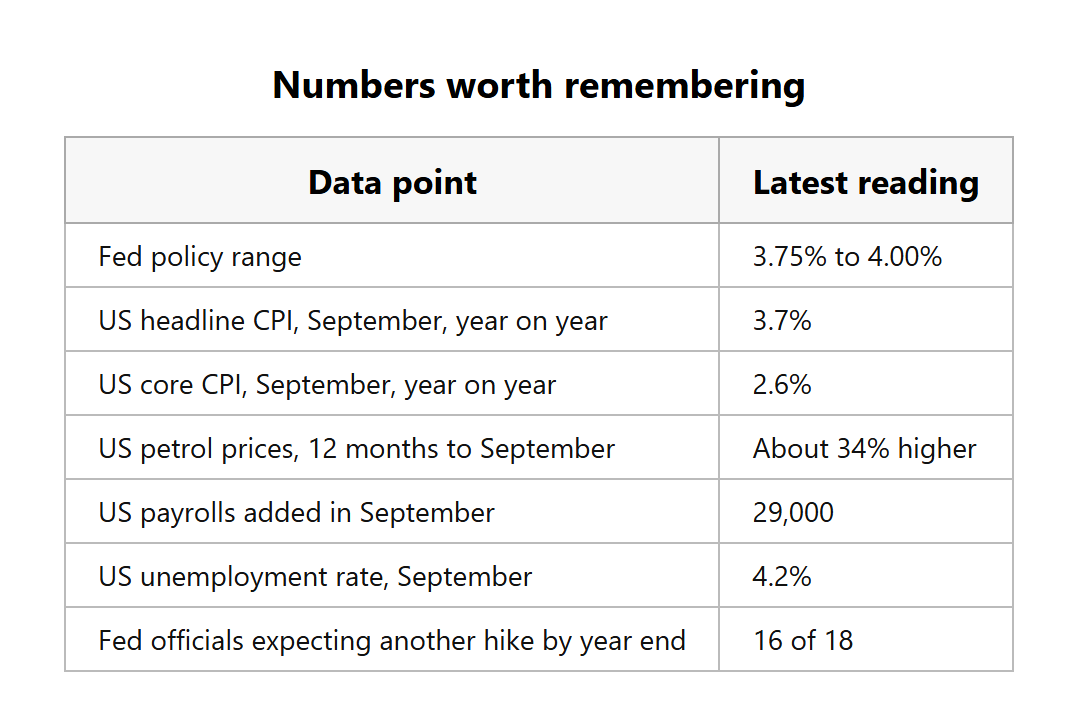
On 16 September, the Federal Reserve raised its policy rate by a quarter point to a range of 3.75% to 4.00%, the first hike since 2023, under Chair Kevin Warsh. Six weeks later, the committee sits down again with a problem that textbooks file under "awkward". Prices are rising faster, and jobs are being created more slowly. The decision lands at 2:00 pm in Washington today, which is 11:30 pm in India, so most of you will wake up to the answer. Here is how to read it before it arrives.
🛢️ Two kinds of inflation, and why the difference matters
Inflation is not one thing. Economists split it into two buckets, and the Fed treats them very differently.
Headline inflation counts everything a household buys, including petrol and electricity. Core inflation strips out food and energy, because those prices swing on events the central bank cannot control: a war, a harvest, a pipeline outage. The Fed can make borrowing dearer to cool demand for cars and houses. It cannot make a barrel of oil cheaper.
September's US consumer price report shows the gap clearly. Headline inflation hit 3.7% over twelve months, up from 3.4% in each of the two previous months. Energy was up about 20% on the year and petrol about 34%, per the Bureau of Labor Statistics report as covered by CNBC and Trading Economics. Core inflation was 2.6%, higher than the 2.5% forecast but still far below the headline. Petrol alone accounted for more than half of the monthly rise.
So the first thing to understand is that most of the heat in the headline number is coming from one input. Brent crude has stayed above 100 dollars a barrel for much of the autumn, well above where it traded in the summer. That is the force behind the number.
⚙️ Why the Fed cannot simply look through it
The standard playbook says a central bank should "look through" a one-off energy spike. Prices jump, then level off, and raising rates only adds a recession on top of a price shock. The playbook has a catch. It works when people believe inflation will come back down. If households and firms start to expect higher prices as the norm, they ask for higher wages and raise their own prices, and a temporary shock becomes a lasting one.
That is the Fed's worry now, and the numbers explain it. Inflation on the Fed's own preferred gauge, the PCE index, is still running above the 2% target, and has been for a long time, which is exactly the situation where expectations can slip. The Fed's own projections in September showed 16 of 18 officials expecting at least one more hike by the end of the year.
The other side of the ledger is the labour market. September payrolls rose by just 29,000, well below forecasts, and unemployment ticked up to 4.2%. July was revised to a loss of 10,000 jobs, and August was cut to 133,000 from 162,000, per the jobs report. An oil shock is a tax on every household that drives or ships anything, so it weakens spending at the same moment it lifts prices. Raise rates into that, and you tighten the squeeze.
That combination, prices rising while growth slows, is what economists mean by stagflation. This is a mild version, with core inflation still under 3% and unemployment at 4.2%, but the shape of the problem is the same, and it is why this meeting is hard.
The dynamics covered in this article affect every US stock in your portfolio. Trade from India on the Winvesta app. No US bank account needed!
🚀 Join 60,000+ investors, become a paying subscriber or download the Winvesta app and fund your account to get insights like this for free!
🏆 Who an oil-led squeeze helps and who it hurts
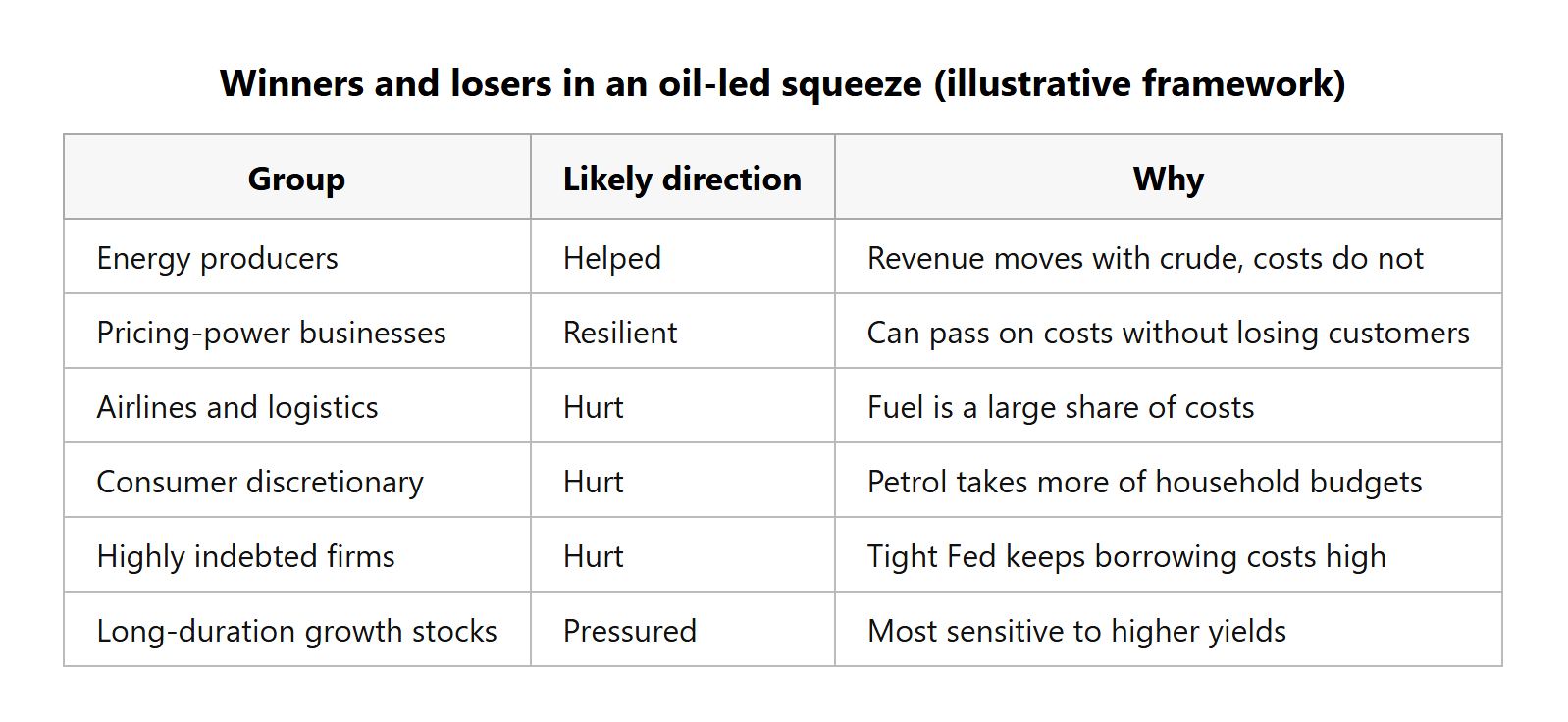
The table above is a framework, not a forecast, and the direction in each row can change if oil reverses.
Energy producers are the obvious beneficiaries while crude stays elevated. Their revenue moves with the barrel, and their costs do not move one for one. Companies with real pricing power, such as dominant software and payments businesses, tend to cope better, because they can pass higher costs on without losing customers.
The pressure falls on businesses where fuel is a large cost and customers are price sensitive. Airlines and logistics firms sit at the top of that list. Consumer discretionary names suffer when petrol takes a bigger bite of household budgets. Highly indebted companies are exposed on a second front, because a Fed that stays tight keeps their borrowing costs high. Long-duration growth stocks, whose value rests on profits far in the future, are the most sensitive to higher yields.
🌏 What this means if you are investing from India
Three channels reach an Indian investor holding US stocks, and oil sits behind all of them.
The first is the dollar. A Fed that hikes or sounds hawkish supports the dollar, and a stronger dollar means your US holdings are worth more in rupees even if the share prices go nowhere. India imports most of its crude, so expensive oil also pressures the rupee from the other side. The rupee has spent much of 2026 under pressure, and a hawkish Fed plus costly oil is the combination that keeps that pressure on. For an unhedged holder of dollar assets, this has been a cushion, not a cost.
The second is yields. The ten-year Treasury yield has been hovering around 5%, after touching a multi-year high above 5.3% in early October. Yields near 5% give investors a real alternative to stocks, which is why valuations on expensive growth names are under pressure whenever the Fed sounds firm. Short-dated yields sitting above the 4.00% top of the Fed's range would tell you the bond market expects more tightening, not less.
The third is your own sector mix. Many Indian portfolios lean heavily on US technology. That is the part of the market most sensitive to yields, and the part with the least direct link to oil. If you hold a broad US index fund, you already own some energy exposure. If you hold only tech, you do not.
🔭 What to watch tonight and over the next few weeks
Tonight, the rate itself is the least interesting part. Market pricing points strongly to a hold, with only a small chance of another hike. What moves markets is the language. Does the statement keep December open? Does Chair Warsh say anything that signals the next step? Chair Warsh has moved away from traditional forward guidance, so his press conference tone is harder to read than usual.
The Fed's next meeting is in December, and it will come with a fresh set of projections. Check the release calendar for the PCE inflation report and the first estimate of third-quarter GDP, which land in the next few days.
Three signals would change the picture. Oil falling back sharply from current levels would weaken the case for another hike. A second weak jobs report would tilt the Fed toward patience. And a ten-year yield that breaks decisively above its early-October high would suggest the bond market thinks the Fed is still behind.
If this changed how you read an inflation number, pass it on.
📊 The bottom line
A rate decision is not a simple read on whether the economy is strong or weak. When inflation comes from an oil shock and hiring is cooling, the Fed is choosing between two imperfect options, and the market trades the language more than the move. Do not try to guess tonight's tone. Check how much of your portfolio is exposed to rising yields, how much to energy prices, and how much to the dollar, because those three variables are what a stagflation-style squeeze actually runs through.
📈 Numbers worth remembering
This article is for educational purposes only and does not constitute investment advice. Winvesta India Technologies Ltd. does not guarantee the accuracy of third-party data cited above. Past performance is not indicative of future returns. Please consult a registered financial adviser before making investment decisions.