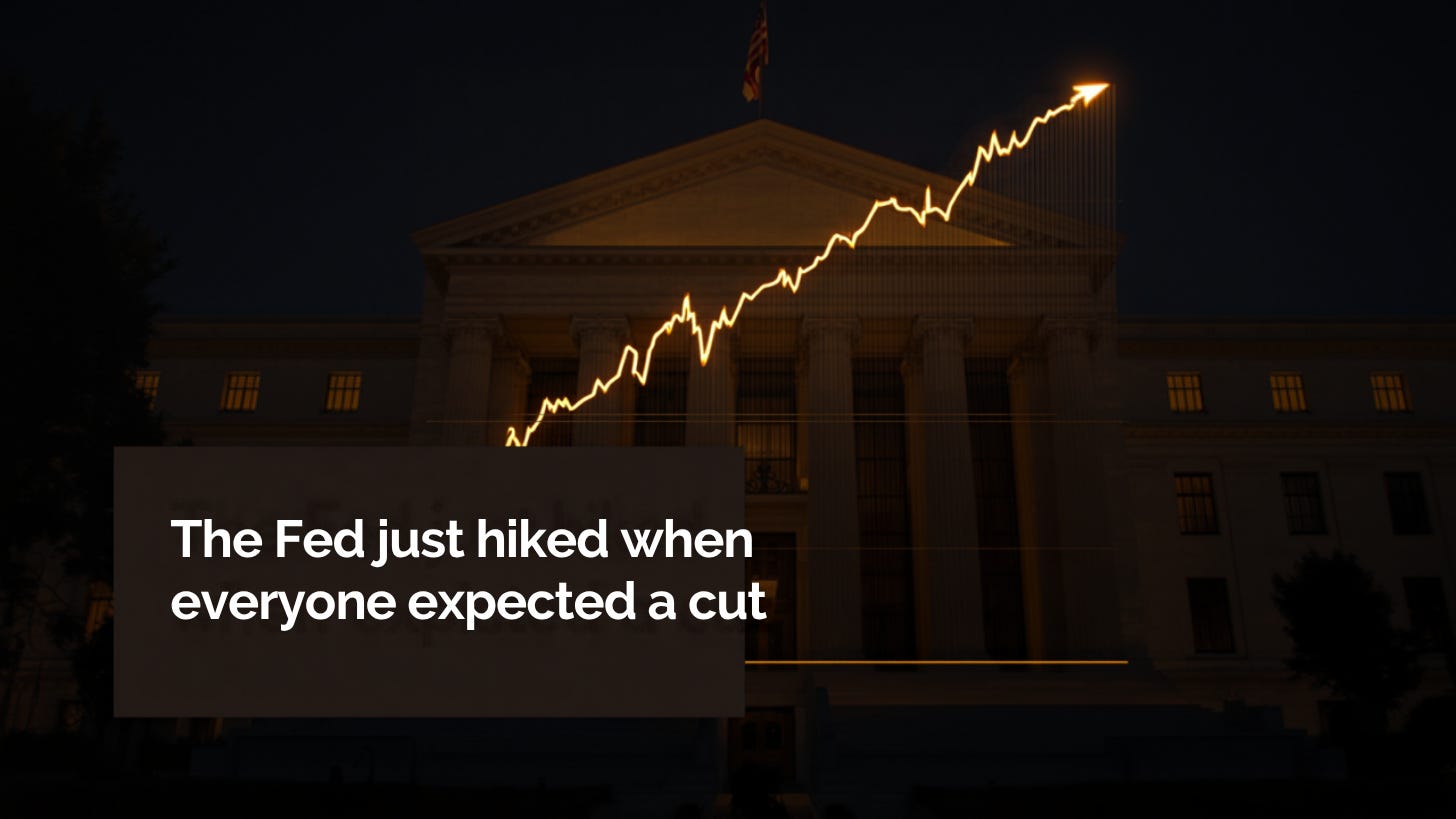
Five years ago, the rule for owning a bank fund was simple: wait for the Fed to cut, then buy financials, and let a steeper curve and cheaper funding do the rest. That rule broke on 16 September, when the Federal Reserve raised its benchmark rate for the first time since 2023, reversing weeks of dovish pricing, and the financial sector barely blinked. That's why we built Winvesta Crisps, to decode what's actually moving the funds you own, in plain language, before the consensus catches up. 60,000+ investors from all over India are already in. What about you?
🔔 Don't miss out! Add winvestacrisps@substack.com to your email list so our updates never land in spam.
Most investors treat a Fed rate hike as bad news for every part of the market, and good news only for cash. That was close enough to true in 2022. It was not true on 16 September 2026, when the Federal Reserve's rate-setting committee voted unanimously to raise the federal funds rate by a quarter point, to a range of 3.75% to 4.00%, its first increase in three years. Fed funds futures had priced roughly one-in-three odds of that outcome as recently as mid-August, when a weak jobs report pushed traders toward pricing cuts, not hikes. The hike happened anyway. Sixteen of eighteen Fed officials now see room for at least one more increase this year, and rate-futures pricing has moved to around 55% odds of a follow-up in October.
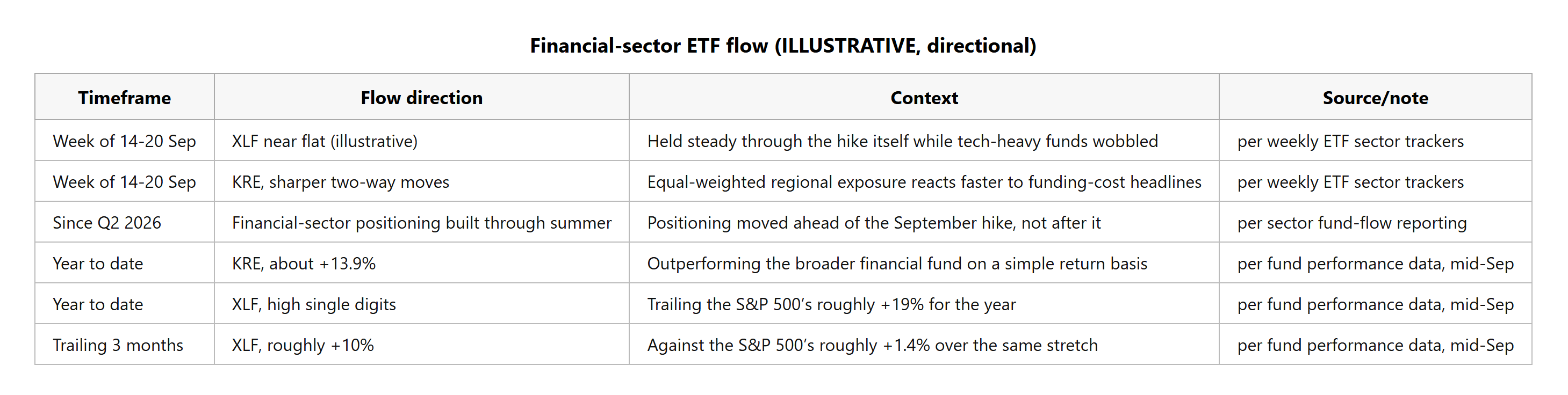
The reaction told you who had actually read the mechanism correctly. The dollar index jumped from about 99.6 to above 100.5 within two trading sessions. The ten-year Treasury yield closed near 5.01%, its highest since October 2023. Real estate funds gave back roughly half their year's gains in six weeks. And financials, the sector every 2023-era playbook says should suffer when the Fed tightens, held up. The regional bank fund is up close to 14% for the year. The broad financial sector fund has beaten the S&P 500 over the past three months even though it still trails on a full-year basis.
That divergence is the story this week. It is also, unusually, a divergence most Indian investors are positioned to miss entirely, because almost nobody holding a US portfolio out of India owns a share of either fund.
🎯 Meet Aditi
Aditi is 33, a product manager at a Gurugram fintech, and has run a US portfolio since 2021. It is worth about ₹52 lakh: roughly two-thirds in a broad S&P 500 index fund, the rest split across three megacap technology names she picked because she uses their products every day. She has never owned a financial-sector fund, a bank stock, or anything resembling one. Her reasoning was straightforward: banks felt like a domestic Indian story, she already gets that exposure through HDFC and ICICI in her Nifty investments at home, and the interesting growth in the US has been in technology, not lenders.
That reasoning was sound for most of the past three years. It stopped being sound the week the Fed did the opposite of what the market had priced.
Her question this week is specific. She has watched the regional bank fund climb close to 14% this year, quietly, without a single headline she noticed, while she was reading about AI chip demand instead. Financials are not new money chasing a hike that just happened; the sector has been working since the summer. She wants to know if she is already late, whether the case still holds now that the hike has actually landed, and which of the two financial funds she keeps seeing mentioned, XLF and KRE, actually fits what just happened.
📊 What a rate-hike winner actually looks like
Start with what her S&P 500 fund already gives her, because it is less than it sounds. The index-level financial weight sits in the mid-teens, spread across dozens of names from insurers to card networks to money-centre banks, diluted enough that a genuine sector move barely registers in her total return. Aditi has broad exposure to "financials" the same way she has broad exposure to "energy": present, and too small to matter on its own.
The two dedicated funds behave differently from each other, and that difference is the whole trade.

The Financial Select Sector SPDR, ticker XLF, holds roughly seventy names weighted toward the largest banks, insurers, payment networks and asset managers, with money-centre banks near the top. It is the orderly-policy version of the trade: diversified funding sources and fee income smooth out the pure interest-rate sensitivity, and a fund that also owns Visa and Berkshire Hathaway's financial arm behaves less like a bet on the yield curve and more like a bet on the economy holding together while rates stay higher.
The SPDR S&P Regional Banking ETF, ticker KRE, is the concentrated version: several dozen regional and community lenders, equal-weighted rather than cap-weighted, so a mid-sized bank in Ohio moves the fund about as much as a larger one in California. KRE's business model is borrowing short from local depositors and lending long against local commercial property, which is precisely the balance sheet that a steeper curve helps and a funding-cost spike hurts, often within the same news cycle.
That is why KRE has actually outperformed XLF this year on a simple return basis, near 14% year to date against XLF's high single digits, while carrying a rougher ride to get there. It is the higher-beta version of the same regime, not a safer alternative to it.