


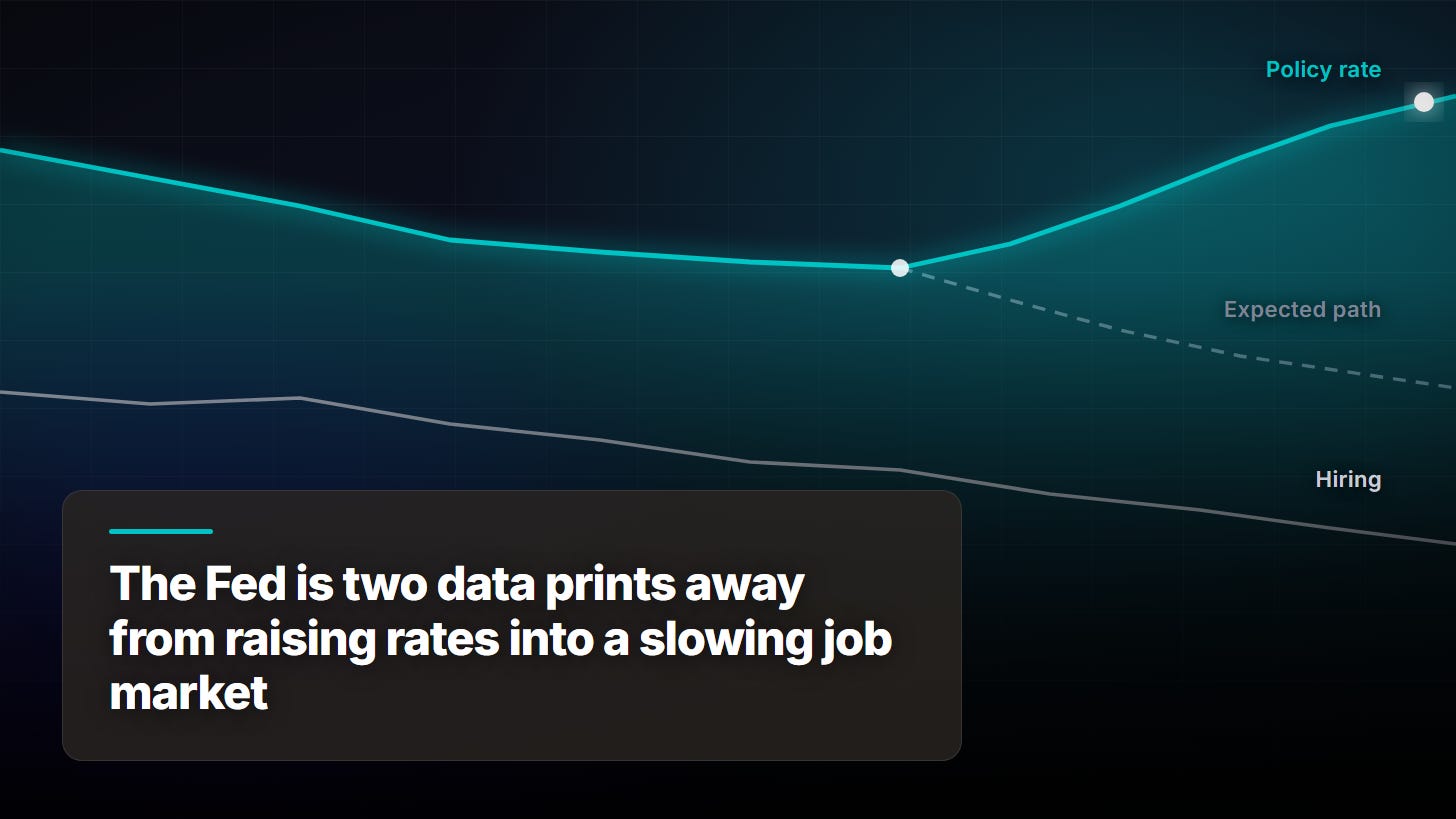
Most portfolios are still built for the rate cuts that were supposed to arrive this year. Futures markets now put roughly two-in-three odds on the opposite, a rise on 16 September, which would be the first since July 2023, at a moment when hiring is already slowing. Understanding why a central bank would tighten into a weakening economy is the difference between reading the next six weeks and being surprised by them. That's why we built Winvesta Crisps: to break down what's actually moving markets, in plain language, before the consensus catches up. 60,000+ investors from all over India are already in. What about you?
🔔 Don't miss out!
Add winvestacrisps@substack.com to your email list so our updates never land in spam.
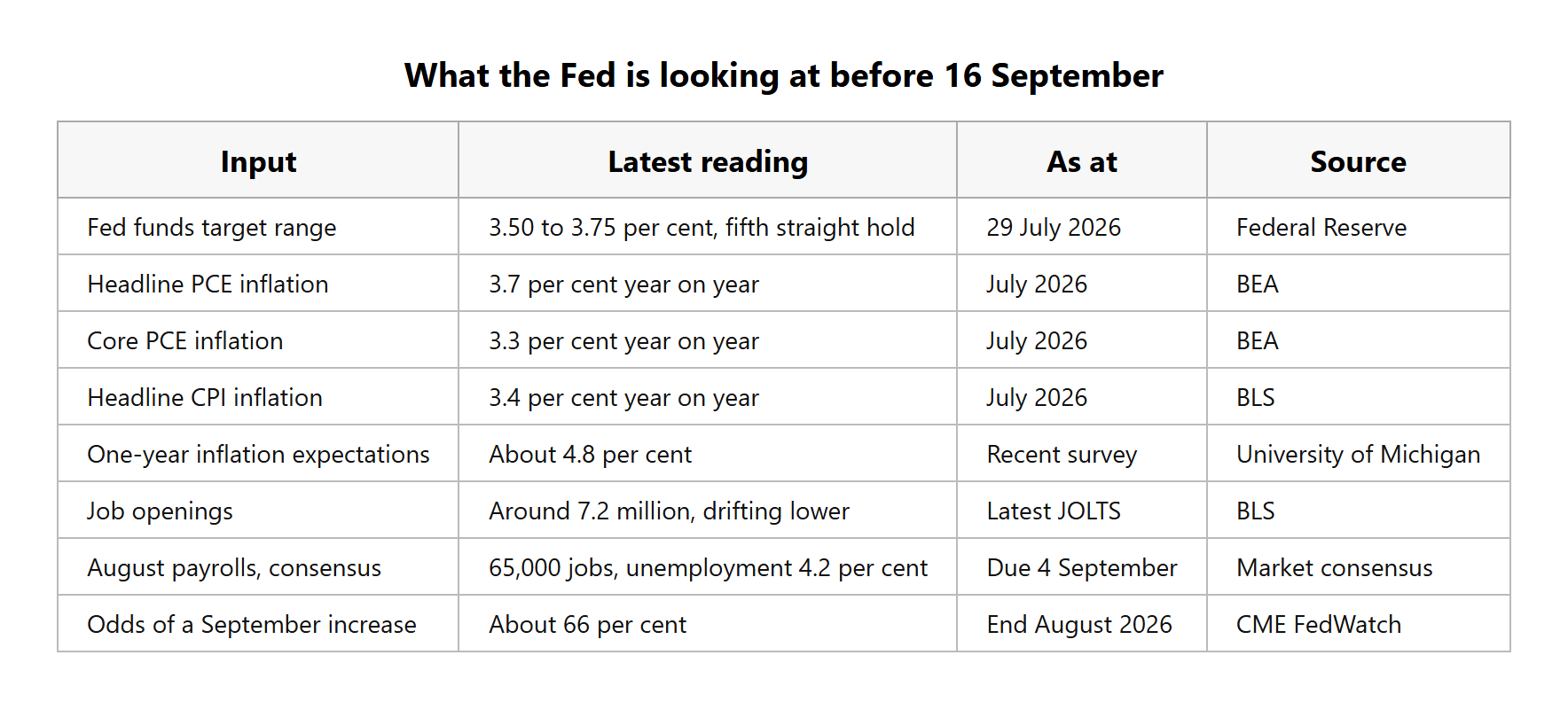
On Friday 28 August, Kevin Warsh gave his first Jackson Hole keynote as Fed Chair and spent it on a single number: 2 per cent. He called headline PCE inflation at 3.7 per cent concerning, defended the target, and described delivering on it as the only true test of the central bank's credibility. Fed funds futures moved within the hour. Odds of a September increase went from about 35 per cent to 58 per cent that day and sat near 66 per cent by the end of the month, per the CME FedWatch tool. The two-year Treasury yield jumped to 4.35 per cent and the ten-year reached about 4.80 per cent on Tuesday, its highest since January 2025. What makes this unusual is not the hawkish speech. It is that the same week produced job openings that are drifting lower, a hiring rate that has been slowing all year, and a consensus forecast of 65,000 new jobs in August. A central bank is preparing to raise the cost of money into that.
🏛️ How a year of expected cuts became a coin flip on a hike
Start with where the policy rate actually is. The Fed spent 2024 and 2025 cutting, taking the target range down to 3.50 to 3.75 per cent, and it has now held there five meetings running, most recently on 29 July. Every forecast published in January assumed the next move was down. The question was how many cuts, not which direction.
Two things broke that assumption, and only one of them is about the American economy.
The first is oil. Disruption in the Strait of Hormuz that began in late February has proved far more durable than the first week of headlines suggested. Oil and petroleum liquids moving through the strait averaged 4.9 million barrels a day in the second quarter of 2026, against roughly 21.6 million barrels a day before the conflict, per the US Energy Information Administration. A 60-day ceasefire lapsed in mid-August and hostilities resumed. Brent peaked near 94.40 dollars a barrel on 21 August, has traded in an 86 to 91 dollar range since, and climbed back above 91 dollars on 1 September as US and Iranian strikes resumed. This is not a spike that is fading. It is now the better part of a year of elevated energy costs feeding through every supply chain that uses freight, plastics or power.
The second is what that has done to the inflation data the Fed actually watches. Headline PCE inflation rose 0.2 per cent in July to reach 3.7 per cent year on year, a tenth above the consensus forecast. Core PCE, which strips out food and energy, came in at 3.3 per cent, exactly where analysts expected. Headline CPI for July was 3.4 per cent, per the Bureau of Labor Statistics. Whichever gauge you prefer, inflation has now run above the 2 per cent target for more than five years.
Then came Warsh. Appointed by President Trump with rate cuts widely assumed to be the point of the appointment, he has instead spent his first months at the Fed rebuilding a reputation for hawkishness, and the Jackson Hole speech read as an argument that the target is not negotiable. Analysts covering the speech noted the obvious tension it creates with a Treasury that would prefer cheaper funding. Markets simply repriced.
⚙️ Why an oil shock splits a central bank down the middle
The textbook answer to a supply shock is to leave it alone, and the reasoning is worth spelling out because it is usually skipped.
Interest rates work on demand. Raising the cost of borrowing makes households buy less and firms invest less, which cools prices that are rising because too many buyers are chasing too few goods. An oil shock is the other kind of inflation. Prices are rising because a waterway is closed, and no interest rate setting anywhere in the world moves a tanker through the Strait of Hormuz. Tightening into it does not fix the cause. It simply adds a second contraction on top of the first, hitting employment to fight a price rise that monetary policy did not create and cannot reverse.
There is also an arithmetic reason to wait. A one-off jump in the price level shows up in the inflation rate for twelve months and then drops out of the comparison by itself. Do nothing and the number falls on its own next spring.
That is the case for holding, and it is a strong one. Here is why the Fed may override it anyway.
The argument turns on how long a shock has to last before it stops behaving like a one-off. Late February to early September is six months and counting, with the ceasefire already broken once. Firms that absorbed the first round of freight and energy costs have started passing them on. Workers who accepted one year of below-inflation pay rises negotiate differently in the second. At that point the shock stops being confined to energy and starts becoming the general price level, and the mechanism that carries it there is expectations.
This is the number to understand. University of Michigan survey respondents have recently put expected inflation over the coming year at about 4.8 per cent, against a five-year expectation closer to 3.2 per cent. Consumers expecting 4.8 per cent do not object to a 4.8 per cent price rise. Firms budgeting for 4.8 per cent wage demands price their products accordingly. If that continues long enough, inflation stops needing the oil shock to sustain it, and the central bank has to break the expectation rather than the shock, which historically costs far more in lost jobs than acting early does.
So a September increase would not be an attempt to lower petrol prices. It would be a costly signal, the point being precisely that it hurts. It says the 2 per cent number is real to the people who set it, and it is aimed at the household survey and the wage round rather than at the oil market.
The uncomfortable part is where the cost lands. Policy acts on demand, and demand is the half of this economy that is already soft. Job openings have hovered around 7.2 million in the most recent JOLTS readings, with hires at 5.1 million, quits at 3.1 million and layoffs at 1.7 million. That is a labour market where firms have stopped hiring aggressively but have not started firing, which is a delicate state to tighten into. Consensus for Friday's August payrolls is 65,000 jobs with the unemployment rate ticking up to 4.2 per cent.
History does not settle the argument, and anyone claiming it does is selling something. The European Central Bank raised rates in July 2008 with oil above 140 dollars, then cut by 175 basis points before the year was out. It raised twice more in 2011 into the euro area debt crisis, and members of its own governing council later described those moves as a mistake. That is the cautionary case, and it is the one bond markets remember. The case on the other side is the 1970s, when central banks treated successive oil shocks as temporary until expectations came loose, and the eventual correction required a recession far deeper than an early move would have caused. Warsh's speech was an argument that the second risk now outweighs the first.
The dynamics covered in this article affect every US stock in your portfolio. Trade from India on the Winvesta app. No US bank account needed!
🚀 Join 60,000+ investors, become a paying subscriber or download the Winvesta app and fund your account to get insights like this for free!
🏆 Winners and losers if the Fed goes
The mechanism that matters for share prices is short and mechanical. A higher policy rate raises short-dated yields, and short-dated yields are the base rate used to value every future stream of profits. Raise it, and profits expected far in the future lose more value than profits expected next year. Whether a company is helped or hurt depends mostly on when its cash arrives.
The directions below are illustrative and directional, drawn from how these assets have already traded in the past week, not forecasts.
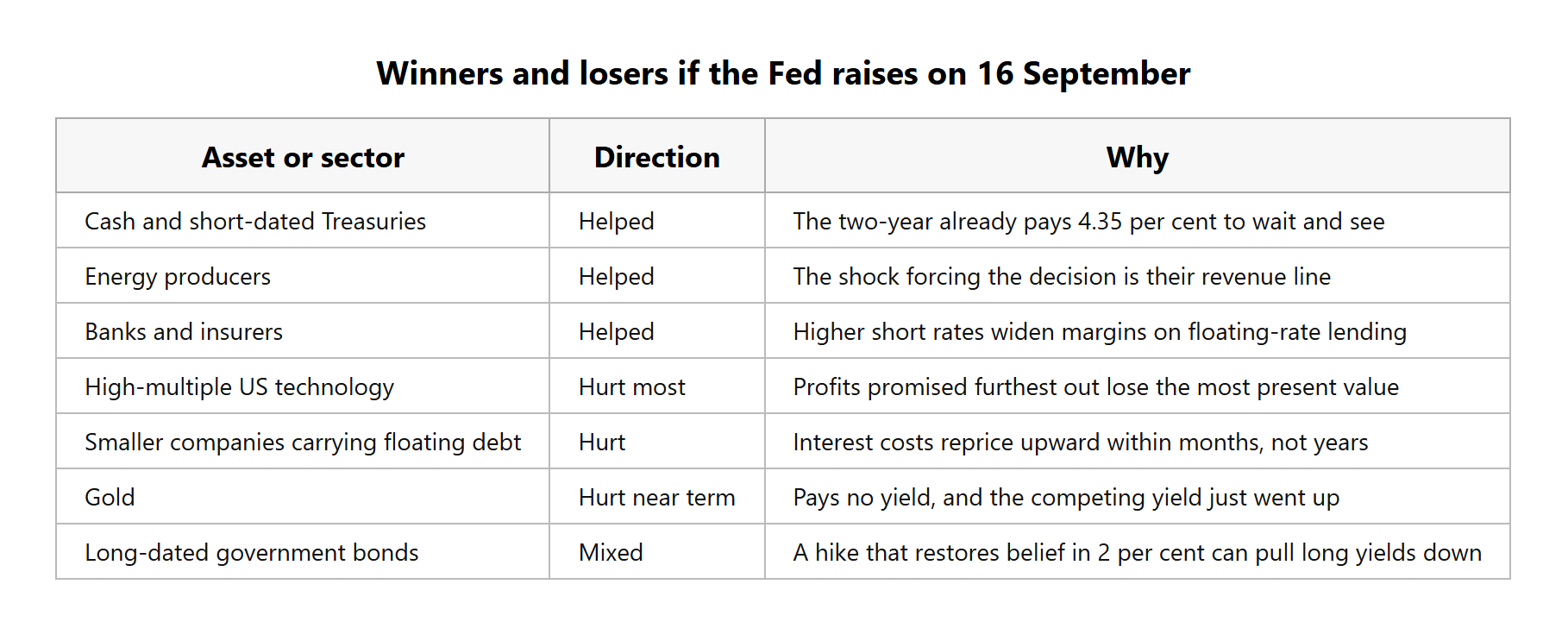
Two rows cut against instinct. Gold, the asset most investors reach for when they hear the word inflation, fell more than 1 per cent on Tuesday to around 4,375 dollars an ounce, its lowest since 19 August, because it pays no yield and a higher yield elsewhere is its main competition. And long-dated government bonds are not the obvious loser here. A credibility hike that convinces markets inflation will be contained can pull long yields down even as short yields rise, which is the whole point of the exercise.
The market response so far has been rotation rather than a broad sell-off. On the day of the speech technology fell 1.29 per cent, led by chip names, while consumer discretionary rose 1.69 per cent and energy held its ground. Eight of the eleven S&P 500 sectors are higher so far in 2026, with energy leading, up 43 per cent. The index is not pricing a disaster. It is repricing which businesses do well when money costs more.
🇮🇳 What this means for Indian investors holding US equities
Three separate channels reach an Indian portfolio, and they do not all point the same way.
The first is the currency. The rupee has moved from roughly 85 to the dollar through 2025 to around 95.2 in early September, with the RBI reference rate at 95.451 on 31 August. Rate rises in the United States widen the yield gap in the dollar's favour, which pushes the same way. For money already invested, a weaker rupee flatters the rupee value of US holdings, and that is genuinely helpful. For money yet to be sent, it makes every future dollar more expensive. Run it in plain numbers. A US holding that falls 8 per cent in dollar terms while the rupee weakens 3 per cent leaves you down about 5 per cent in rupee terms. The currency softens the blow. It does not remove it, and it makes topping up costlier at exactly the moment prices are lower.
The second is the RBI's own position. The repo rate has been on hold at 5.25 per cent with a neutral stance since June, and the central bank has been working hard to defend the currency. Its foreign exchange forward book reached a record 137 billion dollars in July, and it has offered to fully subsidise hedging costs on fresh three to five year FCNR(B) deposits until 30 September. A Fed that raises rather than cuts narrows the room for any Indian easing, because a wider gap in India's favour is what holds the rupee steady. Indian borrowers and rate-sensitive Indian sectors feel that indirectly.
The third is flows, and it is the one that has already happened. Foreign portfolio investors pulled roughly 2.2 lakh crore rupees, about 30.6 billion dollars, out of Indian equities by early June, the largest annual outflow since India opened to foreign portfolio investment in 1993, with some counts running higher since. Higher US yields, a stronger dollar and a widened current account deficit from the oil import bill are the reasons usually given. Indian retail money has been travelling in the opposite direction, with LRS remittances for equity and debt purchases reaching 456.7 million dollars in June alone, more than double a year earlier, per RBI data.
Put those together and the position is specific. Indian investors have been buying US equities, mostly large-cap technology, with rupees that are getting weaker, into a market where the discount rate is going up rather than down. None of that is an argument to stop. It is an argument to know what the position is. A portfolio concentrated in high-multiple US technology is a bet on the direction of US interest rates whether it was built that way or not, and this is the month that becomes visible. A systematic monthly investment keeps buying through a repricing rather than trying to time the meeting.
🔭 What to watch between now and 16 September
Three dates decide this, and all of them are public.
Friday 4 September brings August payrolls. Consensus is 65,000 with unemployment at 4.2 per cent. The headline number matters less than average hourly earnings, because wage growth is the channel through which an oil shock becomes general inflation. Soft jobs with firm wages is the combination that keeps a hike alive.
11 September brings August CPI. The gap between headline and core is the whole argument in one release. Headline staying high while core stays contained supports the case for looking through it. Core drifting up says the shock has spread and strengthens the case for acting.
15 and 16 September is the FOMC meeting. If a rise comes, read the statement's language on supply-driven inflation and the projections rather than the decision itself, since those say whether this is one insurance move or the start of something.
Two live indicators sit underneath those dates. The University of Michigan one-year expectation, near 4.8 per cent, is the series that justifies the hike, so a fall in it takes the pressure off faster than any speech will. And the two-year Treasury yield at 4.35 per cent is the cleanest read available on what the market has actually priced, which means the reaction on the day depends on where it sits going in, not on the decision alone.
The wildcard is the Strait of Hormuz. Flows at 4.9 million barrels a day against 21.6 million before the conflict is the fact underneath everything above. Genuine reopening would take the inflation impulse away within months and the entire case for tightening with it.
If this changed how you read the next Fed headline, pass it on.
🏁 The bottom line
A rate rise on 16 September would not be an attempt to manage the economy in the usual sense. It would be an attempt to defend a number, the 2 per cent target, at a point where six months of energy disruption has started to show up in what households expect prices to do next year. That is a defensible decision and a genuinely risky one, and the ECB's 2008 and 2011 experience is the reason bond markets are nervous about it.
For an Indian investor the practical consequence is narrower than the debate. Money that costs more makes distant profits worth less today, and distant profits are what most US technology holdings are. A weaker rupee will cushion the rupee value of what is already held and raise the cost of adding to it. Neither of those is a reason to sell into a meeting. What they do argue for is knowing how much of a portfolio sits in one long-duration bet, and having that answer before Friday rather than after 16 September.
📊 By the numbers
3.50 to 3.75 per cent: the current Fed funds target range, held for five consecutive meetings, most recently on 29 July
About 66 per cent: market-implied odds of a quarter-point September increase at the end of August, up from roughly 35 per cent before Warsh's 28 August speech, per CME FedWatch
3.7 per cent and 3.3 per cent: headline and core PCE inflation year on year in July, against a 2 per cent target
About 4.8 per cent: University of Michigan one-year inflation expectations in recent surveys, against a five-year expectation near 3.2 per cent
65,000: consensus forecast for August non-farm payrolls due Friday, with unemployment expected at 4.2 per cent
4.35 per cent and about 4.80 per cent: the two-year and ten-year Treasury yields this week, the ten-year at its highest since January 2025
4.9 million barrels a day: oil and petroleum liquids through the Strait of Hormuz in the second quarter, against roughly 21.6 million before the conflict, per the EIA
95.2: the rupee against the dollar in early September, from roughly 85 through 2025, with the RBI's forward book at a record 137 billion dollars in July
July 2023: the last time the Federal Reserve raised interest rates
Disclaimer: All content provided by Winvesta India Technologies Ltd. is for informational and educational purposes only and is not meant to represent trade or investment recommendations. Remember, your capital is at risk. Terms & Conditions apply.
A portfolio built for cuts is a duration fund with a story. Two data prints from a hike just means the 10-year already did the meeting.
https://paretoinvestor.substack.com/p/how-bonds-quietly-rule-everything
Indian clients often ignore currency risk until it hits. A 3% rupee fall offsets an 8% USD drop — but the real issue is hedging costs and RBI constraints limiting domestic easing.
Review asset allocation now, not after a panic. Diversify into hedged or INR-based instruments if US exposure is overweight.
Don't sell blindly, but reassess goals — rupee depreciation and higher US yields change the math.