


Five years ago, a Fed rate-cut cycle was simple instruction for anyone holding a bond fund: yields fall, prices rise, sit back and collect the gain. That assumption broke this year. The Federal Reserve has already cut its policy rate twice in 2026, and the ten-year Treasury yield closed above 5.1% in late September, its highest level since 2007. That's why we built Winvesta Crisps, to decode what's actually moving the funds you own, in plain language, before the consensus catches up. 60,000+ investors from all over India are already in. What about you?
🔔 Don't miss out! Add winvestacrisps@substack.com to your email list so our updates never land in spam.
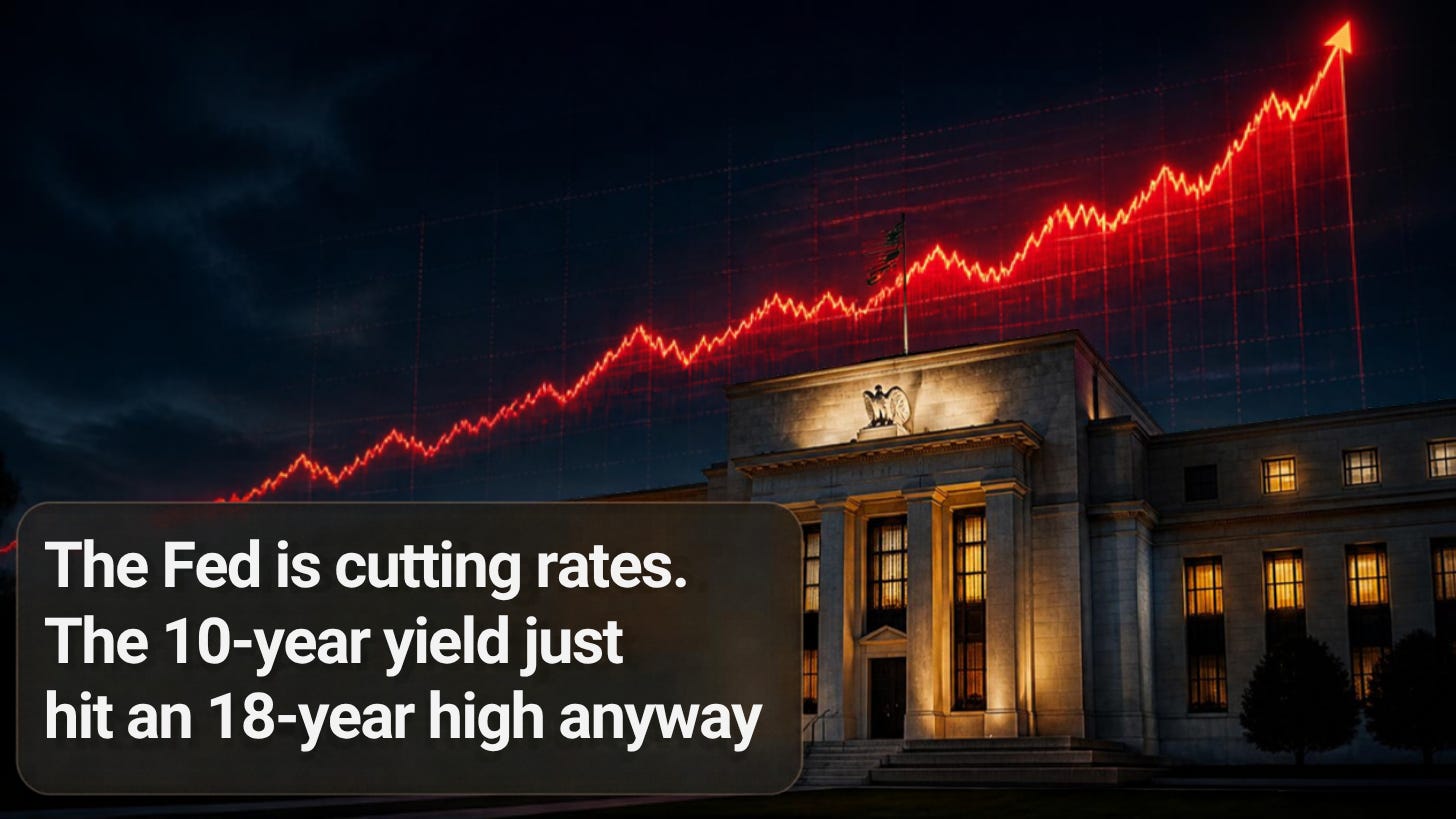
Most investors treat "the Fed is cutting" as a single instruction that applies to every bond fund they own. It does not. The Fed's two cuts this year, plus a third all but priced in for its 28 October decision, have pulled short-term yields down roughly on schedule. The ten-year yield has done the opposite: it closed at 5.17% on 25 September, up from 4.96% just two weeks earlier, and the highest since 2007. Widen the lens further and the divergence gets starker. Since September 2024, the ten-year yield has climbed by around 1.3 percentage points even as the Fed has cut short-term rates by roughly 1.5 percentage points over the same stretch, according to RBC Wealth Management's own tracking of the gap.
A government shutdown that began on 1 October, now in its sixth day, has made the picture harder to read, not easier. Roughly 750,000 federal employees are furloughed, the Congressional Budget Office puts the furloughed payroll cost alone at about $400 million a day, and the shutdown has delayed the data releases the Fed would normally lean on before its 28 October meeting. Policymakers are heading into a near-certain cut with a meaningfully incomplete picture of the labour market behind it. None of that stopped the ten-year yield from climbing all September. Here's what nobody's telling you: the fund you bought because "the Fed is cutting" may be the one fund in your portfolio that this cut barely touches.
🎯 Meet Arnav
Arnav is 36, an engineering lead at a Bengaluru fintech, with a US portfolio worth roughly ₹68 lakh built up since 2021. Most of it sits in S&P 500 and Nasdaq-100 index funds, plus a handful of individual megacap names. In March, with the Fed's first cut of the cycle already signalled, he added a 6% position in TLT, the iShares 20+ Year Treasury Bond ETF, reasoning that a Fed cutting cycle was the obvious moment to lock in a long-duration bond trade before prices moved. He also parked a smaller, almost incidental sum in SHY, the short-duration Treasury fund, purely as a place to hold cash he hadn't decided what to do with.
Six months and two rate cuts later, his "obvious" trade is down. TLT has lost ground in a stretch where the Fed has done exactly what he expected it to do. The "boring" SHY position he barely thought about has held its value and quietly paid out a yield north of 3%. His question is specific: has the TLT trade simply not worked yet, with the third cut on 28 October the catalyst that finally turns it around, or did he misread what a Fed rate cut actually does to a 20-year bond?
His hidden exposure. TLT's effective duration runs to roughly 16 to 17 years, which means its price moves far more on long-end yield swings than on the Fed's own overnight rate. Those long-end swings this cycle have been driven by a separate argument, about fiscal deficits, Treasury issuance and the term premium investors demand to hold government debt for decades, not by what the Fed does at its next meeting. Arnav bought a bet on the Fed. He is actually holding a bet on the bond market's patience with Washington's deficit math, and those two bets have been moving in opposite directions all year.
📊 What TLT, SHY and XLU actually give you

TLT is the purest expression of duration risk available in a single ticker: a portfolio of bonds maturing in 20 years or more, which means a given move in long-term yields shows up in its price almost immediately and almost in full. That is precisely why it has struggled this year. It was never built to track the Fed funds rate. It was built to track the long end, and the long end has its own argument underway about who absorbs the growing supply of Treasury debt now that the deficit keeps widening.
SHY sits at the other end of the same asset class. With an effective duration under two years and roughly $11 billion in assets, making it the largest fund of its kind, it is built to track the Fed's own rate path far more closely than the long end's separate dispute with the bond market. Its 30-day yield sits near 3.3%, and because its holdings mature within three years, it has avoided almost all of the price damage TLT has taken this year.
XLU, the Utilities Select Sector SPDR, is the equity-market version of the same tension. Utilities carry a dividend yield of roughly 3%, trade partly on that yield the way a bond does, and get hit when long rates rise even though they sit in the equity sleeve of most portfolios, not the bond sleeve. It is the fund that reveals whether an investor's "bond problem" has quietly become an "entire portfolio" problem.