


5 years ago, buying semiconductor stocks meant picking Nvidia and hoping for the best. Not anymore. The AI infrastructure buildout has turned the entire chip supply chain (designers, foundries, equipment makers, memory suppliers) into a single macro trade. And the ETF wrappers that package this trade are now doing things that no semiconductor fund has ever done before. SOXX just posted its longest winning streak in its entire 25-year history. SMH is up over 60% year to date. Nvidia reported $81.6 billion in quarterly revenue last week and the stock barely moved. If you don’t understand why that last sentence should give you pause, your portfolio may be carrying more risk than you realise.
That’s why we built Winvesta Crisps -- to decode what’s actually moving the funds you own, in plain language, before the consensus catches up. 60,000+ investors from all over India are already in. What about you?
🔔 Don’t miss out! Get the latest updates delivered straight to your inbox →
The AI trade has a new centre of gravity, and it is not a chatbot. It is a chip. Nvidia just reported $81.6 billion in first-quarter fiscal 2027 revenue, an 85% year-over-year surge that shattered Wall Street’s already elevated estimates of $78.8 billion. The company then guided to $91 billion for the next quarter. Hyperscalers (Amazon, Microsoft, Alphabet, Meta) are on track to spend a combined $695-725 billion on AI infrastructure in 2026 alone, roughly five times what they spent two years ago. The semiconductor cycle is not slowing. If anything, it is accelerating.
And yet. Nvidia’s stock dipped after the print. SOXX and SMH, the two dominant semiconductor ETFs, are trading near all-time highs after 60-78% gains year to date. The Philadelphia Semiconductor Index recently completed a roughly 38-42% six-week rally that prompted at least one sell-side analyst to invoke the dot-com boom as a reference point, per reporting from Al Jazeera.
Most investors see a runaway AI trade that only goes up. But the data tells a more complicated story. The earnings are real. The flows are real. The question is whether you’re buying a structural supercycle at the right moment -- or walking into someone else’s exit at the most consensus point in the trade’s history.
Let me introduce you to someone who might be you.
🎯 Meet Krish
Krish, 33, data engineer in Hyderabad. Portfolio: ₹48 lakhs across US markets through Winvesta. He built his allocation methodically, QQQ as his core, VOO for stability, and a small NVDA direct position after reading about Nvidia’s data centre dominance. He thinks he has roughly 15% exposure to semiconductors.
Here is what Krish thinks he owns:
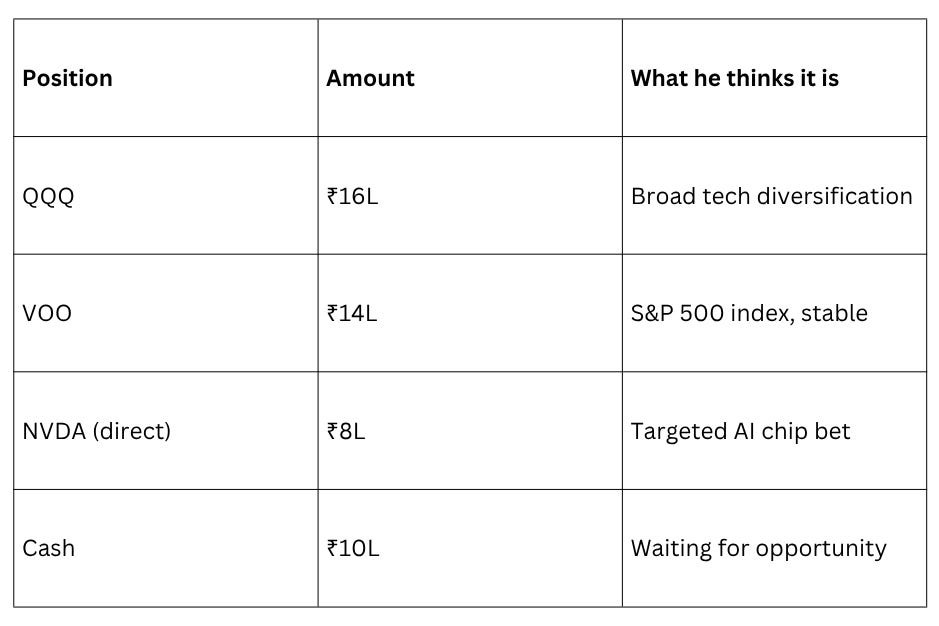
Here is what Krish actually owns, once you account for what lives inside QQQ and VOO:
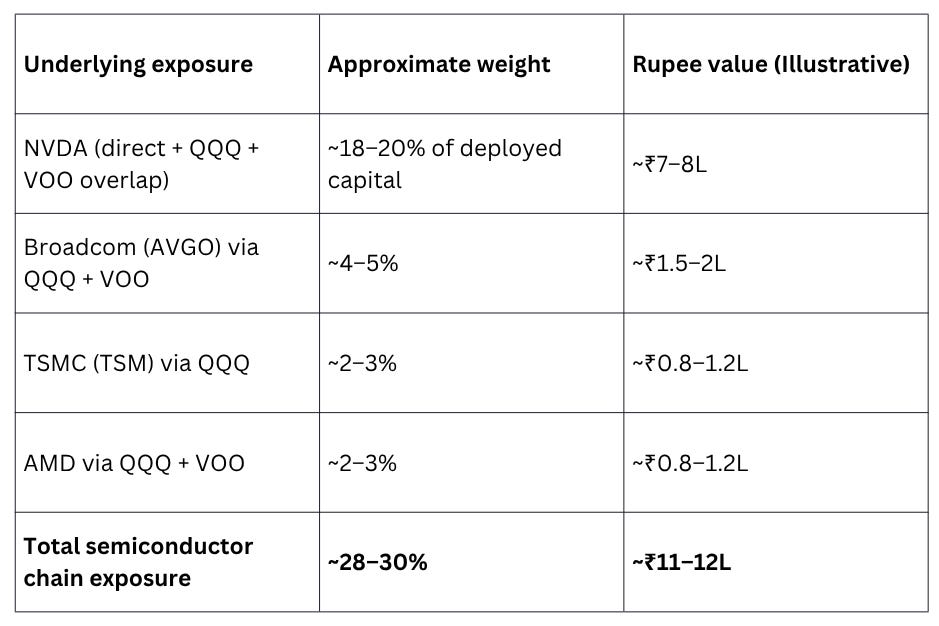
Note: ETF weights are approximate and shift daily. This is illustrative of hidden concentration, not a precision audit. Verify directly with Invesco and Vanguard.
Krish thinks he has a 15% bet on semiconductors. He actually has closer to 28-30% of his deployed capital riding the chip cycle. His “stable S&P 500 index” has Nvidia as its largest holding at approximately 7-8%. His “diversified tech ETF” has NVDA as its largest holding at approximately 8-9%, with Broadcom, AMD, TSMC, and Qualcomm also in its top 10.
Now SOXX is near all-time highs, SMH is up 60%+ year to date, and everyone in his investing circle is talking about buying more. The question he is actually asking, without realising it, is not “should I buy SOXX?” It’s “Should I add a third layer of the same trade on top of the two I already own?”
That is the question this article answers.
📊 What SMH and SOXX actually hold, and what flows are saying

Most investors know the ticker. Very few have looked under the hood. Here is the structural picture:
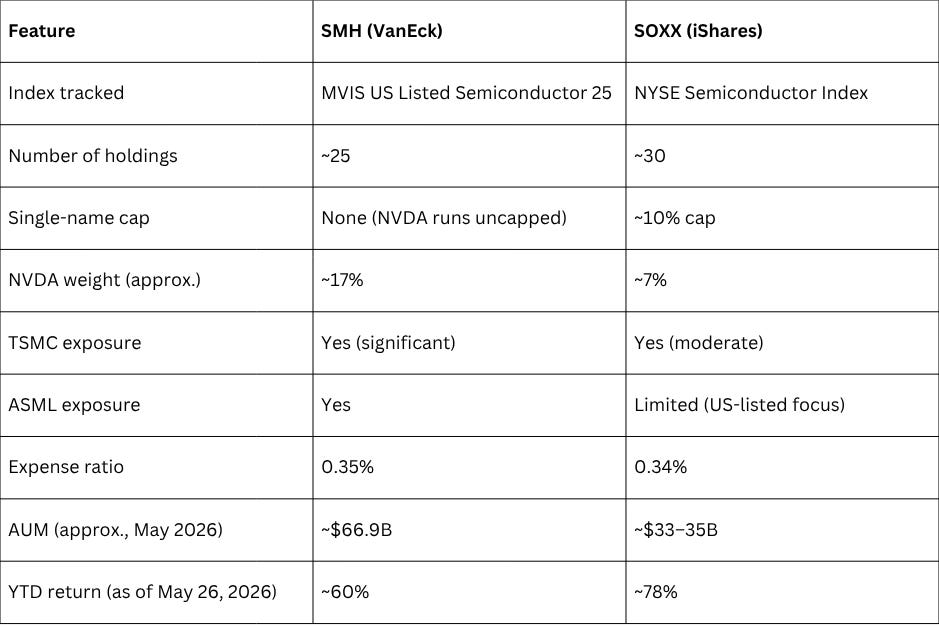
Sources: VanEck, iShares fund pages, PortfoliosLab; verify current weights directly with fund issuers before acting.
The structural difference is the cap. SMH, let’s Nvidia run. When NVDA has a massive quarter, SMH captures more of it. SOXX trims winners at rebalance, giving you broader exposure to the chip supply chain: equipment makers like Lam Research and Applied Materials, memory suppliers like Micron, and foundries like TSMC. That breadth is why SOXX has outperformed SMH year to date: the AI trade broadened in 2026 from pure Nvidia into the equipment and memory sub-sectors, and SOXX’s structure was rewarded for existing.
The rebalancing mechanic is worth understanding. When AMD surges on strong data centre numbers, SOXX automatically buys more AMD and trims names that have lagged. That structural sell-high, buy-low discipline is the reason SOXX has produced a higher Sharpe Ratio than SMH over the past 12 months, even with slightly lower long-run annualised returns.