


Finnish startup Donut Lab made waves at CES 2026 (early January) with claims of a 400 Wh/kg solid-state battery—nearly double Tesla’s current 4680 cells at ~240-270 Wh/kg. While the announcement faces significant scepticism from industry experts (Chinese battery maker Svolt called the parameters contradictory) and lacks independent validation, it highlighted a critical risk many investors overlook: Tesla’s concentration across thematic ETFs creates amplified exposure that most portfolios don’t account for.
Tesla appears in approximately 47 US-listed ETFs with assets over $500 million, with some funds, like ARKK, holding ~11% positions. This means a single investor holding what appears to be a “diversified” mix of innovation, clean energy, and broad-market ETFs could unknowingly have 6-10% of their total portfolio exposure to a single stock.
This article isn’t about whether Donut Lab’s claims prove viable (scepticism is warranted) or whether Tesla faces imminent competitive crisis (it doesn’t). It’s about using the solid-state battery conversation as a case study for understanding concentration risk in thematic investing—and how to manage it before volatility strikes.
🔔 Don’t miss out!
Add winvestacrisps@substack.com to your email list so our updates never land in spam
The concentration problem hiding in plain sight 📊
Here’s the uncomfortable math for “diversified” investors:
Sample portfolio analysis:
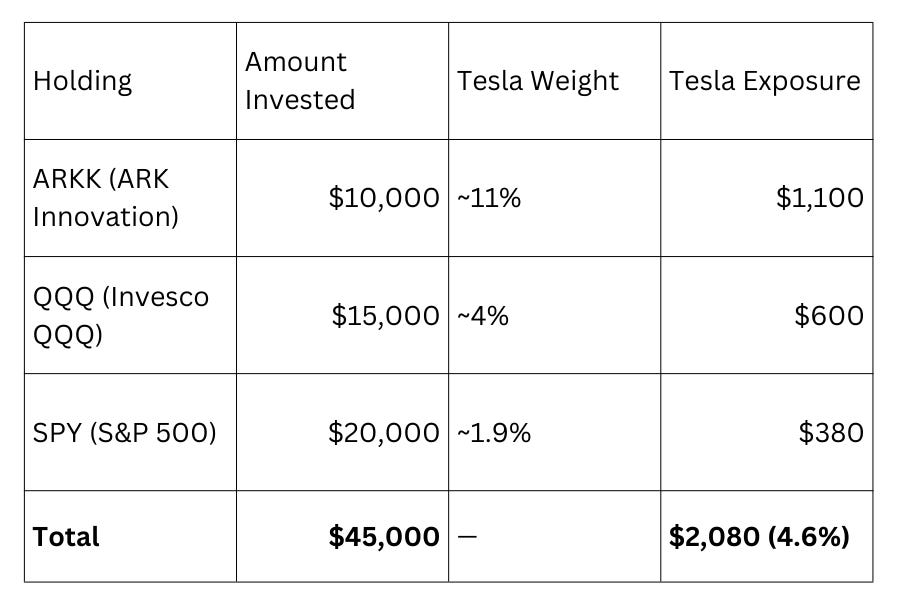
Add direct Tesla shares to this portfolio, and exposure easily exceeds 8-10% without the investor explicitly intending such concentration.
Why this matters:
At Tesla’s current ~$430-450 price range (mid-January 2026), the company trades at approximately 60-70x forward earnings—a valuation that assumes sustained technological leadership and margin superiority. When that assumption faces any challenge—whether from Donut Lab, QuantumScape, or legacy automaker partnerships with battery developers—the high multiple leaves little room for error.
A 20% Tesla decline doesn’t just hit your direct shares. It mechanically impacts:
Your ARKK position (11% weight = 220 basis points of drag)
Your QQQ position (4% weight = 80 basis points)
Your SPY position (1.9% weight = 38 basis points)
Suddenly, your “diversified” portfolio experiences coordinated declines across multiple holdings that feel like systematic risk but are actually concentrated single-stock exposure.
Understanding Tesla’s ETF footprint 🎯
Tesla’s market capitalisation of approximately $680 billion (at $430-450/share) gets distributed across dozens of thematic funds:
Innovation & Tech ETFs (High concentration):
ARKK (ARK Innovation): ~11% Tesla | $8.2B AUM | Disruptive growth mandate
ARKQ (ARK Autonomous Tech): ~10% Tesla | $1.4B AUM | Robotics/AI focus
DRIV (Global X Autonomous & EV): ~8-9% Tesla | $1.1B AUM | Pure-play EV
Clean Energy ETFs (Moderate concentration):
ICLN (iShares Global Clean Energy): ~2-3% Tesla | $6.4B AUM | Diversified renewables
QCLN (First Trust NASDAQ Clean Edge): ~4% Tesla | $2.9B AUM | Green technology
Broad Market ETFs (Lower concentration):
QQQ (Invesco QQQ): ~4% Tesla | $275B AUM | Nasdaq 100
SPY (SPDR S&P 500): ~1.9% Tesla | $485B AUM | S&P 500
Battery & Materials ETFs (Zero Tesla concentration):
LIT (Global X Lithium & Battery Tech): 0% Tesla | $3.1B AUM | Supply chain focus
PICK (iShares MSCI Metals & Mining): 0% Tesla | $4.8B AUM | Mining/materials
The key insight: An investor seeking “diversified EV exposure” across ARKK, DRIV, and ICLN doesn’t get three independent bets on the EV future—they get three overlapping exposures to Tesla plus some incremental diversification to other names.