



Five years ago, analysing Target meant counting store openings and asking whether the home and apparel aisles would clear without heavy markdowns. Not anymore. In the quarter it reported on 19 August 2026, the three smallest lines on Target's income statement, advertising, membership fees and marketplace commissions, grew four times faster than the merchandise on its shelves, while a $994 million cheque from US Customs doubled reported profit. Only one of those two things happens again next year. That's why we built Winvesta Crisps, to decode what's actually driving the companies you own, in plain language, before the consensus catches up. 60,000+ investors from all over India are already in. What about you?
🔔 Don't miss out!
Add winvestacrisps@substack.com to your email list so our updates never land in spam.
Most investors still think of Target as a discount chain fighting Walmart for the same weekly shopping trip. That framing is accurate and dangerously incomplete. Second quarter net sales were $26.5 billion, up 5.3%, and diluted earnings per share came in at $4.11 against $2.05 a year ago, per Target's Q2 2026 earnings release. Almost exactly half that earnings jump was a refund of tariffs the US Supreme Court ruled the government never had the authority to collect. Strip it out and earnings per share still rose about 20%, which is the number worth studying. Underneath it, merchandise sales grew 5.0% and non-merchandise sales grew 20.1%, and the second figure carries margin the first one has never had.
🏭 What Target actually is today
Target runs 2,019 stores across 253.8 million square feet of retail space with more than 400,000 staff, per the Q2 2026 earnings release. Roughly half the merchandise it sells is sourced outside the United States, and Target is the importer of record for most of its owned and exclusive brands, which is why a customs ruling landed in its profit and loss account rather than a supplier's.
The merchandise business is organised into six categories, and in the second quarter every one of them grew. Food and beverage is the largest at $5,991 million, household essentials next at $4,617 million, then apparel and accessories, hardlines (which Target now calls Fun 101), home furnishings and décor, and beauty. The spread between them is the whole turnaround story: hardlines grew 10.6% and beauty 7.2%, while apparel grew 0.1% and home furnishings 0.2%.
Sitting beside that is a business Target does not give its own segment. Advertising revenue, credit card profit sharing and other non-merchandise income together made $592 million of net sales in the quarter, up from $492 million. That looks trivial against $26.5 billion until you read the footnote attached to it. Target discloses that revenue from Roundel, its retail media arm, is classified as net sales, or as a reduction of cost of sales, or as a reduction of SG&A expenses, depending on how each advertising arrangement is structured. The $279 million of advertising revenue on the sales line is a fraction of what Roundel actually generates. Target has said publicly that Roundel produces more than $2 billion of value for the company, and that it aims to double that between 2025 and 2030.
That is the unusual thing about this business. The fastest-growing, highest-margin part of Target is deliberately scattered across three lines of the income statement, so no single number on the page tells you how big it is.
🧩 Segment breakdown
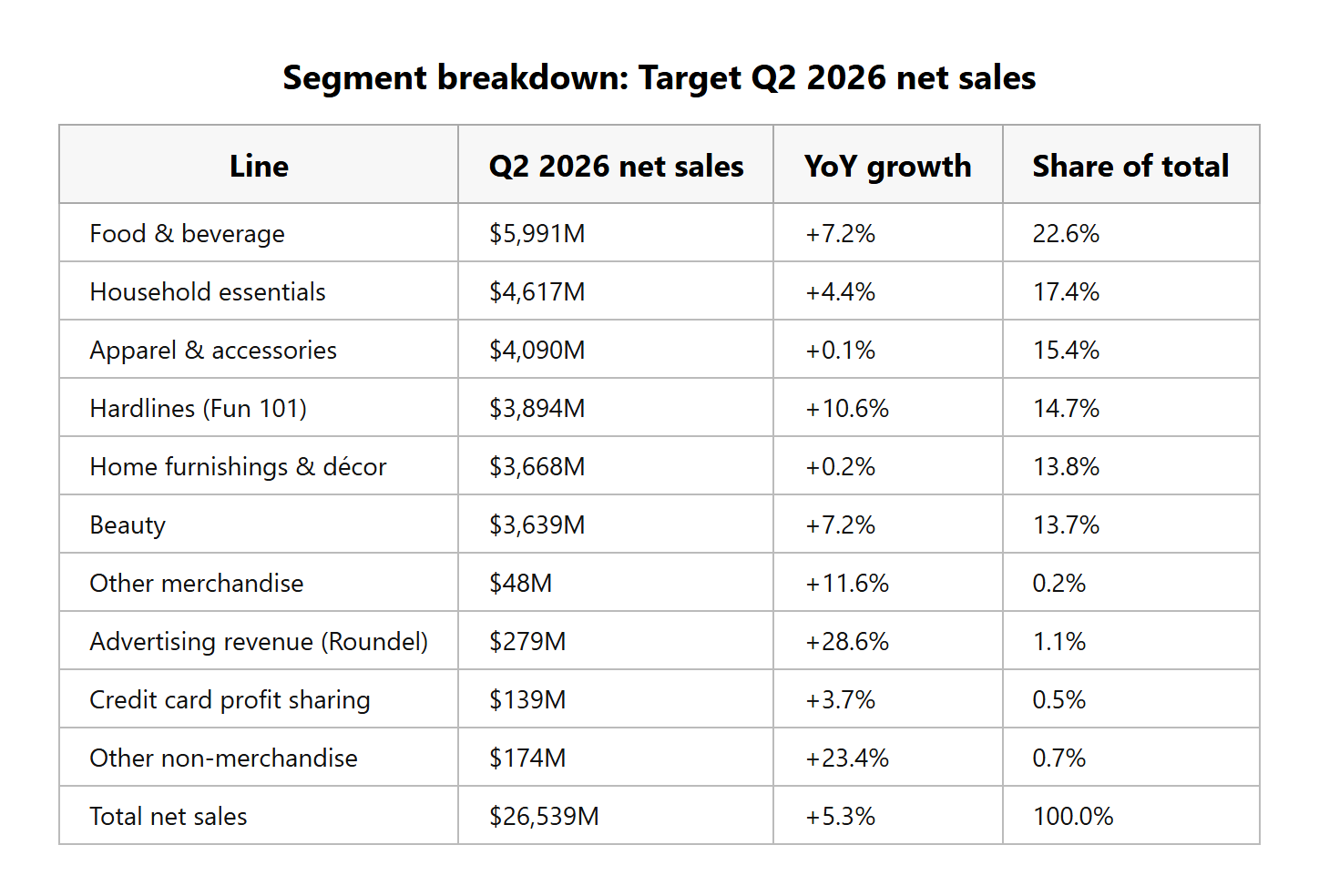
Two things in that table carry the argument. Food and beverage plus household essentials are now 40% of net sales, which is a grocer's mix, and they grew at 7.2% and 4.4%. This is what a traffic-led recovery looks like: comparable transactions rose 3.6% while the average basket rose 0.2%, per the earnings release. People came back more often. They did not spend more per visit.
The other is the bottom of the table. Advertising revenue grew 28.6% year-over-year, other non-merchandise income 23.4%. Those two lines together are 1.8% of net sales and contributed roughly 8% of the entire year-over-year increase in the top line. Their importance has nothing to do with size and everything to do with what they cost to produce.
⚡ The business that does not sit on a shelf
Target's core strategic bet is that it can grow profits faster than sales by selling things that never move through a warehouse.
There are three of them. Roundel sells advertising against Target's own shopping data, working with more than 2,000 vendors and drawing on a Target Circle loyalty base the company puts above 100 million members. Target Circle 360 is the paid membership tier, sold on same-day delivery. Target+ is a curated third-party marketplace where Target takes a commission on somebody else's inventory, somebody else's warehouse and somebody else's working capital.