


Five years ago, valuing SpaceX meant guessing at a private funding mark and arguing about launch cadence. Not anymore. The company has now filed a full quarter of public accounts, and they show a business where launch contributes barely an eighth of revenue, satellite broadband pays the bills, and the fastest growing line item is renting out computing power. That is why we built Winvesta Crisps, to decode what's actually driving the companies you own, in plain language, before the consensus catches up. 60,000+ investors from all over India are already in. What about you?
🔔 Don't miss out!
Add winvestacrisps@substack.com to your email list so our updates never land in spam.
Most investors still think of SpaceX as the company that lands rockets. That framing is accurate and dangerously incomplete. In the quarter it reported on 4 August 2026, its first as a public company, the launch business produced $962 million of a $7.81 billion total, per the Q2 2026 earnings release. The rest came from selling internet connections and selling compute. The market understood this immediately, which is why a quarter that beat revenue expectations by roughly 13% was followed by a sell-off rather than a rally. Investors are no longer being asked to price a launch monopoly. They are being asked to price a capital spending programme.
🏭 What SpaceX actually is today
The company reports in three segments, and the shape of them is the whole story.
Space is the original business: Falcon 9 and Starship, flying payloads for NASA, the US Space Force, and commercial customers. It flew 38 missions in the quarter and 78 in the first half, delivering 485 metric tonnes to orbit, per the Q2 2026 earnings materials. Most of that mass was its own satellites. Revenue of $962 million grew 29% year-over-year, the slowest of the three segments, and the segment lost money on an adjusted EBITDA basis as Starship development costs climbed.
Connectivity is Starlink, and it is the commercial engine. It ended the quarter with 12 million subscribers across 167 markets, roughly double a year earlier, and added 1.7 million net subscribers in the quarter, the best three months the service has recorded. It carries an operating margin of 38.6%, ahead of the 35.9% analysts had modelled.
AI is the segment most likely to be misread, because it is not one business. Per the Q2 2026 10-Q it spans advertising on X, premium subscriptions to X and Grok, data licensing and API access to Grok models, and the cloud compute business. The split matters. Advertising brought in $367 million and actually shrank, down from $426 million a year earlier, which the company put down to a transition to a new advertising platform. AI solutions and infrastructure brought in $2,194 million, and almost all of the segment's growth traces to a single line inside it: cloud services, which SpaceX only started selling this year and which added roughly $1.6 billion of revenue in the quarter. It ended the quarter with 1.4 gigawatts of nameplate compute, up from 0.4 gigawatts a year earlier, and signed $14.1 billion of new cloud contracts.
Read those three together and the identity question answers itself. Launch is the capability that made everything else possible. It is no longer the business.
🧩 Segment breakdown
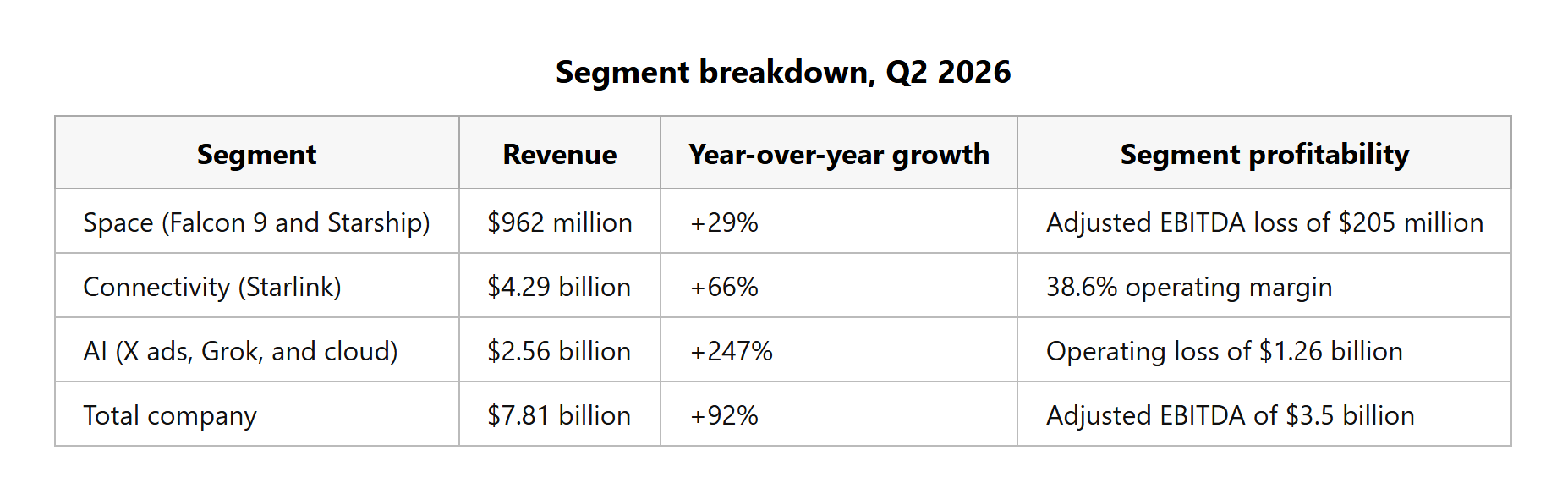
Two numbers in that table deserve a second look. The first is the Space segment's adjusted EBITDA loss of $205 million, which widened as costs rose $389 million year-over-year on Starship research and development. Rockets are not currently a profit centre. They are a cost centre that the connectivity business funds.
The second is the AI segment's operating loss of $1.26 billion, which is large but narrower than the $2.47 billion loss it posted in the first quarter. The direction of travel matters more than the level, because the segment is being scaled deliberately ahead of revenue.
🤖 The compute bet: where the money is actually going
Of the $18.37 billion SpaceX spent on capital projects in the quarter, $15.83 billion went to AI infrastructure. Analysts had modelled roughly $13.22 billion of total capex. The company spent more than that on data centres alone.
Chief financial officer Bret Johnsen told analysts that the next two quarters look similar to this one on capital spending, which points to something close to an $18 billion quarterly run rate. Management has targeted more than 2 gigawatts of compute by the end of 2026 and, per commentary on the call, somewhere closer to 10 than five gigawatts by the end of 2027. Roughly a tenth of that capacity is earmarked for training Grok, with the balance available for inference and third-party rental. The company described itself as exclusive to Nvidia on the Vera Rubin generation of hardware.