


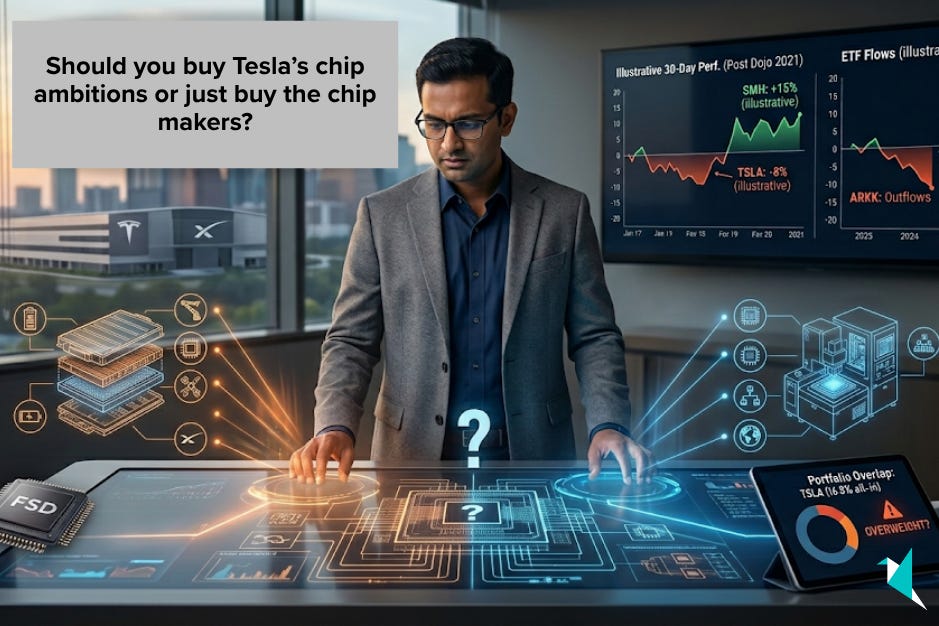
Buying into a big Tesla hardware announcement — and trusting the timeline that came with it — may have been enough. Not anymore. Musk just unveiled a chip fab called Terafab, and the market reacted exactly the way it always does with Musk announcements: excitement before the details arrive. Understanding how to separate a genuine value inflexion from a headline-driven pop is the difference between compounding and chasing.
That’s why we built Winvesta Crisps — to decode what’s actually moving the companies you own, in plain language, before the consensus catches up. 60,000+ investors from all over India are already in. What about you?
🔔 Don’t miss out! Get the latest updates delivered straight to your inbox.
Elon Musk just unveiled plans for Terafab — a chip manufacturing facility near Tesla’s Austin headquarters, developed in collaboration with SpaceX. Some outlets have floated multi-tens-of-billions-of-dollars project-scale and one-terawatt-class compute ambitions, though these remain reports rather than confirmed guidance. TSLA jumped 4.2% on the news before settling back down. Your group chat is buzzing. Your cousin who bought at $400 is feeling vindicated. And you’re wondering: is this the vertical integration play that finally justifies the valuation, or just another “Full Self-Driving next year” promise?
Here’s the important context before you decide: Tesla has been investing in in-house chip design since at least 2016, and publicly showcased its FSD chip in 2019 and Dojo in 2021. What’s new in 2026 isn’t the chip design ambition — Tesla already designs and deploys its own automotive and AI chips at scale across its vehicle fleet. What’s new is the plan to integrate manufacturing at scale through Terafab vertically. That’s a meaningful escalation. And each prior announcement came with a familiar playbook: the stock rallied, timelines stretched, and investors who chased the announcement tended to underperform those who just bought NVDA or TSM.
But let’s not dismiss this entirely. Because this time, there’s a SpaceX angle. And SpaceX has actual chip supply chain vulnerabilities that need to be solved. So maybe it’s different?
Let’s run the numbers to see whether you should buy this story, ride the hype, or use it as a reminder to check your chip exposure.
🎯 Let’s meet Ananya and see how her portfolio is doing
Ananya, 38, product manager in Pune. Portfolio value: ₹42 lakh ($50,000).
She bought Tesla in 2023 at $245, thinking she was getting a discount. She also owns QQQ and VGT for “diversified tech exposure.” She checks her portfolio every few days and feels pretty good about her tech allocation.
Then I showed her this:
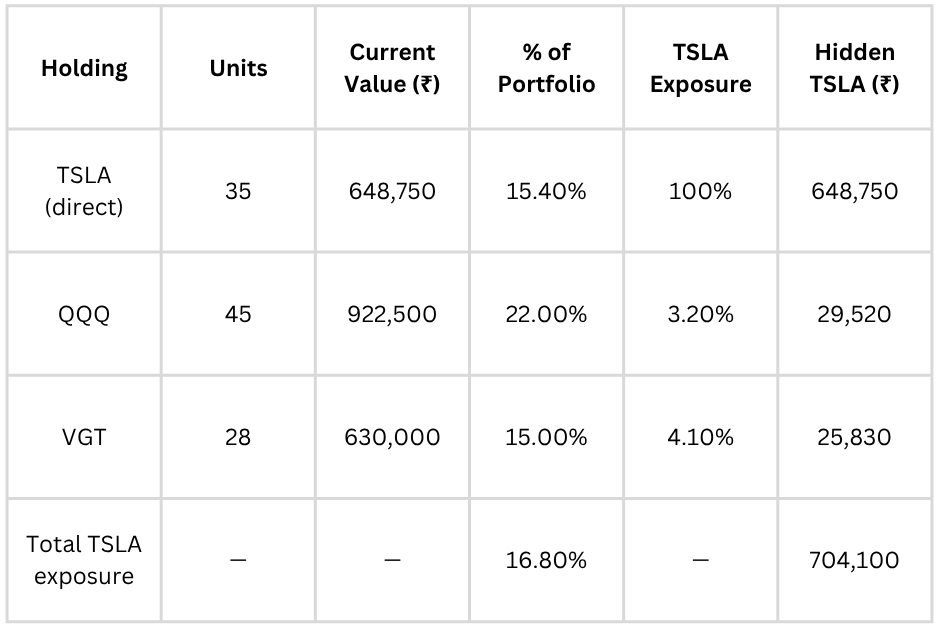
Ananya thought she had 15.4% in Tesla. She actually has 16.8%. That extra 1.4% doesn’t sound like much until you realise it’s ₹58,350 in real terms, and that she didn’t consciously choose to be overweight.
Now here’s what happened to Ananya during Tesla’s April 2025 correction (when the Cybertruck recall hit):
Direct TSLA position: Down 23% in 11 days = -₹1,49,212
QQQ held steady: Down just 2.8% = -₹25,830
VGT dropped harder: Down 4.1% = -₹25,830
Total portfolio impact: -₹2,00,872 in under two weeks
Her “diversified” tech portfolio dropped 4.8% when she thought her Tesla exposure was “contained.” The QQQ and VGT she owned for stability amplified her Tesla concentration instead of hedging it.
This chip announcement? It’s creating the same dynamic right now. Let’s figure out if you should lean in or derisk.
📊 What ETF flows actually tell you

Exchange-traded fund flows are the market’s truth serum. Marketing decks lie. Press releases spin. But money moving in and out of ETFs shows you what investors are actually doing with their capital.
Here’s what flowed into Tesla-heavy ETFs in the 5 trading days through March 21, before the announcement (figures are approximate and sourced from public ETF flow trackers; exact magnitudes vary by provider):
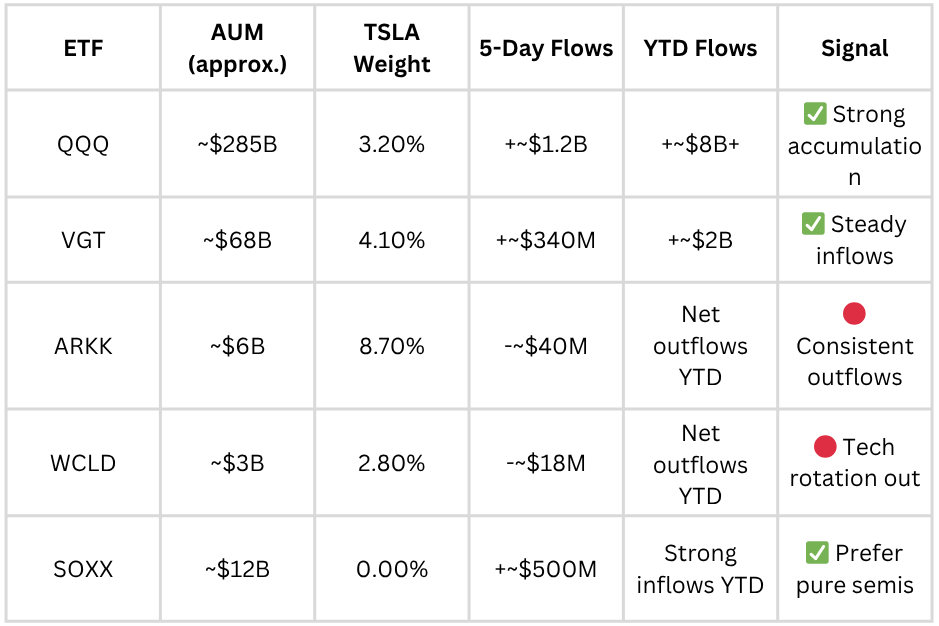
What this tells you:
The broad tech ETFs (QQQ, VGT) are still seeing inflows — but that’s index rebalancing and passive accumulation, not a bet on Tesla specifically. ARKK, which has the highest Tesla concentration among major ETFs, has been seeing net outflows year-to-date.
Meanwhile, SOXX (pure semiconductor play) has been attracting strong inflows. Investors want chip exposure, but they’re buying the established manufacturers, not the companies announcing manufacturing plans.
Here’s the flow divergence that matters: in the days after the announcement, early data suggests modest inflows into ARKK (one of its first positive days in weeks) while SOXX continued its steady accumulation. The direction of that money tells you where conviction lies.
What the flows suggest: money is leaving high-beta, Tesla-heavy funds like ARKK and moving into broad semiconductor ETFs like SOXX and SMH. The historical pattern around Tesla's “chip independence” announcements — in both 2019 and 2021 — saw short-term rallies followed by underperformance relative to the semiconductor sector over the following 30 days.
🧠 The psychology trap

This announcement feels different because:
Vertical integration is Tesla’s superpower — They’ve done it with batteries, motors, and seats. Why not full-stack chip manufacturing?
SpaceX needs supply chain resilience — Starship launches require radiation-hardened chips that have 9-month lead times.
Musk has a track record of eventually delivering — Late, yes. But FSD improved, 4680 cells are ramping, and Starship flew.
AI chip demand is exploding — If Tesla can fab their own Dojo-class chips, that’s a meaningful moat.
All of that is true. But here’s the comparison table that should give you pause:
Note: The table below is illustrative, drawing on available public reporting. Musk has not disclosed a formal production timetable for Terafab; the “first output” reference below reflects market assumptions, not company guidance.
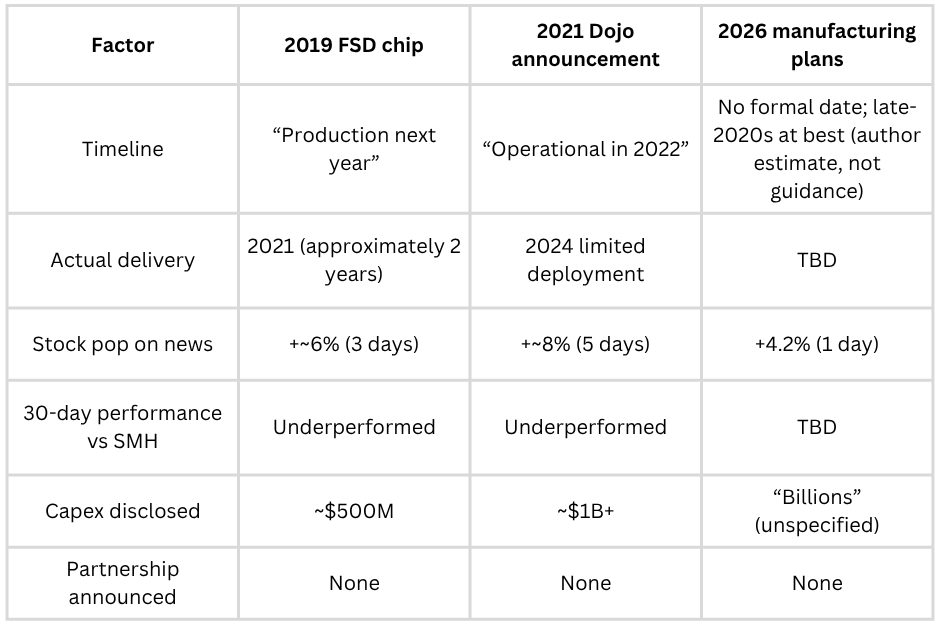
The pattern: Big vision, vague timeline, no named partners. Tesla has successfully executed on in-house chip design — what it hasn’t demonstrated is chip fabrication at a competitive scale. That’s what Terafab is claiming to solve. But fabrication is a different, harder, more capital-intensive problem than design.
Now here’s the rational vs FOMO checklist. Check the boxes that describe your current thinking:
Rational investor:
[ ] I want to see the capex figures and partnerships before adding exposure
[ ] I’m comparing Tesla’s fab timeline to how long TSMC took to build comparable capacity
[ ] I already have chip exposure through SMH/SOXX
[ ] I’m waiting for at least one independent analysis of their fab plans
FOMO investor:
[ ] “This time feels different”
[ ] I’m checking the TSLA price multiple times a day
[ ] I’m thinking about how much I’d make if this really works
[ ] I’m more focused on missing the rally than on position sizing
If you checked more boxes on the right, you’re about to make an emotional decision with math consequences. Let’s run those consequences.
🚀 Want to invest in Tesla, NVDA, SMH, or SOXX from India? Open your Winvesta account today. Trade US stocks and ETFs directly — no US bank account needed.
💡 Three realistic scenarios for Ananya’s portfolio
Numbers below are illustrative, based on assumed returns, not forecasts. These are stress-test scenarios designed to frame risk, not predictions.