


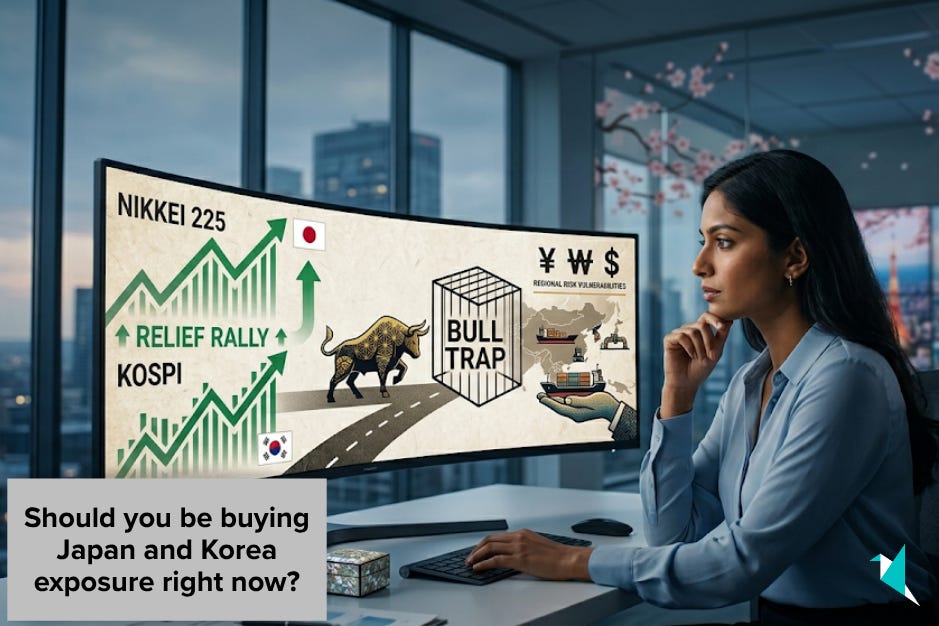
Ignoring geopolitical headlines in favour of “just holding the index” may have worked. Not anymore. When Trump threatens to close the world’s most critical oil chokepoint, the shockwaves reach every ETF you own — from the Dow’s industrial heavyweights to your “safe” global diversifier. The Japan-Korea trade is no longer just a regional story; it’s embedded in DIA, VT, and half the other funds Indian investors hold.
That’s why we built Winvesta Crisps, to decode exactly which risks are hiding inside the funds you hold, in plain language, before the damage is done. 60,000+ investors from all over India are already in. What about you?
🔔 Don’t miss out! Get the latest updates delivered straight to your inbox →
Markets are doing that thing again where terrible news and a partial reprieve arrive simultaneously, and somehow stocks go up. Japan’s Nikkei 225 and South Korea’s KOSPI both rallied sharply on Monday morning after Trump posted an expletive-filled Truth Social threat to bring “Hell” to Iran, while simultaneously extending tariff deadlines on other fronts. If you own EWJ, DIA, or any global diversification ETF, your portfolio just got a sugar rush. But here’s what nobody’s telling you: past geopolitical relief rallies of this kind have a habit of reversing just as quickly as they appeared, and the cross-asset signals right now look less like an all-clear and more like confusion dressed up as optimism.
Let me introduce you to someone who might be you.
🎯 First, let’s see if you’re actually Bhoomi
Bhoomi, 38, product manager in Pune. Portfolio: ₹42 lakhs across US markets. She bought DIA (Dow Jones ETF) six months ago as her “stable, blue-chip allocation” — worth ₹6.8 lakhs. She also owns VT (total world stock ETF) for diversification and a small position in EWJ (Japan ETF) that her advisor recommended last year during the “Japan reopening” hype.
Here’s what Bhoomi thinks she owns versus what she actually owns:
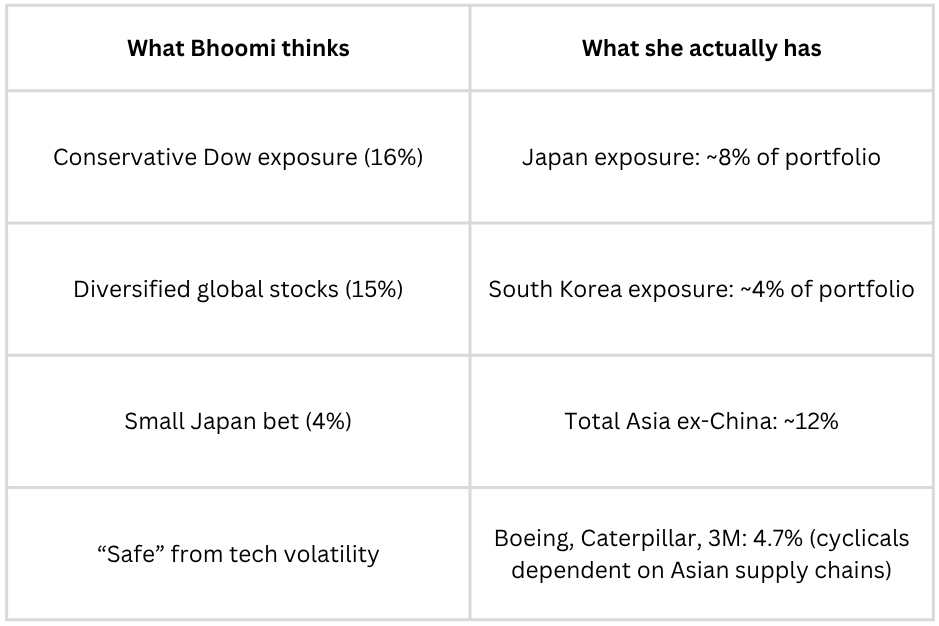
Her hidden risk: Through DIA’s industrial holdings, VT’s roughly 9–10% Japan/Korea weighting, and her direct EWJ position, Bhoomi has approximately ₹5 lakhs exposed to the Japan-Korea corridor. That’s more than her entire position in any single US stock.
What happened to her last week: When Trump first threatened Iran on April 2nd and oil spiked sharply, her portfolio dropped roughly ₹1.84 lakhs in two days. The Nikkei fell around 3%, the KOSPI dropped in a similar range, and DIA’s industrial stocks got hammered on supply chain fears. Monday’s rally brought back approximately ₹1.12 lakhs. She’s still down roughly ₹72,000 from Wednesday’s close, but it feels like she’s winning.
That feeling is the trap.
📊 What ETF flows actually tell you
ETF flows are the market’s polygraph test. Retail investors watch headlines. Institutional money watches risk-adjusted carry trades, currency hedging costs, and correlation breakdowns. Right now, those two groups are saying completely different things.
Here’s the approximate direction of smart-money flows last week (April 1–5).
Note: precise weekly flow figures vary by source and data provider. The table below is directional and illustrative, not drawn from a single audited dataset.
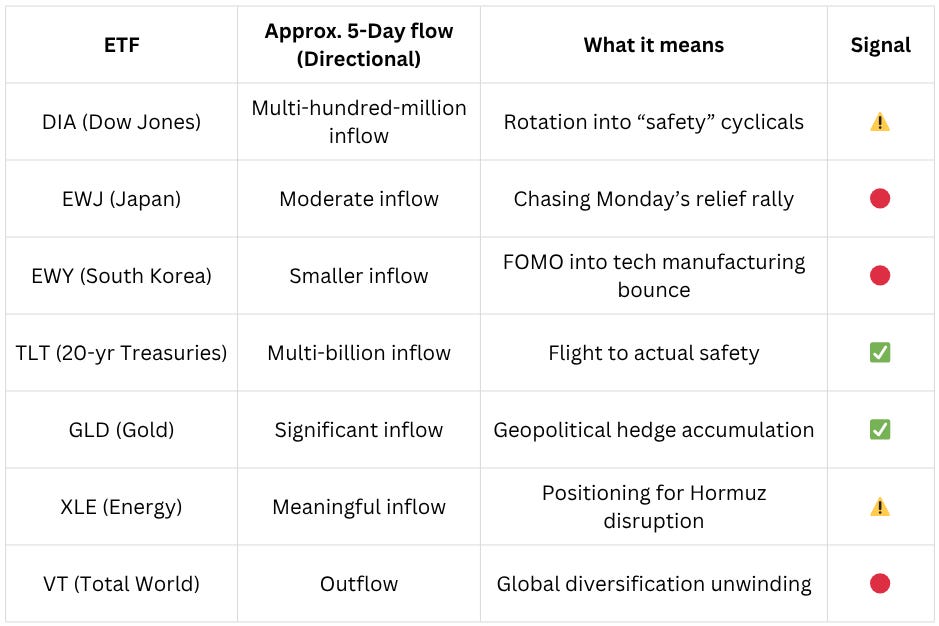
Here’s the divergence that matters: While hundreds of millions in capital chased Japan and Korea ETFs on Monday morning’s bounce, multiple billions moved into long-duration Treasuries over the same period. Fear money is meaningfully outpacing greed money — by a significant margin.
Translation: Retail is buying the headline relief. Institutions are buying protection.
The last time a similar pattern emerged was in late 2024, when China announced stimulus measures, and Asian ETFs surged sharply over a matter of days. Then reality set in, the stimulus disappointed, the carry-trade math broke down as the yen strengthened, and EWJ gave back much of its gains over the following weeks. Everyone who bought the headline spike got caught.
🧠 The psychology trap
Right now, your brain is doing something predictable. It’s giving you reasons why this time the bounce is real:
✅ “Trump extended the tariff deadline, that’s bullish for trade!”
✅ “Japan and Korea are cheap compared to US markets”
✅ “Geopolitical tension usually fades quickly”
✅ “My DIA position is finally recovering”
Let’s be clear about what history suggests. Past geopolitical relief rallies — the China stimulus announcement in late 2024, earlier tariff-truce bounces in 2025 — followed a recognisable pattern: a sharp initial move, a brief window of optimism, and then a reversal as the underlying issues reasserted themselves. In those past examples, the smaller the initial bounce, the faster it tended to fade. This current rally is not a particularly enthusiastic one — worth noting, even if past episodes are no guarantee of what comes next.
None of this is a guaranteed template. But the setup rhymes.
The rational vs FOMO checklist:
Ask yourself honestly:
❌ Do I understand what happens to my portfolio if the yen strengthens another 3%?
❌ Can I explain why Japan is up when Trump literally threatened to bring “Hell” to Iran?
❌ Do I know what percentage of South Korea’s exports go through the Strait of Hormuz?
❌ Would I be buying this if I didn’t already own it?
If you answered “no” to three or more, you’re not investing, you’re rationalising a position that’s already underwater.
🚀 Want to add DIA, EWJ, or EWY to your portfolio? Trade these ETFs directly from India on the Winvesta app. No US bank account needed!
Join 60,000+ investors, become a paying subscriber or download the Winvesta app and fund your account to get insights like this for free!
💡 Three realistic scenarios for Bhoomi’s portfolio
Let’s model what actually happens to Bhoomi’s ₹42 lakh portfolio under different outcomes. She has roughly ₹6.8L in DIA, ₹6.3L in VT, ₹1.68L in EWJ, and approximately ₹5L in total Asia ex-China exposure.
The following scenarios, probabilities, and return estimates are illustrative stress tests based on assumed returns and subjective probabilities, not forecasts, market consensus, or guarantees of future performance.