


Picking pharma stocks meant reading clinical trial results. Not anymore. AI is rewriting the drug discovery playbook — and deals like Lilly-Insilico are moving billions of dollars into platforms that haven’t yet generated a single approved drug. If you don’t understand where institutional money is actually flowing, your “diversified” portfolio might be carrying far more single-theme concentration than you think.
That’s why we built Winvesta Crisps — to decode what’s actually moving the sectors you own, in plain language, before the consensus catches up. 60,000+ investors from all over India are already in. What about you?
Eli Lilly just committed up to $2.75 billion for AI-powered drug discovery. Insilico Medicine’s shares jumped on the news. The AI-meets-biotech narrative is back with force. And if you’ve been building a “diversified” portfolio across tech ETFs and pharma names, there’s a real chance you’re far more concentrated in a single theme than you realise.
But here’s what most investors are missing: this isn’t a simple “buy biotech or don’t” moment. It’s a signal about where AI sits in its commercial maturity — and whether your portfolio is positioned for the next phase, or still carrying last cycle’s infrastructure bet into a different market.
Lilly is not a speculative biotech making a moonshot bet. It is one of the most disciplined capital allocators in global pharma. When they write a cheque like this, they believe the molecules look good before a single human has tested them. That’s the part of this story that actually matters.
🔔 Don’t miss out!
Add winvestacrisps@substack.com to your email list so our updates never land in your spam folder.
🔬 The deal: What just happened
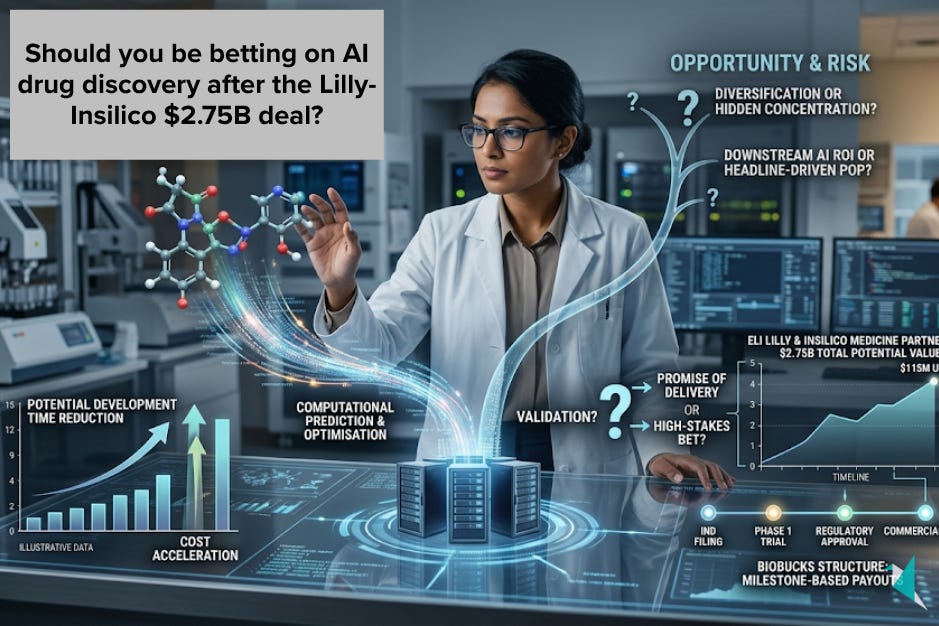
Insilico Medicine is an AI-powered clinical-stage biotech that uses generative AI and machine learning to design novel drug molecules. Instead of traditional trial-and-error screening of existing compounds, Insilico’s platform computationally proposes molecular structures targeting specific disease mechanisms. The company claims significant reductions in early-stage development time and cost compared to conventional approaches — though independent validation of precise figures is limited.
The Lilly partnership, announced March 29, 2026, grants Eli Lilly exclusive worldwide rights to develop and commercialise a portfolio of preclinical oral therapeutics discovered through Insilico’s AI platform, targeting undisclosed indications. The structure, per reporting from CNBC, FierceBiotech, and Investing.com:
~$115 million upfront to Insilico
Up to $2.75 billion in total potential value via development, regulatory, and commercial milestones plus tiered royalties
Exclusive worldwide rights to specific AI-discovered preclinical oral programs — not a blanket platform licence
The “biobucks” structure matters. Most of that $2.75 billion is contingent — it pays out only if drugs actually work, survive clinical trials, and earn regulatory approval. That’s a long and uncertain road. But Lilly staking nine-figure upfront capital on preclinical AI-discovered molecules is a meaningful vote of confidence at a stage where most pharma companies ask for Phase 1 data first.
🌀 What this actually validates
The honest answer: It validates the promise of AI drug discovery, not the delivery.
Lilly is a top-ten global pharma by market cap. Their decision to write this cheque says the molecules look promising enough to bet real capital on — before a single human clinical trial. The deal is meaningfully larger than most prior AI platform partnerships in pharma, which have typically involved smaller upfronts and narrower scopes. The exclusivity clause signals conviction, not just curiosity.
But context matters. Here’s how this moment compares to previous “validation” events:
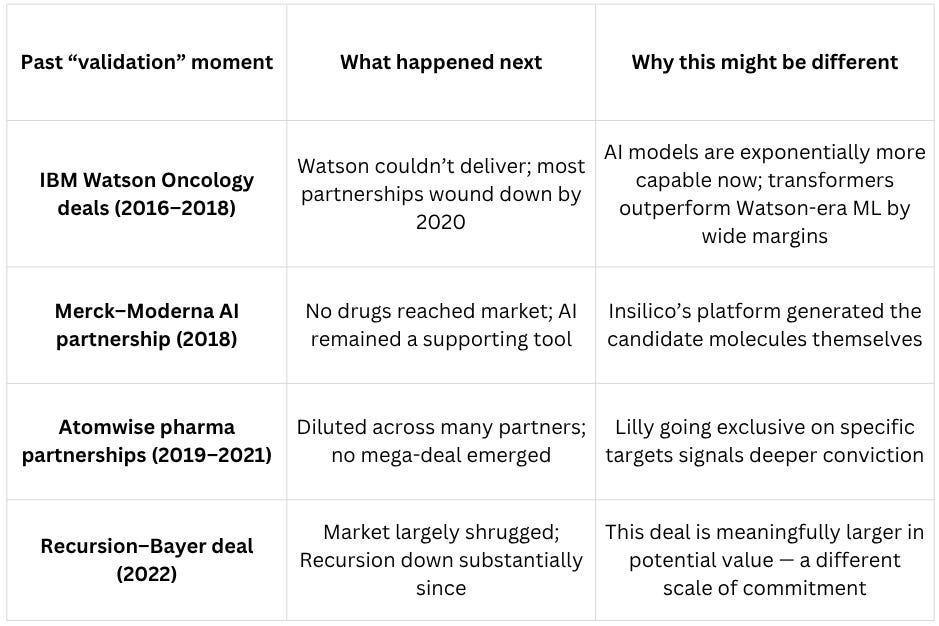
The difference between Watson-era “AI in pharma” and today: The molecules are computationally designed, not just screened. That’s a step change in AI’s role in the pipeline. Still, one deal is one data point. Three to five more top-ten pharma mega-deals would confirm a trend. Right now, it is an important signal. Not yet a confirmed rotation.
✨ What’s genuinely working in AI-pharma
The Lilly-Insilico deal is part of a broader shift: AI is maturing past infrastructure buildout and beginning to generate demonstrable downstream value. Drug discovery is one of the cleanest use cases, because the economics of traditional development are painful enough that even partial AI acceleration creates large value.
The core economic argument:
Traditional drug discovery from target identification to IND filing takes roughly 4–6 years and hundreds of millions of dollars before a single human trial
AI platforms can compress early computational stages — designing, screening, and optimising candidates faster than conventional screening.
Lilly is paying ~$115 million upfront before Phase 1 data, suggesting internal models show the economics make sense even after accounting for clinical risk.
The cleaner AI-pharma thesis: AI doesn’t eliminate the brutally high failure rate of clinical trials, but it can reduce the time and capital burned before reaching human trials. That’s where the value is — not in guaranteed approvals, but in cheaper, faster shots on goal.
Where it gets murky: Most “AI-pharma” ETFs hold 100+ companies. A handful have actual AI-discovered molecules in clinical trials. Buying XBI, hoping the Lilly deal lifts all biotech, is a scatter-gun approach to a precision theme.
Want to add Lilly or US equities to your portfolio? Trade directly from India on the Winvesta app. No US bank account needed!
🚀 Join 60,000+ investors — become a paying subscriber or download the Winvesta app and fund your account to get insights like this for free!