


Most investors buy an S&P 500 fund to stop picking stocks. Cap weighting has quietly picked one for them: about 34 paise of every rupee in that fund now sits in seven companies running the same trade. On Saturday the people building frontier AI asked the industry to slow down, and on Wednesday the Federal Reserve is expected to raise rates into it. Knowing how a theme becomes an index is the difference between owning 500 companies and owning one bet held 500 ways. That's why we built Winvesta Crisps: to break down what's actually moving markets, in plain language, before the consensus catches up. 60,000+ investors from all over India are already in. What about you?
🔔 Don't miss out!
Add winvestacrisps@substack.com to your email list so our updates never land in spam.
On 12 September, Anthropic's Dario Amodei called for frontier AI development to be deliberately slowed, proposing outside evaluators inside the leading labs, common safety benchmarks, and agreed limits on how fast systems are allowed to gain capability. Sam Altman of OpenAI and Elon Musk both endorsed the idea within a day, per reporting in the Washington Post and CNBC. President Trump dismissed it on the Sunday, saying a slowdown would risk America's lead over China. Here is the part that matters for your portfolio: not one of Anthropic, OpenAI or xAI is in your index fund. The listed companies that would actually pay for a slowdown are, and per September 2026 data they are roughly 34 per cent of the S&P 500. The AI trade stopped being a sector call some time ago. It is now the index.
📉 How the most diversified product in finance got this narrow
The S&P 500 was sold to a generation of investors on a single idea. Buy all of it, own the American economy, stop guessing. For most of its history the arithmetic backed that up. The top 10 holdings averaged about 24 per cent of the index, and the previous high-water mark was 28 per cent, set in 1970.
That number now sits somewhere between 37 and 41 per cent depending on the provider and the date, per RBC Wealth Management and figures compiled by Pensions and Investments. The seven largest, the ones the market keeps calling the Magnificent Seven, are about 34 per cent on their own. The other 493 companies share what is left.
Three things got it here, and only one of them is about AI.
Cap weighting is the first and it is not a flaw. An index that weights by market value will always hold more of what the market has decided is worth more. That is the design, and for decades it produced a spread that looked like the economy.
The second is that one theme happened to be concentrated in very few listed names. Semiconductors, cloud infrastructure and the memory that goes into a data centre are industries with two or three serious players each, not twenty. When capital spending on AI accelerated, it did not spread across 500 balance sheets. It landed on about a dozen.
The third is flows. Index domestic-equity funds held roughly 18 per cent of the entire US stock market's value at the end of 2024, per Investment Company Institute data, ahead of the 12 per cent held by active domestic-equity funds. Broader definitions that count internally managed index portfolios and closet indexing put the passive share far higher, above 50 per cent in some academic estimates. The honest version is that the measurement is contested and the direction is not.
⚙️ What cap weighting actually does to your money
Work through one rupee, because the mechanics are where the risk hides.
You send 1,000 rupees into an S&P 500 index fund. The fund does not divide it 500 ways. It buys in proportion to market value, so roughly 340 rupees goes into seven companies, and the smallest 100 companies in the index share something closer to 20 rupees between them. You have not made a concentrated bet. You have accepted the one the index made on your behalf.
Now run it in reverse, which is the direction nobody models. A 10 per cent fall in those seven names takes about 3.4 per cent off the index before a single one of the other 493 has moved. A 20 per cent fall takes closer to 7 per cent. For that to be cushioned, the remaining 493 have to rally hard at exactly the moment the largest companies are falling.
They are not positioned to do that, and this is the part most concentration commentary misses. The other 493 are not independent of the trade. The biggest individual gainers in the index this year have been the AI supply chain rather than the AI platforms: Sandisk up over 700 per cent, Dell up around 245 per cent, Micron up around 243 per cent, per year-to-date figures compiled in early September. Those are not diversifiers. They are the same story with a different ticker and more operating leverage.
Then add what happens on Wednesday. August consumer prices rose 0.4 per cent on the month with core at 0.3 per cent, faster than expected, and producer prices came in at 0.4 per cent on the month and 5.4 per cent on the year. Odds of a rate rise at this week's meeting jumped to about 90 per cent from 70 per cent in a day, per CME FedWatch, and prediction markets put a 25 basis point rise at roughly 90 per cent for the 15 to 16 September meeting. It would be the first rise since 2023, and futures are pricing two by year end.
A higher discount rate hurts long-duration growth assets most. The seven companies carrying a third of the index are the longest-duration assets in it, because their valuations rest on cash flows years out. So the oil shock that pushed Brent to around 105 dollars and West Texas Intermediate to around 101 dollars is not a separate story from the concentration story. It is the mechanism that turns concentration from a statistic into a drawdown.
The dynamics covered in this article affect every US stock in your portfolio. Trade from India on the Winvesta app. No US bank account needed!
🚀 Join 60,000+ investors, become a paying subscriber or download the Winvesta app and fund your account to get insights like this for free!
🏆 Who a narrower index helps and who it hurts
Concentration is not a risk that sits in one place. It redistributes, and the split follows who needs the AI capital cycle to keep running.
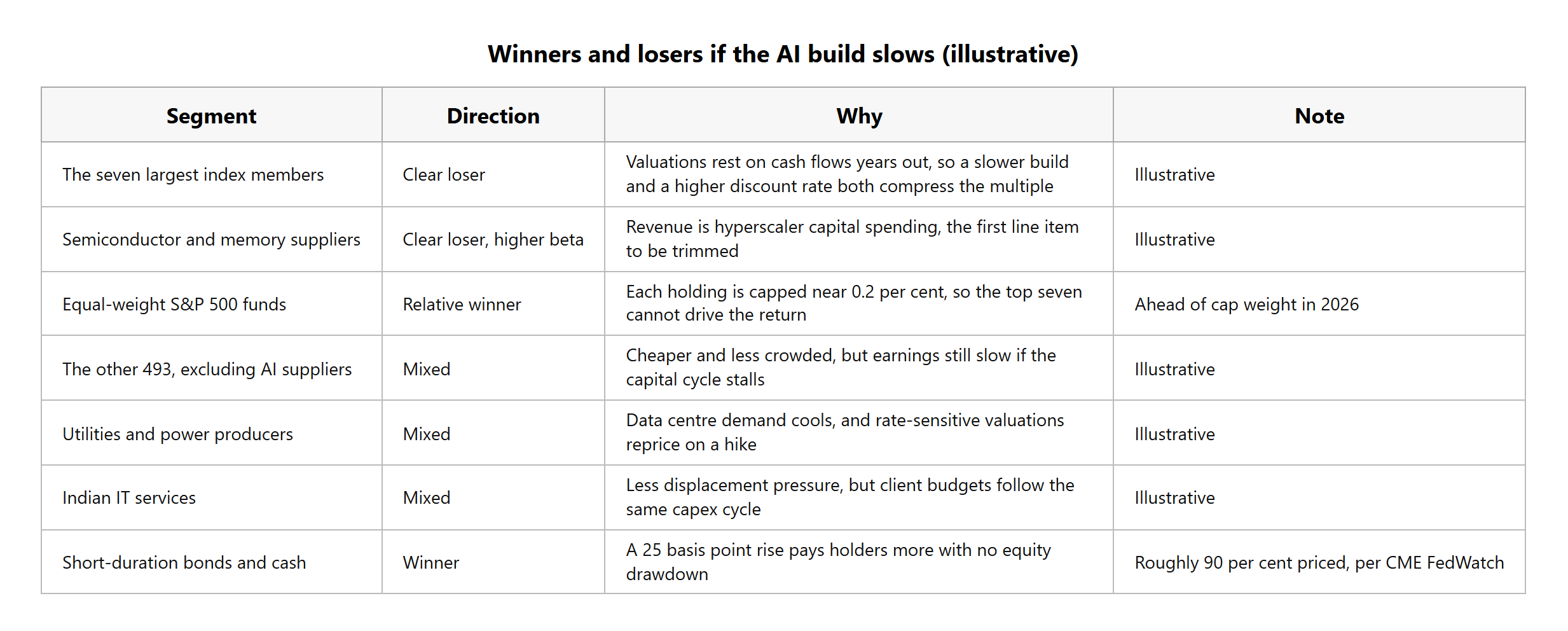
The useful thing to notice is that most large portfolios sit on both sides at once. An investor holding an S&P 500 fund, a Nasdaq 100 fund and a US technology fund does not own three positions. They own the same seven companies three times, at three different expense ratios.
🇮🇳 What this means for an Indian investor holding US equities
Start with the position most Indian investors are actually in, because it is not the same as an American one.
An Indian portfolio that holds a Nifty index fund plus an S&P 500 fund looks like 550 companies and two countries. It is not. The Nifty's top 10 were 53.58 per cent of that index as of 30 June 2026, with financials around 37 per cent of the whole thing, per index provider data. Reliance alone was about 9 per cent in mid-September. So the real shape is two concentrated positions: one on Indian banks and the rate cycle they trade on, and one on US AI capital spending. The number of stocks is high. The number of bets is two.
The second thing is specific to India and it is uncomfortable. You may not be able to fix your US concentration through a domestic fund even if you want to. The industry-wide overseas investment cap of 7 billion dollars, with a separate 1 billion dollar allowance for overseas ETFs, was close to exhausted again by May 2026. Axis suspended fresh inflows into select overseas schemes from 6 May, and Nippon India and Kotak are among the houses that have paused or capped subscriptions. As of the middle of this year there was no announced plan to raise the cap, and AMFI has asked more than once. A closed fund cannot rebalance you into anything. The route that stays open is direct US investing under the Liberalised Remittance Scheme, where you choose the weights yourself, including the option of an equal-weight fund.
Third, run the currency maths, because the shock absorber Indian investors have relied on for a decade was switched off three weeks ago. A falling rupee has quietly added to rupee returns on US portfolios year after year. This year roughly 5.75 percentage points of a rupee investor's gain on the S&P 500 came from the currency rather than the index. The Reserve Bank has just raised 136.37 billion dollars through its special swap window and pushed reserves to a record 740.80 billion dollars, specifically to stop the rupee falling further from its 96.82 low in May. It is trading nearer 94.50 now.
The table below runs the arithmetic both ways, holding the other 493 companies unchanged so the concentration effect is visible on its own. It is an editorial model, not a forecast.
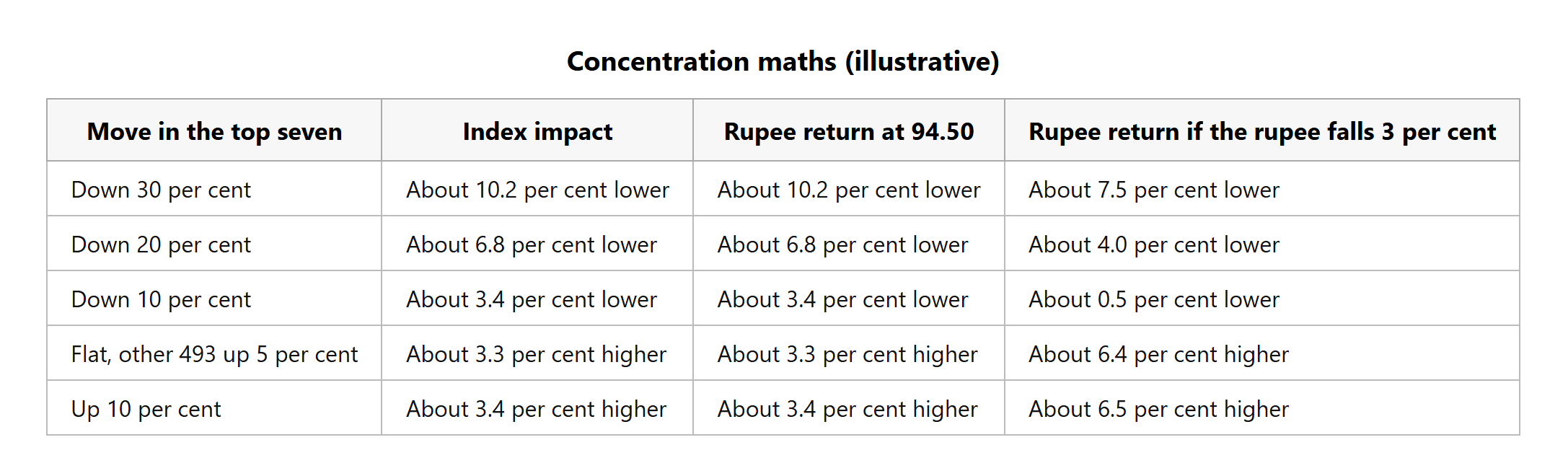
Put those together. If the top seven correct meaningfully, the index falls, and the rupee cushion that used to soften a dollar drawdown is being actively fought by the institution best placed to fight it. Indian investors have been paid twice on the way up. They should not budget for being paid twice on the way down.
🔭 What to watch
Five things, each one checkable by anyone with a browser.
Wednesday's Fed decision and the rate path that comes with it. The rise itself is close to fully priced, so the information is in the guidance: whether the committee signals the second rise that futures already expect, and how it describes an inflation problem that is largely coming from energy.
The gap between RSP and SPY. Equal weight has been ahead of cap weight this year, with the size of the gap varying by source and measurement date, after three years of losing to it. That spread is the cleanest free breadth indicator available. Widening in equal weight's favour says participation is spreading. A sharp reversal says the index is narrowing again.
The Magnificent Seven weight itself, published monthly. It is about 34 per cent. A move through 35 per cent tells you the problem is getting worse while everything looks calm. A fall back under 30 per cent would be the first real evidence of broadening in three years.
Whether the slowdown proposal acquires any legal form. Right now it is three executives and a White House that said no on 13 September. Voluntary safety benchmarks cost the listed companies very little. Statutory limits on capability growth or on data centre build-out would cost them a great deal, and that difference is not yet priced.
Hyperscaler capital spending guidance in the late October earnings round. Capex plans are the cash flow that the semiconductor and memory names are valued on. One cautious guidance line from a large buyer does more damage to the supply chain than any safety proposal.
If this changed how you read the phrase "diversified index fund", pass it on.
🏁 The bottom line
Nobody reading this chose to put a third of their US exposure into seven companies running the same trade. Cap weighting did it, gradually, and it was the correct decision every single year on the way up. The index is not broken and this is not an argument for selling it. It is an argument for knowing what it currently is, which is a concentrated position in the AI capital cycle wearing the clothes of a diversified fund.
The awkward timing is that three cross-currents have arrived in the same week. The people closest to the technology are asking for a slower build. The Federal Reserve is about to raise the discount rate that the most expensive part of the index is most sensitive to. And the rupee tailwind that has flattered every Indian investor's US returns is being deliberately held back. None of those alone would matter much. Together they are a reason to look at what you own rather than what you thought you bought.
The fix, if you decide you want one, is unglamorous. Know the number. Decide whether a third in one theme is the number you actually want. If it is not, equal weight and deliberate satellites do the job, and a position you sized on purpose behaves very differently in a drawdown from one you inherited by arithmetic.
📊 By the numbers
About 34 per cent: the seven largest companies' combined share of the S&P 500 as of September 2026, with the other 493 sharing the rest
37 to 41 per cent: the top 10 weight depending on provider and date, against a long-run average near 24 per cent and a prior peak of 28 per cent in 1970
53.58 per cent: the Nifty's top 10 weight as of 30 June 2026, with financials around 37 per cent of the index, so Indian investors own concentration at home too
18 per cent versus 12 per cent: index domestic-equity funds' share of total US market value at end-2024 against active funds, per Investment Company Institute data
90 per cent: the odds of a 25 basis point rise at the 15 to 16 September Fed meeting after the August inflation prints, per CME FedWatch, which would be the first rise since 2023
7,585.73, 52,093.11 and 25,981.57: where the S&P 500, Dow and Nasdaq Composite closed on 15 September, all lower on the day
105.68 and 101.39 dollars: Brent and West Texas Intermediate settlement prices on 15 September, the energy shock behind the inflation the Fed is responding to
7 billion dollars: the industry-wide cap on Indian mutual funds' overseas investment, close to exhausted again since May 2026, which is why several international schemes are shut to fresh money
5.75 percentage points: the share of a rupee investor's gain on the S&P 500 this year that came from the currency rather than the index, a cushion the RBI is now spending to remove
Disclaimer: All content provided by Winvesta India Technologies Ltd. is for informational and educational purposes only and is not meant to represent trade or investment recommendations. Remember, your capital is at risk. Terms & Conditions apply. Sector impact and portfolio impact figures in this article are illustrative editorial models, not reported or verified data.