


Salesforce, the world’s largest CRM provider, quietly rewired its entire platform around autonomous AI agents that don’t assist employees but replace entire job functions, qualifying leads, resolving support tickets, managing IT queues, running sales outreach, all without a human ever clicking a button.
Agentforce crossed $800 million in annualised recurring revenue in its first 15 months, growing 169% year on year, and Salesforce has set its FY2030 revenue target at $60 billion or more on the back of it.
That’s why we built Winvesta Crisps, to decode what’s actually driving the companies you own, in plain language, before the consensus catches up. 60,000+ investors from all over India are already in. What about you?
🔔 Don’t miss out!
Add winvestacrisps@substack.com to your email list so our updates never land in spam.
Most investors hear “Salesforce” and picture a sales team logging calls into a CRM. That framing is roughly a decade stale. The company that built its empire on organising customer data and automating the odd email sequence has spent the last two years rebuilding its entire platform around a single bet. Autonomous AI agents.
Systems that don’t just suggest the next action but actually complete it without human input will become the dominant unit of enterprise computing. The product built around this bet is called Agentforce. It crossed 29,000 cumulative enterprise deals in its first 15 months, per company filings, with deal count growing 50% quarter over quarter.
And yet, as of May 25, 2026, Salesforce stock trades around $179, down roughly 38% from its 52-week high of around $286, per CNBC. The market is watching a company with $41.5 billion in full-year FY2026 revenue, a record $72.4 billion in remaining performance obligations, a $50 billion share buyback programme, and an AI platform that enterprise customers are adopting at a pace management describes as unprecedented, and pricing it at its cheapest forward multiple in years, roughly 13.6x, per analyst estimates. The disconnect is the story. Wednesday’s Q1 FY2027 results will be the first real test of whether that discount is a buying opportunity or a warning.
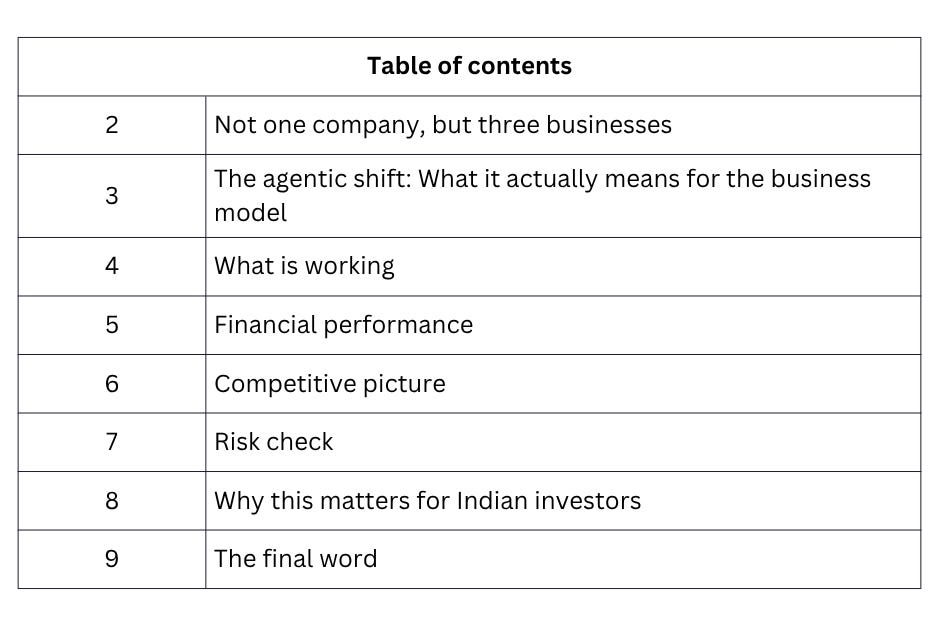
🏗️ Not one company, but three businesses
Most coverage of Salesforce leads with total revenue and stops there. That misses the three structurally different businesses running inside the same platform, each with different growth trajectories and very different implications for the stock.
The core CRM suite, Sales Cloud, Service Cloud, Marketing Cloud, Commerce Cloud, is the foundation. This is the business most investors know: subscription software that organises customer data, automates workflows, and helps enterprises manage the full customer journey from lead to renewal. It is large, sticky, and growing at a mid-to-high single digit pace organically. It is not the growth engine anymore. It is the distribution moat that makes the rest of the story possible.
Data Cloud and the Informatica layer is the intelligence foundation. Salesforce completed its acquisition of Informatica, the enterprise data management company, by early 2026 for approximately $8 billion, per company disclosures. The combination created what Salesforce calls Data 360, a unified data architecture that connects, cleans, and governs every piece of enterprise data before an AI agent ever touches it. The full Data 360 portfolio, including Informatica Cloud, crossed $2.9 billion in annualised recurring revenue by the end of FY2026, up more than 200% year on year, per company filings. CEO Marc Benioff has framed the acquisition in blunt terms: without clean, connected, trusted data, AI agents produce hallucinations rather than outcomes. The data layer is the prerequisite, not the product.
Agentforce is the new revenue engine. This is the business that is doing what the rest of the enterprise software industry is still mostly talking about. Agentforce deploys autonomous AI agents directly into the core CRM workflows that enterprises already run on Salesforce. These are not chatbots or assistants that suggest what a human should do next. They are agents that receive a trigger, reason through a problem using the Atlas Reasoning Engine, pull live data from Data Cloud, and complete a multi-step workflow without human intervention, subject to guardrails the enterprise sets. Per company commentary, agents can qualify inbound leads end to end, resolve customer service cases autonomously, route IT tickets and reset passwords, run outbound sales development sequences, and manage marketing campaign execution. The same platform, within the same Salesforce org already licensed by the enterprise, is performing work that previously required headcount.
🤖 The agentic shift: what it actually means for the business model

The most important shift in Salesforce’s business is not product-level. It is pricing-level. Traditional Salesforce licences were sold per seat, meaning the more humans used the software, the more the enterprise paid. Agentforce introduces a new pricing dimension: Agentic Work Units, or AWUs, which measure tasks completed by an AI agent rather than seats held by a human employee.
This matters for two reasons. First, it means the addressable market for Salesforce’s revenue is no longer capped by enterprise headcount. An agent that handles 10,000 customer service interactions a month generates 10,000 units of billable work regardless of how many human agents a company employs. Management disclosed that 2.4 billion AWUs have been delivered to date across Agentforce and Slack, growing 57% quarter on quarter, per company filings. Second, the AWU model creates a consumption-based revenue layer on top of the existing subscription base, meaning enterprises that deploy agents at scale will pay materially more than their prior contract without Salesforce having to win a new customer.
Salesforce is also accruing a strategic position that is structurally difficult to replicate: it sits at the intersection of the application layer and the data layer for enterprise customer operations. Microsoft has Copilot embedded in Office and Teams. Google has Gemini embedded in Workspace. But neither of those platforms owns the CRM data, the customer journey data, the service history, or the sales pipeline that Salesforce has been accumulating for 25 years. An AI agent that can reason across all of that data inside a single governed trust layer has a materially different capability than an agent bolted onto a productivity suite. That data moat is why enterprises are giving Agentforce production access rather than running it in sandboxed pilots.
The deal activity backs this up. Salesforce closed more than 29,000 cumulative Agentforce deals since launch, per company filings, including a $5.6 billion ceiling contract with the US Army, a 10-year arrangement with no guaranteed purchase amount, per the Wall Street Journal. Deals over $1 million grew 26% year on year and deals over $10 million grew 33% year on year in Q4 FY2026, per the earnings release. SharkNinja, Wyndham, and others have been cited as customer references reporting measurable return on investment from Agentforce deployments.