


When Disney’s board reportedly moves to name Josh D’Amaro as the company’s next CEO—a vote expected within days—it won’t just be a corporate succession story. It’s a masterclass in reading ETF flows, understanding investor psychology, and decoding what billions of dollars in fund movements actually tell us about market sentiment.
Here’s why this matters for ETF investors: D’Amaro isn’t a streaming technologist or a media executive. He’s a parks guy—the chairman who’s been squeezing record revenue from theme parks, resorts, and cruise ships. His expected promotion signals a strategic pivot that will ripple through consumer-discretionary ETFs, S&P 500 trackers, and dividend-growth funds that hold Disney.
But the real question isn’t about Disney’s strategy. It’s about what ETF flow patterns reveal: Are investors making rational, data-driven bets on this shift? Or are they chasing momentum in mega-cap consumer names regardless of fundamentals?
This is a case study in using ETF flows as a real-time sentiment indicator—and understanding when flows signal conviction versus when they’re just noise. Let’s break down how to read the signals.
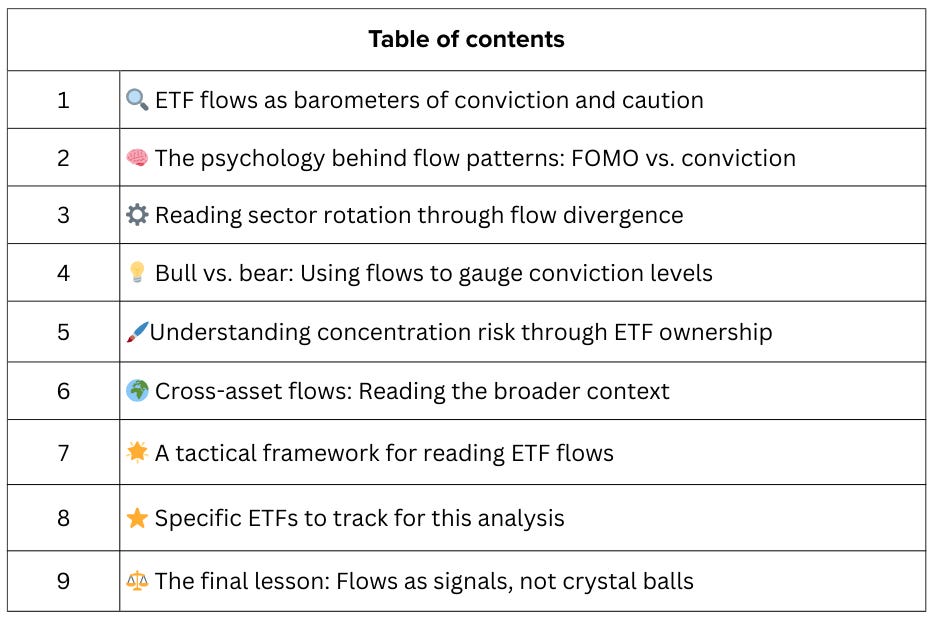
🔍 ETF flows as barometers of conviction and caution

The Core Principle: ETF flows measure actual dollars moving in or out of funds—not just price changes, but real buy and sell decisions by investors. When an ETF sees persistent inflows, it means investors are deploying fresh capital into that theme, sector, or strategy. When outflows pile up, it’s a vote of no confidence (or at least profit-taking).
This makes flow data a more immediate sentiment gauge than quarterly earnings reports or analyst upgrades. Price can rise on low volume or because of buybacks. But flows require conviction—or at least the illusion of it.
Disney as the lens: The stock doesn’t trade in isolation. It’s a prominent holding in major consumer discretionary ETFs, features in S&P 500 funds, and anchors entertainment-themed strategies. So when we analyse “Disney flows,” we’re really examining whether investors are buying into the sectors and themes where Disney plays a significant role—or rotating away from them.
The strategic signal: If D’Amaro’s promotion is confirmed, it telegraphs that Disney may double down on experiential revenue—theme parks, cruises, resorts—rather than bleeding cash to compete with Netflix on streaming. For ETF investors, this matters: it changes which sector funds benefit, which thematic plays make sense, and how to interpret flow patterns across consumer discretionary, entertainment, and large-cap blend strategies.
Key takeaway: Major corporate strategy shifts create natural experiments for observing how capital flows respond. Disney’s CEO transition offers a clear before-and-after moment to track whether ETF investors actually respond to fundamentals or simply chase price momentum.
🔔 Don’t miss out!
Add winvestacrisps@substack.com to your email list so our updates never land in spam.
🧠 The psychology behind flow patterns: FOMO vs. conviction

Understanding investor psychology through flows:
Why do investors pile into assets—and the ETFs that hold them—after rallies have already begun? Behavioural finance offers several explanations:
Recency bias: Recent performance feels predictive
FOMO: Fear of missing out drives late entries
Momentum persistence: Trends stay intact longer than logic suggests
The Disney example: The stock has had a volatile few years, but 2025 and early 2026 have been kinder. Parks are printing money post-pandemic, streaming losses have narrowed, and activist threats have been fended off. For ETF investors, that narrative shift creates a perceived green light: “Things are stabilising. Leadership is clarifying. Time to buy.”

The analytical question: Are buyers chasing momentum or making calculated bets on operational improvement?
This is the core challenge in reading ETF flows: distinguishing between rational capital allocation and herd behaviour. Disney’s irreplaceable IP (Marvel, Star Wars, Pixar) and D’Amaro’s operational track record provide a rational bull case. But the timing of flows—whether they lead fundamentals or lag them—reveals the true driver.
What to watch: Compare when flows accelerate relative to:
Actual earnings improvements
Strategic announcements (like CEO succession)
Stock price movements
If flows follow price rather than leading it, you’re seeing momentum. If flows anticipate improvements before they show up in results, that’s conviction.