


Tracking Qualcomm meant counting smartphone shipments and waiting to hear whether Apple had renewed its modem order. Not anymore. The company that spent two decades as a bet on Android phone volumes just told investors its future runs through car dashboards and Amazon's data centres instead, and the market punished an earnings beat because it could not agree on how fast that future arrives. That's why we built Winvesta Crisps - to decode what's actually driving the companies you own, in plain language, before the consensus catches up. 60,000+ investors from all over India are already in. What about you?
🔔 Don't miss out!
Add winvestacrisps@substack.com to your email list so our updates never land in spam.
Qualcomm just reported a quarter the market couldn't make up its mind about
Most investors still think of Qualcomm as the company that puts Snapdragon chips inside Android phones and collects a licence cheque from Apple. That framing is accurate and dangerously incomplete.
On 4 November 2026, Qualcomm reported fiscal fourth-quarter results for the period ended 27 September 2026. Non-GAAP revenue came in at $10.44 billion, down 7% year over year, and non-GAAP diluted earnings per share fell 28% to $2.17, per the company's Q4 FY2026 earnings release. Handset chip revenue, still Qualcomm's single largest line, dropped 26% to $5.14 billion. By the numbers that have defined Qualcomm for twenty years, this was a rough quarter.
And yet the headline that mattered was not the handset decline. It was automotive revenue nearly doubling, a data centre business that barely existed eighteen months ago posting its first real disclosed quarter of revenue, and a $60 billion ceiling on a new Amazon chip partnership that most of Wall Street is still arguing about. Shares fell roughly 7 to 9% in the hours after the report, not because the quarter missed, but because Qualcomm's forward guidance landed below the $2.27 per share Wall Street wanted, and investors still cannot agree on how real the data centre story is. One analyst on the earnings call pushed back directly on the pace of a three-year ramp; Qualcomm's own management answered that the constraint is supply, not demand.
That disagreement, over a company simultaneously shrinking in its oldest business and racing to build a new one, is what this piece unpacks.
What Qualcomm actually is today
Qualcomm's business has three real pieces, and the mix between them has shifted more in the past eighteen months than in the prior decade.
The core is QCT, the chip division, which supplies Snapdragon processors and modems for smartphones, automotive infotainment and driver-assistance systems, and a long tail of connected devices from laptops to industrial sensors. QCT generated $9.02 billion in Q4 FY2026, down 8% year over year, per the earnings release.
Sitting beside it is QTL, the licensing arm that collects royalties on Qualcomm's cellular patents from essentially every phone maker in the world, Apple included, regardless of whose chip is inside the device. QTL brought in $1.30 billion in the quarter at a 70% EBT margin, per the same release; it is pure, high-margin cash flow with almost no incremental cost to Qualcomm.
The business that did not exist as a disclosed line a few years ago is data centre silicon: custom AI inference chips and optical networking components built for hyperscale cloud customers, led by a multi-generation deal with Amazon Web Services signed in September 2026. Qualcomm does not yet break this out as a fourth reporting segment, but management disclosed quarterly data centre revenue of roughly $650 million within its broader commentary, and has reiterated a $5 billion fiscal 2027 target and a longer-term $15 billion ambition for the business, per Qualcomm's guidance and reporting by Fierce Network.
The read for Indian investors: Qualcomm is still, for now, mostly a handset chip company. In India specifically, Snapdragon-based devices captured more than half of Android smartphone shipments in the premium segment above ₹30,000 in Q1 2026, according to Counterpoint Research, even as MediaTek continues to lead overall Indian chipset volume by unit count. Qualcomm's premium dominance here is real. Its total India relevance is still mostly a smartphone story, not yet a data centre one.
Segment breakdown
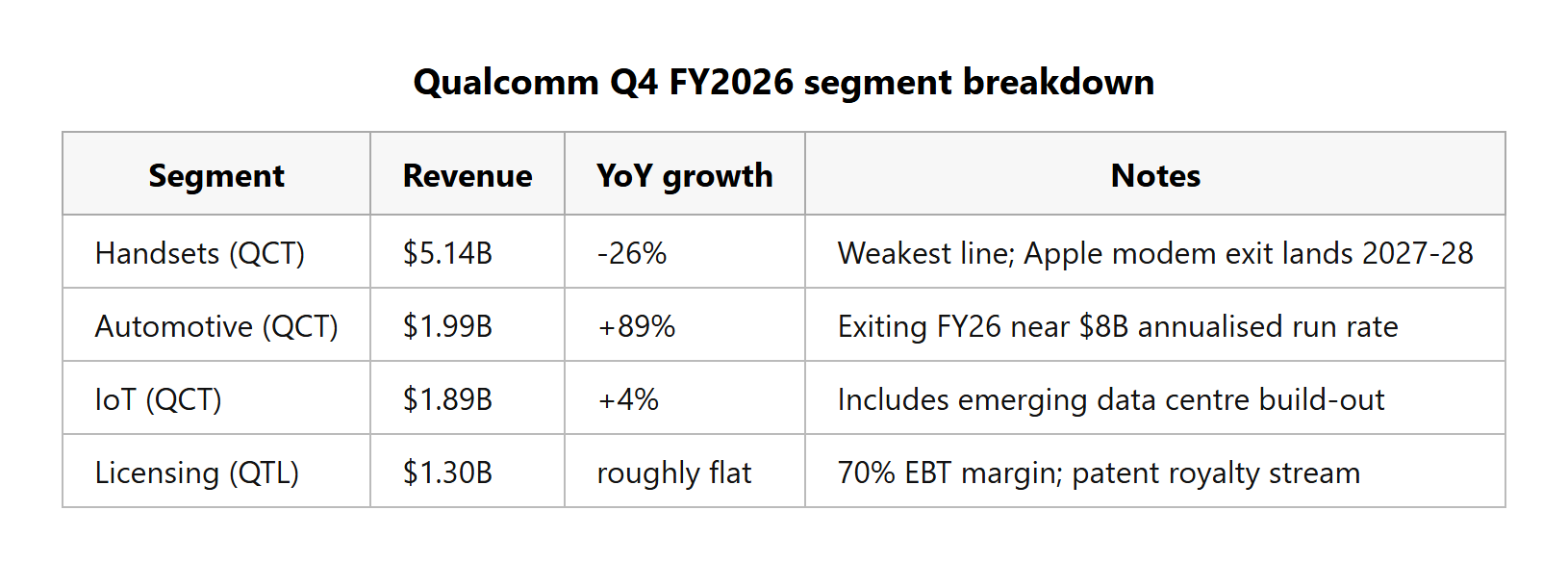
Qualcomm does not report data centre as a standalone segment. Management disclosed quarterly data centre revenue of approximately $650 million within the mix above, mainly custom AI silicon and optical networking built for Amazon Web Services, alongside an earlier disclosed data centre relationship with Meta.