


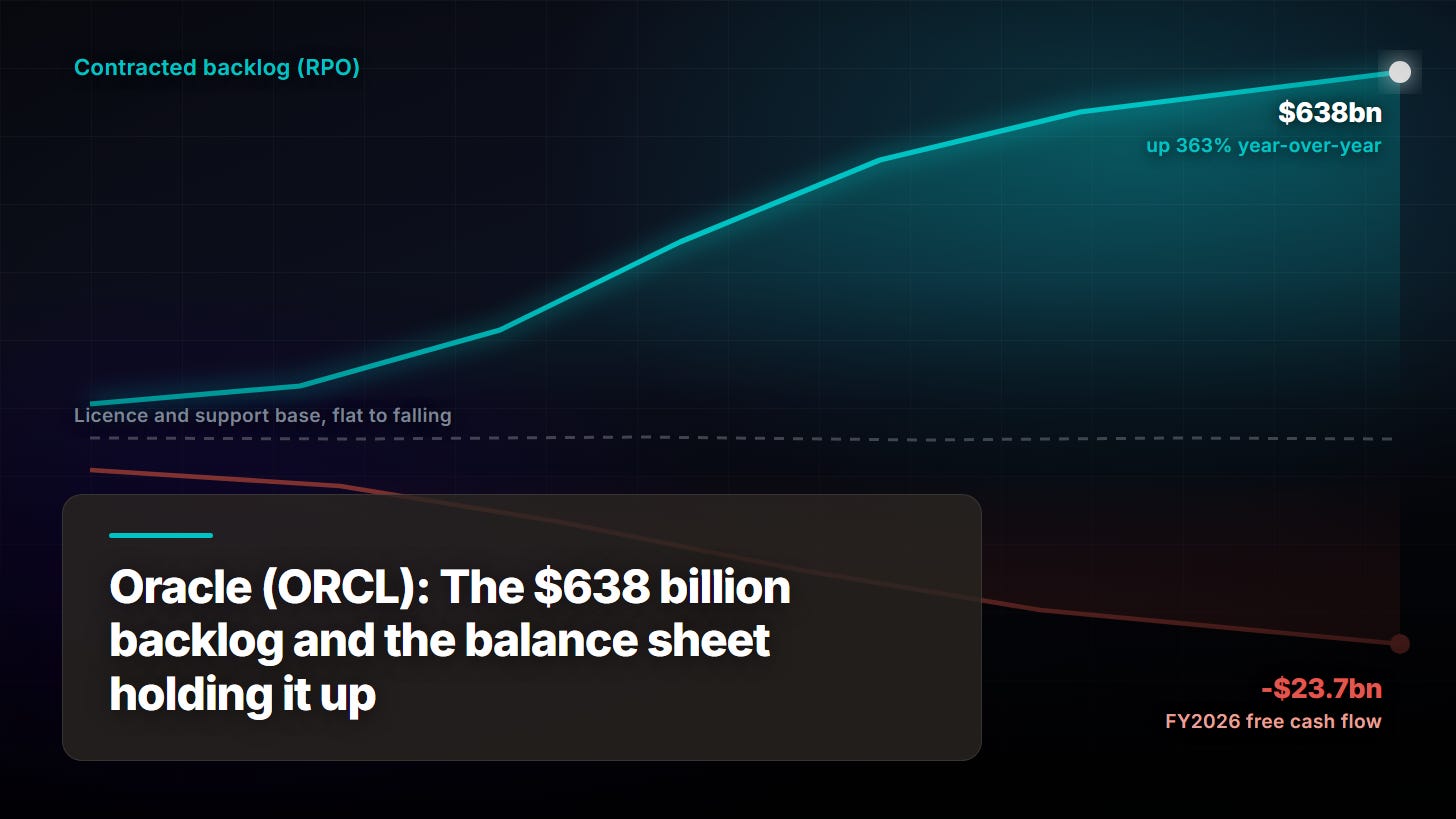
A year ago the bull case for Oracle was a number: $638 billion of contracted future revenue, up 363% in twelve months, the largest order book any enterprise software company has ever disclosed. The stock has since fallen by more than half from its high, and S&P has cut the credit rating to one notch above junk. The backlog did not shrink. The market simply started asking who pays for the machines that fill it. That's why we built Winvesta Crisps, to decode what's actually driving the companies you own, in plain language, before the consensus catches up. 60,000+ investors from all over India are already in. What about you?
🔔 Don't miss out!
Add winvestacrisps@substack.com to your email list so our updates never land in spam.
Most investors still think of Oracle as a database company that sells cloud on the side. That framing is accurate and dangerously incomplete. In the year ended 31 May 2026, Oracle reported revenue of $67.357 billion, up 17%, of which cloud infrastructure alone was $18.101 billion, up 77%, per Oracle's Q4 FY2026 earnings release. In the same year it spent $55.663 billion on property and equipment, against operating cash flow of $31.977 billion, producing free cash flow of negative $23.686 billion. Read those two facts together and the company stops looking like software. Oracle now spends 83 paise of every rupee of revenue on building data centres, which is not a software business model, it is a utility construction model with a software company's balance sheet underneath it. Oracle reports first-quarter results after the US close tonight, and none of the figures in this article are those results.
🏭 What Oracle actually is today
Oracle sells four things that behave completely differently.
The first is the legacy database and licence support business, roughly $24.541 billion of software revenue in FY2026 and shrinking slightly at minus 1%, per the Q4 FY2026 release. This is the annuity. Tens of thousands of banks, telcos, airlines and government departments run mission-critical systems on Oracle Database and pay maintenance every year because migrating off is a multi-year project nobody wants to sponsor. It funds everything else.
The second is applications: Fusion ERP, NetSuite and the industry suites, grouped as cloud applications at $15.888 billion, up 11%. Steady, competitive, unspectacular, and the part of Oracle that looks most like Salesforce or SAP.
The third is Oracle Cloud Infrastructure, the business that changed the story. OCI was a distant fourth-place hyperscaler for most of the last decade. In FY2026 it produced $18.101 billion of revenue, up 77% for the year and 93% in the fourth quarter alone. The reason is specific rather than general: Oracle bet early on renting very large, very dense GPU clusters with high-bandwidth networking to a small number of AI labs, at a moment when Amazon, Microsoft and Google were rationing capacity to their own products and their own strategic partners.
The fourth is the piece that gets almost no attention in India and probably deserves the most. Oracle has spent two years putting its database physically inside its competitors' data centres, as Oracle Database@Azure, Database@Google Cloud and, since 2026, an AWS partnership. Multicloud database revenue grew several hundred per cent year-over-year through fiscal 2026 off a small base, per management commentary on the quarterly calls, and the strategic logic is cleaner than the growth rate. Every enterprise that wanted to move to AWS but could not move its Oracle database now has a route. Oracle stops being the thing you migrate away from and becomes the thing you carry with you.
Put those four together and Oracle is a shrinking annuity funding a hyperscaler build, with an applications business paying the light bill and a multicloud strategy quietly defending the annuity. Every one of those parts is real. Only one of them is why the stock moves.
🧩 Segment breakdown
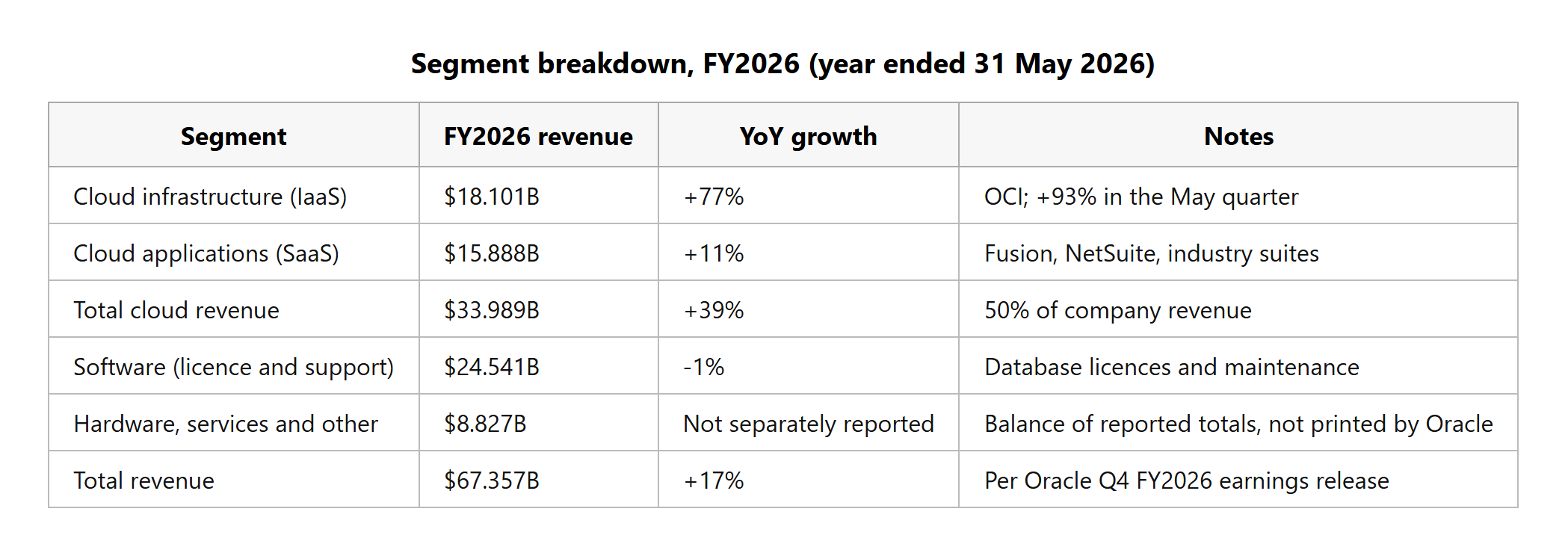
Two things stand out. Cloud is now almost exactly half of Oracle, at $33.989 billion of $67.357 billion, which was not true two years ago. And the growth is extremely lopsided: infrastructure at 77% against applications at 11%. Oracle's revenue mix is being rewritten by one line item.
The residual line matters too. Oracle's headline release breaks out cloud and software but does not separately state hardware, services and other revenue in the same summary, so the roughly $8.8 billion balance shown here is calculated from the reported totals rather than printed by the company. Treat it as arithmetic, not disclosure.
⚡ Converting $638 billion: the core strategic bet
Remaining performance obligations, or RPO, is the accounting term for contracted revenue not yet recognised. It is the closest thing enterprise software has to an order book. Oracle ended fiscal 2026 with RPO of $638 billion, up 363% year-over-year and up $85 billion in a single quarter, per the Q4 FY2026 release.
For scale: that backlog is roughly nine and a half times Oracle's entire annual revenue. Nothing in enterprise software history compares. It exists because of one contract above all others, the reported five-year, roughly $300 billion agreement with OpenAI for compute starting in 2027. On those two figures alone, a single customer accounts for something close to 47% of the entire order book, and S&P flagged that concentration as a credit risk when it downgraded Oracle in July 2026.
Here is the mechanic that decides whether this ends well. RPO is not cash and it is not capacity. To convert a dollar of that backlog into a dollar of revenue, Oracle first has to build the data centre, buy or install the GPUs, energise the site and hand over working capacity. The spending happens years before the revenue does. That is why capital expenditure ran at $55.663 billion in a year when the AI cloud business generated $18.101 billion of revenue, and why management has guided to roughly $70 billion of net capital expenditure in fiscal 2027 against a $90 billion revenue target.