


Geopolitics was background noise for most investors. Something you filed away. Not anymore. Liberation Day changed that permanently. Tariffs, trade wars, and supply chain rewiring are now front-and-centre forces that move markets—sometimes violently, overnight.
That’s exactly why Winvesta Crisps exists: to break down the macro forces reshaping the companies you own, in plain language, before the consensus catches up. 60,000+ investors from across India are already in. What about you?
🔔 Don’t miss out!
Add winvestacrisps@substack.com to your email list so our updates never land in spam.
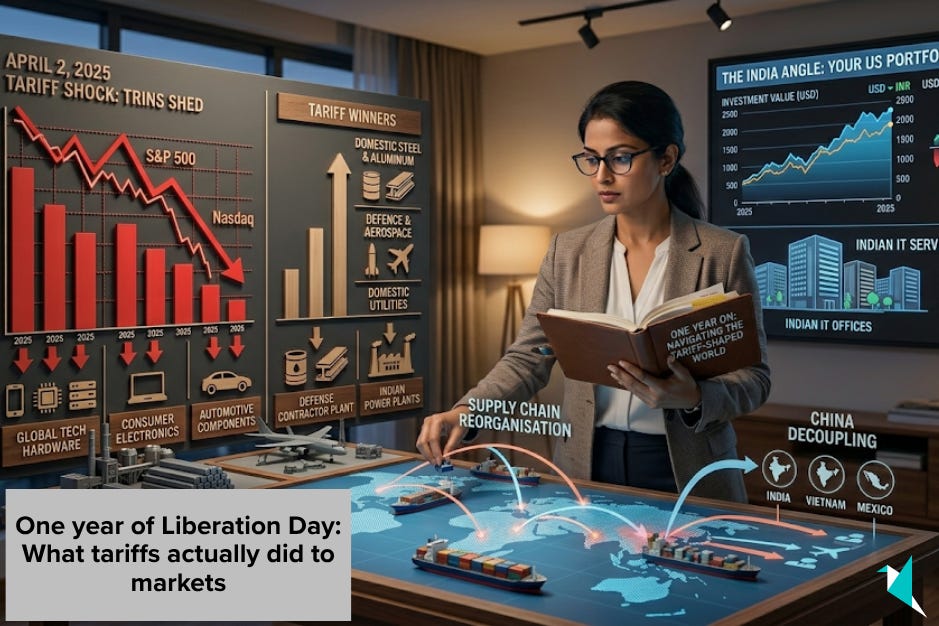
A year ago tomorrow, the US president walked up to a podium, held up a laminated chart, and told the world: "It's our declaration of economic independence." Within hours, global markets were in freefall. The S&P 500 shed trillions in market cap over two trading days. Traders scrambled. CEOs panicked. That was Liberation Day — April 2, 2025 — and it wasn't just a political moment.
It was a structural inflexion point that rewrote the rules of global trade in a single afternoon, upending supply chains, corporate margins, inflation forecasts, and Fed policy all at once. Twelve months on, the dust has settled enough to see clearly. This is your full debrief — what happened, why it moved markets the way it did, who won, who lost, and what it means for you as an Indian investor with skin in the US market.
What was Liberation Day? The tariff shock explained 🗓️
On April 2, 2025, the Trump administration announced one of the most sweeping tariff regimes in modern US history. The headline: a baseline 10% tariff on imports from virtually every country in the world—with significantly higher “reciprocal” rates targeted at specific trading partners.
The logic behind it was straightforward, even if the economics were contested. The argument was that the US had been running persistent trade deficits with many countries, paying more for their goods than they were buying from America. Tariffs, the administration argued, would correct this imbalance, bring manufacturing jobs back home, and generate federal revenue.
How the rates were structured
A universal 10% baseline applied to nearly all imports
China faced the steepest treatment, with rates eventually escalating into triple digits as Beijing retaliated
The European Union, Japan, Vietnam, and others faced elevated “reciprocal” rates, though most of these were subsequently paused for 90 days within a week of the announcement
A handful of goods—semiconductors, pharmaceuticals, and certain energy products—were initially carved out
The China escalation was where things got genuinely dramatic. As both sides responded and counter-responded, the effective tariff rate on Chinese goods climbed to levels not seen in decades—making the 2018–2019 trade war look like a warm-up act.
The immediate market reaction: When markets went into shock 📉
Markets didn’t wait for the details. The initial reaction was swift and steep.
The sell-off
In the two trading sessions following the announcement, US equities experienced one of the sharpest two-day drops in years. The technology-heavy Nasdaq bore the brunt—companies with complex global supply chains and significant exposure to Chinese manufacturing saw their valuations hammered. The broader S&P 500 followed, with virtually every sector selling off in unison.
Bond markets told their own story. Treasury yields initially fell as investors rushed to safety, then spiked as fears of inflation (tariffs are, at their core, a tax on imported goods) crept in. The dollar moved sharply, and emerging-market currencies—including the Indian rupee—felt the aftershocks.
The 90-day pause relief rally
Just when sentiment hit a wall, the administration announced a 90-day pause on the elevated “reciprocal” tariffs for most countries (not China). What followed was a powerful multi-week rebound that fully erased the losses from Liberation Day—the kind of recovery that rewards those who stay disciplined and punishes those who panic-sold.
The whipsaw illustrates something important: in a tariff-driven market environment, policy announcements can move stocks more violently than earnings reports. Macro sensitivity went through the roof.
What tariffs actually do: The economics, simply explained 🔧
Tariffs are fundamentally a tax on imports. But their effects ripple through the economy in ways that aren’t immediately obvious.
Who pays the tariff?
This is widely misunderstood. The exporting country does not pay tariffs—they’re paid by the company or individual importing the goods into the US. An American retailer importing sneakers from Vietnam now pays a higher customs duty. They then face a choice: absorb the cost (hurting margins), pass it to consumers (raising prices), or find alternative suppliers (disrupting supply chains).
In practice, the answer is usually a mix of all three, which is why tariffs are inflationary, margin-compressive, and operationally disruptive all at once.
The stagflation risk
The most feared combination in economics is rising prices and slowing growth—stagflation. Tariffs create the conditions for exactly this. They raise costs (inflationary) while also dampening trade volumes, corporate investment, and consumer confidence (deflationary for growth).
This put the Federal Reserve in an uncomfortable spot. With inflation pressures bubbling up from tariff pass-through, cutting rates to support growth has become more complicated. Markets spent much of mid-2025 repricing Fed expectations almost weekly as the data came in choppy and contradictory.
Retaliation cycles
Trade policy doesn’t exist in a vacuum. China retaliated. The EU threatened countermeasures. Canada and Mexico—bound to the US by the USMCA trade agreement—navigated their own negotiations. Retaliation hits US exports: agricultural products, aircraft, luxury goods, and industrial machinery found themselves priced out of key markets. American companies selling globally weren’t just facing higher import costs—they were losing market access abroad.
Winners and losers: Which sectors felt it most 🏆
Not every sector suffered equally. Trade policy creates real winners and losers—and identifying those dynamics is where investors who did their homework were rewarded.
Sectors under pressure
Technology and consumer electronics bore perhaps the heaviest burden. The industry’s supply chains are deeply entangled with China and Southeast Asia. Smartphone assembly, semiconductor packaging, server manufacturing—all concentrated in exactly the regions facing the steepest tariffs. Margin pressure was immediate and significant.
Retail and e-commerce felt the squeeze on both sides: higher import costs on goods and weaker consumer spending as prices climbed. Discount retailers and companies with thin margins had the least room to absorb the shock.
Automotive faced a double hit—tariffs on both imported vehicles and imported components. Global automakers with US assembly plants found their profitability assumptions upended overnight.
Sectors that held up—or benefited
Domestic steel and aluminium producers were notable beneficiaries. Tariffs on imported metals gave domestic producers pricing power they hadn’t enjoyed in years, and their stocks reflected this.
Defence and aerospace companies with predominantly domestic supply chains were relatively insulated—and benefited from a broader narrative of reshoring and domestic industrial investment.
Financials, particularly banks with large domestic lending books, were less directly exposed to the trade shock. Their performance was more tied to the Fed rate path than to tariff mechanics.
Energy was mixed—domestic producers benefited from protectionist rhetoric, but uncertainty around global demand and retaliatory moves kept the sector volatile.
Want to invest in sectors navigating the tariff landscape? Trade US stocks and ETFs directly from India on the Winvesta app. No US bank account needed!
🚀 Join 60,000+ investors—become a paying subscriber or download the Winvesta app and fund your account to get insights like this for free!
The India angle: What this means for your US portfolio 🌍
For Indian investors holding US equities through platforms like Winvesta, Liberation Day wasn’t just a foreign headline—it had direct portfolio implications.
Rupee-dollar dynamics
When US markets sold off sharply, the dollar initially strengthened as a safe-haven currency—meaning Indian investors’ dollar-denominated portfolios experienced some natural cushioning in rupee terms during the initial shock. But as uncertainty deepened and the dollar weakened later in the year (as recession fears competed with inflation fears), the currency equation worked the other way.
Understanding this interplay—between your US equity returns in dollars and what those returns translate to in rupees—is a core part of international investing that Liberation Day made very concrete.
The IT sector watch
Indian IT services companies are deeply tied to US corporate spending. When US companies started tightening capex and discretionary technology budgets amid tariff-related uncertainty, Indian IT bellwethers felt the pressure in their order books and guidance. This was a channel through which Liberation Day reached Indian domestic markets too—not just via foreign portfolio outflows, but through the earnings reality of India’s own export-oriented businesses.
The opportunity in the volatility
For investors with a long time horizon and rupee-cost discipline, the sharp sell-offs in April and May 2025 created entry points in high-quality US businesses at valuations that had been sharply compressed. Those who bought during the fear period benefited from both price appreciation and, at times, a favourable dollar tailwind.
The lesson: macro shocks create windows. The investors who prepared—who understood what was happening and why—were positioned to act when others were paralysed.
One year on: Where things actually stand 📊
Twelve months of tariff-era investing have produced a few clear conclusions.
Markets adapted—unevenly
The most striking thing about the past year is how differentiated the outcomes have been. Companies that moved quickly to diversify supply chains—shifting manufacturing out of China to Vietnam, India, and Mexico—have recovered and, in some cases, outperformed. Companies that were slow to adapt or lacked the balance sheet to absorb the disruption struggled.
This rewarded active analysis over passive indexing in ways that felt unusual for a period when index-level returns had dominated.
Inflation stayed stickier than expected
The inflationary pass-through from tariffs proved persistent. Consumer prices in categories like electronics, appliances, and apparel remained elevated relative to pre-Liberation Day levels. This complicated the Federal Reserve’s rate path and kept bond market volatility elevated through the year.
The US-China decoupling accelerated
Perhaps the most durable structural shift from Liberation Day has been the acceleration of supply chain reorganisation. The phrase “China plus one” (maintaining China operations but adding a parallel supply base elsewhere) went from corporate buzzword to boardroom urgency. India, Vietnam, and Mexico emerged as primary beneficiaries of this redirected capital and manufacturing investment.
Trade deals and negotiations evolved
The 90-day pause for most countries eventually led to bilateral negotiations with several trading partners. Some agreements were reached; others remain in flux. The tariff landscape in April 2026 is more complex and country-specific than the universal shock of April 2025 implied—but the baseline 10% remains broadly in place, and the China situation remains fundamentally unresolved.
How to invest in a tariff-shaped world 🎯

Liberation Day changed the investing playbook. Here’s what actually holds up twelve months on.
1. Supply chain geography now matters
When researching any company, ask: where are their inputs sourced, and where are their goods manufactured? A company with a heavily China-dependent supply chain carries a structurally different risk profile today than one that has diversified across Southeast Asia, India, or Mexico. This isn’t a one-time analysis—it needs to be revisited as companies adapt.
2. Domestic revenue exposure is a premium
Companies that generate the majority of their revenue domestically (within the US) are largely insulated from tariff-related trade friction. In a tariff-heavy world, “domestic” is a moat. Utilities, domestic banks, and healthcare providers with US-centric models—these categories behaved like shock absorbers.
3. Pricing power separates the survivors from the strugglers
Companies with genuine brand strength or switching-cost moats were able to pass higher input costs to customers without losing significant volume. Companies without pricing power—commodity retailers, margin-thin importers—saw their economics deteriorate. Warren Buffett’s definition of a great business (one that can raise prices without losing customers) has never felt more relevant.
4. Watch the policy, not just the market
In a tariff-driven environment, executive orders move markets more than earnings beats. Building a habit of tracking policy signals—trade negotiations, tariff exemption lists, retaliation announcements—is now a genuine edge for retail investors who are paying attention.
5. Currency-adjust your thinking
For Indian investors in US equities, returns aren’t just about stock prices—they’re about stock prices in dollars, translated back to rupees. A period of dollar weakness can erode gains; a period of dollar strength can amplify them. Being aware of this dynamic enables more informed position-sizing and timing decisions.
Someone shared this with you? If this changed how you see markets and macro, pass it on.
The bottom line 🏁
A year ago, Liberation Day felt like a thunderclap. Chaotic, scary, and hard to parse in real time.
Twelve months later, the picture is clearer. Tariffs reshaped supply chains, complicated the Fed’s job, created genuine winners and losers across sectors, and accelerated a structural decoupling between the world’s two largest economies. Markets—characteristically—overreacted first and then recalibrated.
What Liberation Day actually taught investors is a lesson as old as markets themselves: the companies with durable advantages, flexible operations, and genuine pricing power navigate disruption. The ones without those qualities don’t. Macro shocks don’t create new rules—they just stress-test the existing ones harder and faster.
As an Indian investor with access to US equities, you’re not just buying stocks. You’re buying into an economy that’s in the middle of a significant structural rewiring. Understanding that rewiring—what’s driving it, who benefits, who doesn’t—is exactly the edge that separates informed investors from everyone else.
And that’s what Winvesta Crisps is here for. Every Wednesday. Every week.
Disclaimer: All content provided by Winvesta India Technologies Ltd. is for informational and educational purposes only and is not meant to represent trade or investment recommendations. Remember, your capital is at risk. Terms & Conditions apply.