



Five years ago, energy was the sector you held for a 3% dividend and then forgot about, the boring ballast at the back of the portfolio. Not anymore. In the first quarter of 2026, the Iran war and the closure of the Strait of Hormuz turned energy into the single best trade on the board, with crude oil funds doubling while the S&P 500 fell. Now, a US-Iran peace roadmap has knocked Brent from above $120 back to roughly $77 in weeks, and the same funds that minted gains are giving them back just as fast. That is why we built Winvesta Crisps, to decode what is actually moving the funds you own, in plain language, before the consensus catches up. 60,000+ investors from across India are already in. What about you?
🔔 Don’t miss out! Add winvestacrisps@substack.com to your contacts so our updates never land in spam, and get every edition delivered straight to your inbox.
Most investors look at oil falling from $120 to $77 and conclude the energy trade is dead, time to move on. The cross-asset data tells a more uncomfortable story for anyone still holding the winners. The decline is not a clean all-clear: it is the sound of a fragile peace deal being priced in at the exact moment the world’s biggest oil producers prepare to flood the market with supply. If you bought XLE, OIH, or USO during the spike, your portfolio is no longer riding a supply shock. It is sitting atop a supply glut that has not yet fully materialised, with a ceasefire holding it up that has already collapsed once.
Let me introduce you to someone who might be you.
🎯 First, let’s see if you’re actually Varun

Varun, 41, runs a mid-sized logistics business in Chennai. Portfolio: roughly ₹55 lakhs across US markets, built patiently through Winvesta over four years, mostly a VOO and QQQ core.
In March 2026, when the Strait of Hormuz shut and diesel prices started eating his freight margins alive, Varun made a sharp call. If high oil was going to punish his business, he would at least own the other side of the trade. He rotated about ₹8 lakhs into energy: roughly ₹4 lakhs into XLE, ₹2.5 lakhs into OIH, and ₹1.5 lakhs into USO. He was early, and he was right. By May, energy was the only green sector on his screen.
Here is what Varun thinks he owns versus what he actually owns:
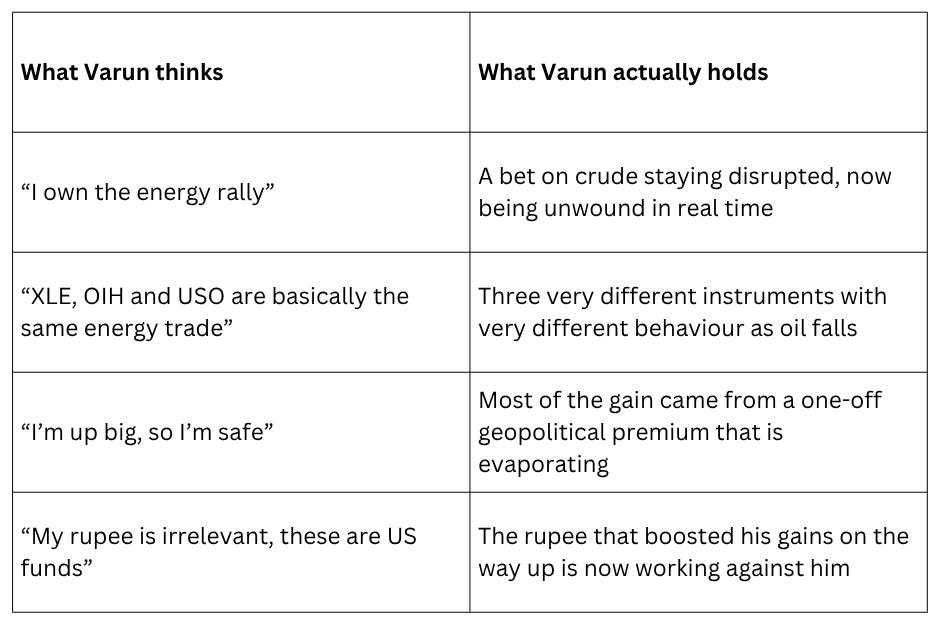
Note: position sizes are illustrative and used to show the concentration picture, not a precise audit.
His hidden risk: Varun’s ₹8 lakh energy bet peaked near ₹11.5 lakhs in early May, a gain of roughly 45% blended, when WTI was pinned near $93 and Brent was above $115. Since the US-Iran roadmap landed and crude slid toward $77, that sleeve has bled back toward the ₹9.5 to ₹10 lakh range. He is still in profit. It just does not feel like it anymore.
What he has not noticed: the rupee. When oil was spiking, the rupee was sliding toward record lows near ₹95 per dollar, which quietly inflated the rupee value of his US holdings on top of the dollar gains. A double tailwind. Now that oil is falling, the rupee is recovering, with Bank of America and ING projecting a move back toward ₹86 to ₹87, per their published forecasts. For an Indian holder of US energy ETFs, that is a double drag: the fund falls in dollars, and each dollar is worth fewer rupees.
The same currency move that made Varun look like a genius is now charging him twice.
🛢️ What’s actually inside XLE, OIH, and USO
These three tickers are not interchangeable. As oil rose they all went up together, which hid how differently they behave. As oil falls, that difference is the whole game.