


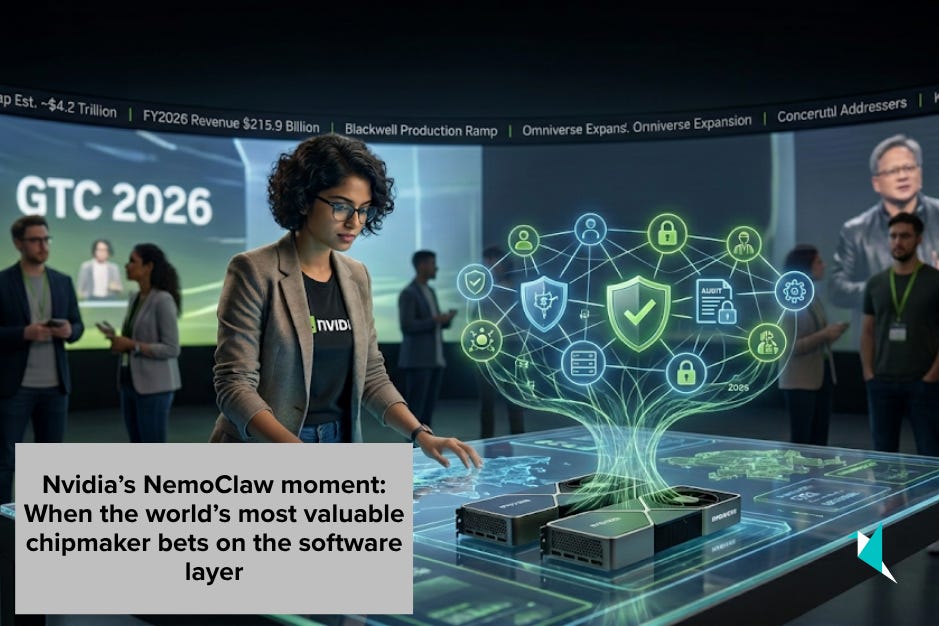
Betting on Nvidia meant betting on GPUs. Not anymore. With Nvidia now layering enterprise software toolkits and agent security frameworks on top of its hardware dominance, the investment thesis is more nuanced than a straight chip-cycle call—and, in our view, potentially more durable.
That’s why we built Winvesta Crisps, to decode what’s actually driving the companies you own, in plain language, before the consensus catches up. 60,000+ investors from all over India are already in. What about you?
🔔 Don’t miss out!
Add winvestacrisps@substack.com to your email list so our updates never land in spam.
Most investors saw “NemoClaw” in the GTC 2026 headlines and kept scrolling. Meanwhile, Nvidia had a market cap of around $4.2 trillion, posted $215.9 billion in fiscal 2026 revenue, and used its marquee developer conference to signal something that matters beyond another chip roadmap, an open-source security and privacy layer built for the agentic AI era. NVIDIA is using GTC 2026 to extend its AI platform from chips into software, with NemoClaw—currently in alpha, per NVIDIA’s own documentation—framed as its open-source security and privacy contribution to the OpenClaw community. Whether that ambition translates into durable software economics remains to be seen; the strategic direction looks clear, though that’s an editorial read of the evidence, not a settled conclusion.
🔥 Top movers
🍏 Current landscape

NVIDIA entered March 2026 as one of the world’s most valuable companies, with a market cap estimated at around $4.2 trillion as of late March 2026, per Stock Analysis, and reported fiscal 2026 revenue of $215.9 billion, per NVIDIA’s February 25, 2026, earnings release. At GTC 2026, it introduced NemoClaw, an alpha-stage open-source security and privacy stack for OpenClaw agents.
The GTC 2026 conference in March brought a clear strategic signal. NVIDIA announced NemoClaw, an alpha-stage open-source security and privacy stack built for the OpenClaw agentic AI platform, per NVIDIA’s press release and official documentation. Per TechCrunch, the pitch addresses what the publication called Nvidia’s “biggest problem”—security in agentic AI deployments. For a company whose hardware already powers the dominant share of global AI workloads, moving into software tooling is a logical extension. Though NemoClaw is early-stage, how quickly it translates into meaningful software revenue remains an open question.
Market capitalisation: Approximately $4.2 trillion as of late March 2026, per CompaniesMarketCap
Fiscal 2026 revenue: $215.9 billion, per Nvidia’s February 25, 2026, earnings release
Datacenter dominance: Datacenter segment revenue reached $62.3 billion in Q4 fiscal 2026—the single-quarter figure, per Nvidia’s earnings release—reflecting the sustained pace of AI infrastructure investment
Software push: NemoClaw, currently in alpha, signals Nvidia’s intent to extend its platform into enterprise AI software—though adoption, monetisation, and durability remain unproven at this stage
In short, Nvidia is trying to push its platform further into software—and NemoClaw is its latest move in that direction, adding a security-focused agent layer to an existing stack that already includes NeMo and other enterprise AI tooling.
🌀 Turning the tables
How is NemoClaw reshaping Nvidia’s enterprise AI play?
1. From inference to agent orchestration
OpenClaw has emerged as a platform for building and deploying AI agents. NemoClaw is Nvidia’s open-source contribution to that ecosystem, focused on security, privacy, and production reliability, per Nvidia’s March 2026 press release and Nvidia’s official blog. The pitch is practical: enterprises deploying autonomous agents in sensitive workflows—legal, financial, healthcare—need auditability and security guarantees that earlier agentic frameworks don’t fully address.
2. The software layer plays
NVIDIA’s hardware generates the compute. NemoClaw is a bet that Nvidia can build a position in the layer above it, where AI agents are orchestrated, governed, and integrated into business processes. If that bet pays off, it’s a higher-margin, recurring-revenue opportunity that complements chip sales. That’s the thesis. The sources support that Nvidia has made a clear move in that direction; whether enterprise adoption follows at scale remains to be determined, per Constellation Research’s coverage of GTC 2026.
3. Ecosystem leverage
NVIDIA’s CUDA developer community—one of the largest in enterprise software—could give NemoClaw a meaningful distribution tailwind. Developers already building on Nvidia infrastructure are plausible early adopters for an agent framework designed to run on the same hardware stack. That’s the logic; whether it converts into actual NemoClaw adoption is something the market will find out as the alpha progresses.
✨ What is working?
NVIDIA’s strengths heading into mid-2026 are broad and structural:
Hardware moat: CUDA’s deep entrenchment across AI research and enterprise deployment creates switching costs that competitors cannot close quickly. AMD’s MI300X is gaining traction in specific workloads, but Nvidia’s software ecosystem advantage remains substantial, per Reuters coverage of GTC 2026.
Sovereign AI tailwinds: Nations building domestic AI infrastructure—across the EU, India, the Middle East, and Asia-Pacific—continue to place significant orders for Nvidia systems, diversifying revenue beyond US hyperscalers.
Margin strength: Gross margins have remained exceptionally high even as supply chains normalised, reflecting the pricing power that comes from performance leadership and deep ecosystem lock-in.
Blackwell transition: The next-generation Blackwell architecture is entering production, with cloud providers and enterprises queuing for allocations. Demand signals suggest the upgrade cycle is robust.
Automotive momentum: The Drive Thor automotive AI platform has been selected by multiple major automakers for upcoming model years, establishing a meaningful second growth vertical beyond data centres.
Want to add Nvidia to your portfolio? Trade NVDA directly from India on the Winvesta app. No US bank account needed!
🚀 Join 60,000+ investors—become a paying subscriber or download the Winvesta app and fund your account to get insights like this for free!