


Five years ago, owning Nvidia meant taking a view on how many graphics cards gamers would buy. Not anymore. The company now sells complete AI data centre systems, and in its most recent quarter the networking business alone grew 199% year-over-year. The part nobody talks about is what the market has done with that: the shares are up about 20% over the past year while revenue grew 85%, and the price-to-earnings multiple has fallen to roughly a third below its own five-year average. That's why we built Winvesta Crisps, to decode what's actually driving the companies you own, in plain language, before the consensus catches up. 60,000+ investors from all over India are already in. What about you?
🔔 Don't miss out!
Add winvestacrisps@substack.com to your email list so our updates never land in spam.
Most investors still argue about whether Nvidia is a bubble. The market stopped agreeing with them some time ago. In the quarter ended 26 April 2026, Nvidia reported revenue of $81.6 billion, up 85% year-over-year, with data centre revenue of $75.2 billion, up 92%, per the company's Q1 fiscal 2027 results. Over the twelve months to 19 August 2026 the shares rose about 19.5%, to $217.56. A business growing at 85% whose shares grow at 20% is being derated, and the numbers say so plainly: the trailing multiple is about 33 times against a five-year average near 62, and the forward multiple of roughly 22 sits below the semiconductor industry median of about 30, per market data. On Wednesday 26 August the company reports again. The question is no longer whether Nvidia can beat. It is what a beat is still worth.
🧩 What Nvidia actually sells now
The gaming company is gone. In the last reported quarter, data centre was 92% of revenue.
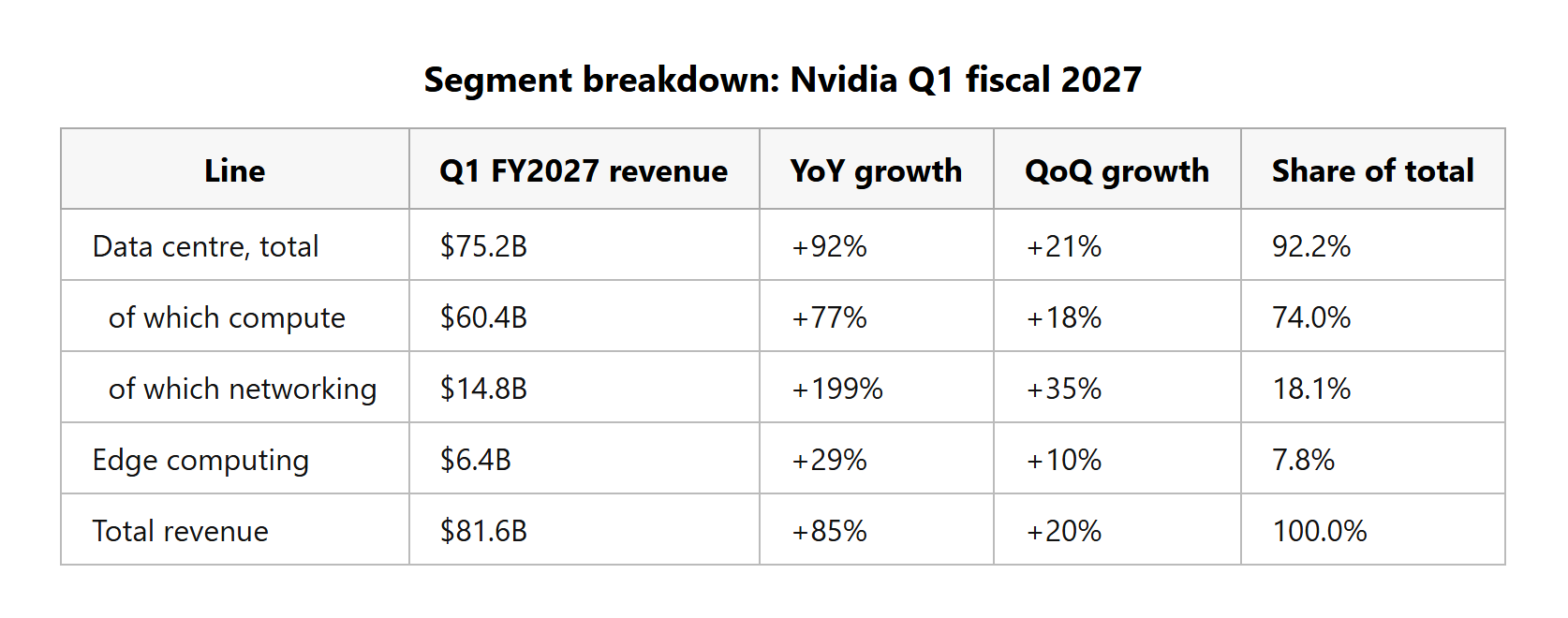
Two rows in that table carry the argument. Compute, which is the accelerators themselves, was $60.4 billion and grew 77%. Networking was $14.8 billion and grew 199%, more than doubling its share of the company in a single year. Everything else, which Nvidia now groups as edge computing, was $6.4 billion.
Networking is the line most investors under-read. It covers the switching, interconnect and optics that tie thousands of accelerators into a single machine, and its growth rate is roughly two and a half times the growth of the chips themselves. That is what happens when the unit of sale stops being a chip and becomes a data centre. A customer buying accelerators can shop around. A customer buying a rack-scale system with Nvidia's fabric inside it has bought an architecture, and architectures do not get swapped out at the next procurement cycle.
The margin profile tells you how much pricing power sits behind that. GAAP gross margin was 74.9% in the quarter, on $81.6 billion of revenue. Semiconductor companies do not earn 75% gross margins on hardware unless the customer has no alternative that works.