



Five years ago, Netflix was the company you paid a monthly fee to binge a show without a single advertisement. In the quarter it just reported, Netflix ran the biggest live sports slate in its history, sold enough advertising to matter to Madison Avenue, and signed a ten year, five billion dollar deal to carry WWE's flagship show. That's why we built Winvesta Crisps - to decode what's actually driving the companies you own, in plain language, before the consensus catches up. 60,000+ investors from all over India are already in. What about you?
🔔 Don't miss out!
Add winvestacrisps@substack.com to your email list so our updates never land in spam.
Most investors still think of Netflix as a subscription business that sells ad-free television on demand, a company whose stock moves on how many new households sign up each quarter. That framing is accurate and dangerously incomplete. Netflix stopped reporting subscriber numbers altogether in 2025, and in their place it has built an advertising business from close to nothing, bought its way into live sports and wrestling, and started behaving, quarter by quarter, less like a streaming app and more like a television network that happens to be ad supported, on demand and live all at once. The subscription business still funds all of it. It is no longer the only story.
🏭 What Netflix actually is today
Netflix's core business is still the one most people recognise: a paid, ad-free or lower-priced ad-supported subscription to a library of films, series and documentaries, sold in more than 190 countries. The company last disclosed a global membership figure alongside its Q4 2025 results, when paid memberships topped 325 million, per Subscription Insider's coverage of that shareholder letter. Since the start of 2025, Netflix has stopped reporting quarterly subscriber counts entirely, choosing instead to be judged on revenue, margin and engagement.
What has changed underneath that subscription number is the shape of the business funding it. Netflix now runs four reportable geographic regions, United States and Canada (UCAN), Europe, Middle East and Africa (EMEA), Latin America (LATAM) and Asia-Pacific (APAC), each growing at a double digit clip. Layered on top of that core is an advertising tier that barely existed three years ago, a slate of live sports and wrestling rights that did not exist at all before 2024, and a games division still small enough that Netflix does not break out its revenue separately. The company that used to compete only with HBO and Disney+ for prestige television now also competes with NBC, Fox and ESPN for sports rights, and with Google's YouTube for the household remote control itself.
🧩 Segment breakdown: every region is growing, and advertising sits inside all of them
Netflix's third quarter of 2026, the three months to 30 September 2026 and reported on 20 October 2026, showed broad-based growth rather than one standout market. Total revenue reached 12,874.2 million dollars, up 12% year-on-year (11% on a foreign exchange neutral basis), per Netflix's Q3 2026 shareholder letter. UCAN, still the largest region, grew revenue 11% to 5,628.2 million dollars. EMEA grew 11% (9% FX neutral) to 4,106.6 million dollars. LATAM grew the fastest on a reported basis, up 17% (12% FX neutral) to 1,602.6 million dollars, while APAC grew 12% (15% FX neutral, reflecting currency effects) to 1,536.8 million dollars.
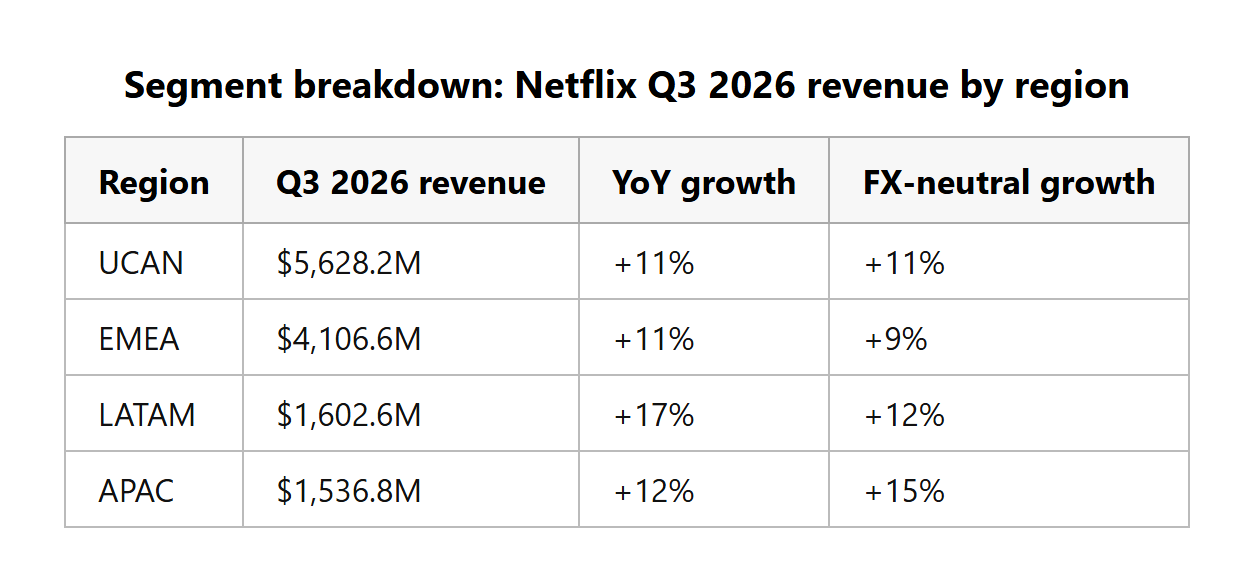
Netflix does not break out advertising revenue by region, or disclose it as a separate line in the quarterly letter at all. What the company does say is that advertising revenue sits inside every one of these four regional totals, growing fastest in UCAN where the ad tier launched first, but expanding as Netflix rolls its ad products into new markets. The geographic breakdown looks like a mature, diversified subscription business because it is one. The advertising and live events layer inside it is where the more interesting growth sits, and that is a number Netflix is choosing not to disclose on its own.
⚡ The core strategic bet: turning a subscription app into a TV network
Netflix's advertising business grew from a standing start in late 2022 to more than 1.5 billion dollars of revenue in 2025, more than two and a half times what it generated in 2024. For 2026, Netflix had initially guided to roughly doubling that figure to approximately 3 billion dollars. In its Q3 2026 letter, the company cut that guidance to approximately 2.7 billion dollars, citing a slower rollout of some ad product capabilities, its own words, rather than any weakness in advertiser demand. Netflix says its ad-supported tier now reaches more than 250 million global monthly active viewers, a reach metric built by multiplying ad-tier members by average household size rather than a subscriber count, so it should be read as an audience estimate and not a paid-account figure.