



Most investors still look at Microsoft as a legacy software company. They see Windows licences and Office subscriptions and think they understand the business. Meanwhile, Azure and the Intelligent Cloud segment likely contribute the largest share of operating income, Copilot is embedding AI agents into the daily workflows of hundreds of millions of enterprise users, and the real valuation story is hiding in cloud infrastructure margins and AI platform lock-in—not software renewals.
That’s why we built Winvesta Crisps— to decode what actually drives the companies you own, in plain language, before the consensus catches up. 60,000+ investors from all over India are already in. What about you?
🔔 Don’t miss out!
Add winvestacrisps@substack.com to your email list so our updates never land in your spam folder.
Everyone thinks Microsoft is a software company that happens to run cloud servers. It’s not. It’s the most horizontally integrated AI platform in the world—owning the infrastructure (Azure), the applications (Copilot), the developer tools (GitHub), and the enterprise relationships that tie them all together. Microsoft reported approximately $245 billion in revenue for fiscal 2024, per its FY24 results, with Intelligent Cloud delivering over $100 billion of that and accounting for a disproportionate share of operating profit. The software franchises—Office, Windows, LinkedIn—exist primarily to feed the flywheel: acquire enterprise customers, embed them into the Microsoft ecosystem, monetise them through AI-powered subscriptions, and funnel their workloads into Azure. That combination makes Microsoft the most structurally embedded AI company in the global economy. Here’s why the real story isn’t the software—it’s the AI platform underneath.
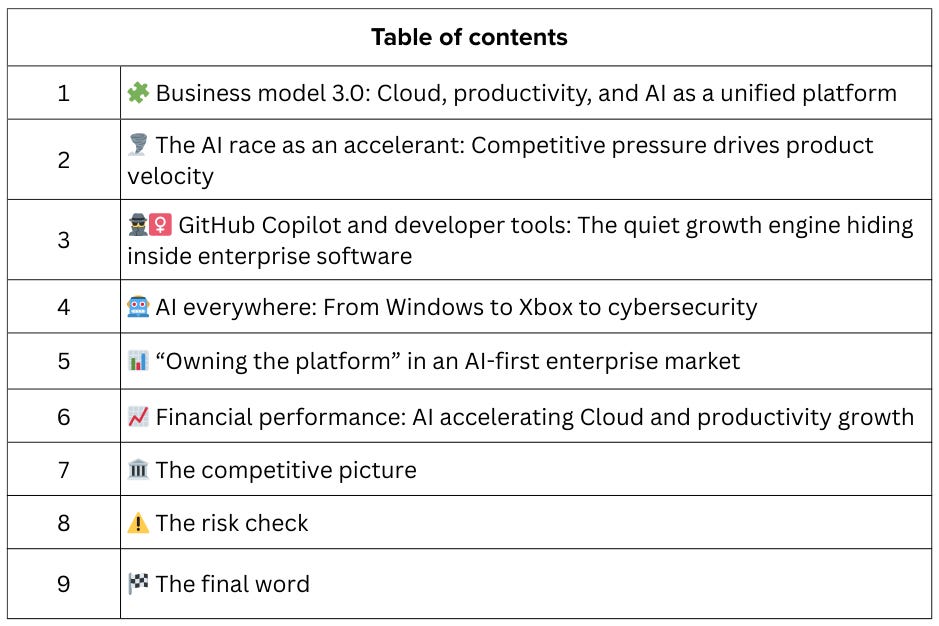
🧩 Business model 3.0: Cloud, productivity, and AI as a unified platform
Microsoft doesn’t make most of its money from a single franchise anymore. It generates revenue across three distinct engines—each with different growth trajectories, margin profiles, and competitive dynamics.
Intelligent Cloud is where the real money lives. This segment—anchored by Azure—generated over $100 billion in fiscal 2024, growing at roughly 20–21% year-over-year. Azure is the second-largest cloud provider globally, capturing enterprise workloads that demand hybrid infrastructure, compliance tooling, and tight integration with on-premises systems. Management has indicated that AI workloads contribute meaningfully to Azure’s growth, though Microsoft does not publish a precise breakdown. The company has deployed AI-optimised data centres globally, securing Nvidia H100 and H200 GPUs at scale, and offers models from OpenAI, Meta, and Mistral through Azure AI Studio. This isn’t just infrastructure-as-a-service; it’s the operating system for enterprise AI.
Productivity and Business Processes—Office 365, Dynamics 365, and LinkedIn—delivered approximately $84 billion in fiscal 2024, growing around 13%, based on a blend of company filings and external estimates. The shift here is subtle but significant: Office is no longer productivity software—it’s a collaboration platform with embedded AI agents. Microsoft 365 Copilot, launched in November 2023 at $30 per user per month, has seen rapid enterprise adoption. Microsoft says a large majority of Fortune 500 companies are piloting or deploying Copilot. Copilot for Sales, Copilot for Service, and the newly announced Cowork feature extend AI assistance into CRM workflows, customer support, and now multi-agent project coordination. LinkedIn, meanwhile, crossed 1 billion members and is integrating AI-driven recruiter tools and content generation.
More Personal Computing—Windows, Xbox, Surface, and search advertising—brought in approximately $59 billion in fiscal 2024, growing modestly at around 3%, based on similar filings and estimates. Windows 11 now ships with Copilot built into the taskbar, turning the operating system into an AI-first interface. Bing, powered by OpenAI’s GPT-4, has gained modest search share, but more importantly, it serves as a testbed for conversational AI features. Gaming revenues—boosted by the $69 billion Activision Blizzard acquisition—are being integrated into Game Pass and cloud gaming, with AI used for content moderation, NPC behaviour, and accelerating game development.
In other words, “Microsoft” is now an AI application and infrastructure company that happens to have legacy software franchises—not a software firm dabbling in AI.
Someone shared this with you? If this changed how you see Microsoft, pass it on.
🌪️ The AI race as an accelerant: Competitive pressure drives product velocity

The announcement that Microsoft has launched a Copilot feature called Cowork—the same name Anthropic used for its multi-agent collaboration product—illustrates how competitive dynamics are reshaping product roadmaps. Anthropic’s original Cowork threatened to disintermediate Microsoft’s productivity suite by enabling AI agents to coordinate directly without needing Office or Teams. Microsoft’s response? Integrate the concept, brand it under Copilot, and distribute it to its massive commercial Office user base overnight.
Partnering with rivals creates integration advantages. Microsoft’s $13 billion investment in OpenAI—along with a reported multi-billion-dollar investment and cloud-credit partnership with Anthropic—means it has visibility into cutting-edge model development. When Anthropic unveiled Claude’s “computer use” API and Cowork, Microsoft likely had early visibility into the direction of multi-agent architectures. Turning that into a Copilot feature leverages Microsoft’s distribution moat: enterprises already pay for Microsoft 365, so adopting Cowork as a Copilot add-on requires no new vendor relationship or procurement process.
Embedding AI across the workflow reduces churn. By integrating AI agents into Outlook, Teams, Word, Excel, and now project coordination tools, Microsoft increases switching costs. A user who relies on Copilot to draft emails, summarise meetings, analyse spreadsheets, and coordinate multi-agent workflows is deeply embedded in the Microsoft ecosystem. Competitors like Google Workspace and Anthropic’s standalone agents face the friction of replacing an entire productivity stack rather than just one tool.
Defensibility through platform lock-in. Microsoft’s Cloud and productivity dominance creates a flywheel: Azure hosts the AI models, Microsoft 365 distributes the applications, and enterprise data stays within Microsoft’s compliance and security perimeter. For a firm that monetises through seat-based subscriptions and consumption-based cloud billing, embedding AI everywhere typically means higher average revenue per user and accelerated growth in cloud consumption.
🕵️♀️ GitHub Copilot and developer tools: The quiet growth engine hiding inside enterprise software
One of Microsoft’s most valuable franchises sits far from the Windows and Office headlines: developer tools, anchored by GitHub and Visual Studio.
GitHub Copilot’s momentum has been striking. Launched in June 2022, GitHub Copilot reached around 1.8 million paid subscribers by fiscal 2024 and is used by tens of thousands of organisations, including Accenture, Shopify, and Stripe. At $10–19 per user per month for individual and business tiers, third-party estimates suggest it generates several hundred million dollars annually—small relative to Microsoft’s total revenue —but analysts estimate very high growth rates. GitHub internal studies and customer case studies cite significant productivity gains, with developers reportedly completing tasks substantially faster using AI-assisted coding.
Microsoft launched GitHub Copilot Enterprise in early 2024, priced at $39 per user per month, offering customised models trained on private codebases. Early adopters include Mercedes-Benz and Duolingo, which have reported meaningful reductions in code review time. This shifts GitHub from a version control tool into an AI-native development platform, competing with Amazon CodeWhisperer and Replit.
Microsoft acquired GitHub for $7.5 billion in 2018, and it’s now central to the AI strategy. With over 100 million developers on GitHub, Microsoft has distribution for AI-powered coding tools, model fine-tuning, and cloud deployment pipelines. Azure and GitHub are tightly integrated: developers can deploy containerised apps from GitHub Actions directly to Azure Kubernetes Service with AI-optimised infrastructure recommendations.
For Intel, it was Altera hiding inside the turnaround chaos. For Microsoft, developer tools are the high-margin, recurring, sticky franchise hidden within the enterprise software narrative—and it’s growing faster than the legacy Windows business.
Want to add Microsoft to your portfolio? Trade MSFT directly from India on the Winvesta app. No US bank account needed!
🚀 Join 60,000+ investors—become a paying subscriber or download the Winvesta app and fund your account to get insights like this for free!