


Buying a Nasdaq-100 fund and calling it your “diversified tech allocation” was a reasonable shortcut. Not anymore. The same seven stocks that dominate that fund are now splitting into winners and losers inside a single earnings week, while the funds that actually diversify you away from that risk, the semiconductor and equipment names, sit forgotten in most portfolios. That’s why we built Winvesta Crisps, to decode what’s actually moving the funds you own, in plain language, before the consensus catches up. 60,000+ investors from all over India are already in. What about you?
🔔 Don’t miss out! Get the latest updates delivered straight to your inbox →
Most investors see one AI trade. Buy Nasdaq. Buy the Magnificent Seven. Ride the wave. But the data this earnings season tells a different story. The AI trade split into two trades sometime this year, and the market has been pricing them in opposite directions ever since. Alphabet lost roughly seven percent of its value in a single session last week for spending more on AI, not less. Over the same stretch, the group of companies that actually sells the picks and shovels for that spending, the semiconductor sector, has been one of the best performing corners of the market all year. Microsoft and Meta report Wednesday. Apple and Amazon report Thursday. If you own a Nasdaq-100 fund and think you’re diversified across technology, this week is when you find out how much of that fund is still riding one side of a trade that already broke in half.
🎯 Meet Karan
Karan, 34, is a data analyst at a fintech in Bangalore. He built his US portfolio the way a lot of Winvesta users do, one ETF at a time, over about three years, without ever sitting down to map how the pieces overlap.
His ₹35 lakh US allocation breaks down like this: roughly ₹14 lakh in QQQ, bought early as his “broad technology” bet. About ₹4 lakh in MAGS, added last year after reading about the Magnificent Seven as a concentrated way to own the AI leaders directly. Around ₹3 lakh in SMH, added on a colleague’s suggestion earlier this year and never topped up. The rest, close to ₹14 lakh, sits in cash waiting to be deployed.
Here’s what Karan thinks he owns: a broad technology fund, a concentrated bet on the seven biggest AI winners, and a small semiconductor position for good measure. Here’s what he actually owns.
QQQ’s top holdings have, for well over a year, been dominated by the same handful of mega-cap names that make up the entire Magnificent Seven basket, together typically accounting for close to half the fund’s weight, per Invesco’s own published breakdown of the index. MAGS is those same seven companies again, just repackaged as an equal-weighted basket. Add the two together and Karan’s “diversified technology allocation” and his “concentrated AI bet” are, for practical purposes, the same trade, sized at somewhere near ₹10-11 lakh, or close to a third of his entire US portfolio.
His SMH position, the one holding that has actually behaved differently from the Magnificent Seven this year, the one riding the other half of the AI trade, is worth less than a third of that. Karan built a portfolio that feels spread out. It is, in practice, one large bet on seven companies reporting earnings this week, and one small bet on everyone selling them the hardware.
📊 What’s actually inside QQQ, MAGS and SMH
QQQ tracks the Nasdaq-100, and its top ten holdings are still overwhelmingly the same AI infrastructure spenders that make headlines every earnings season: Microsoft, Apple, Amazon, Meta, Alphabet, alongside Nvidia and Broadcom on the supply side. MAGS strips that overlap out and hands you the seven mega-caps directly, equal-weighted, with no smaller Nasdaq names to dilute the concentration. SMH sits on the other side of the ledger entirely: chip designers, fabrication equipment makers and memory producers, the companies getting paid by the hyperscalers rather than the ones doing the paying.
That distinction has mattered more this year than in any recent one. Semiconductor funds have posted some of the strongest returns in the market for 2026 so far, while the Magnificent Seven basket has struggled to stay positive, a divergence institutional strategists have been flagging since at least mid-year.
Here’s the illustrative flow picture across these three funds over the past week and the past several months.
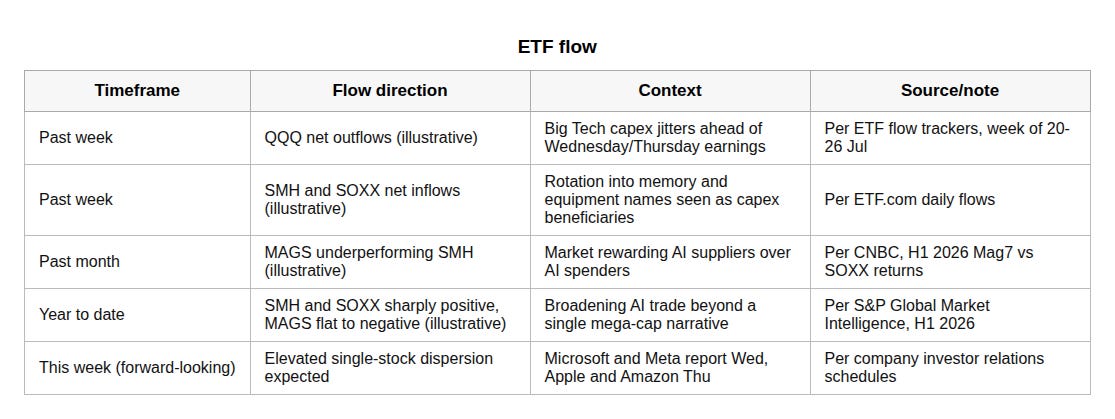
Read that pattern carefully. Money has been rotating out of the concentrated mega-cap trade and into the picks-and-shovels trade for months, not days. That’s not a one-week panic. It’s a structural repricing of who gets credit for the AI build-out: the companies building the infrastructure, or the companies selling them the parts.
Want to add QQQ, MAGS or SMH to your portfolio? Trade them directly from India on the Winvesta app. No US bank account needed!
🚀 Join 60,000+ investors, become a paying subscriber or download the Winvesta app and fund your account to get insights like this for free!
💡 Three scenarios for Karan’s portfolio this earnings week
The following scenarios, probabilities and return estimates are an illustrative editorial model built on assumed outcomes, not a forecast, market consensus or a guarantee of anything.
Scenario 1: Earnings reassure the market (30% probability)
Microsoft’s Azure growth clears the roughly 36 to 40 percent bar the Street is watching for, Meta’s ad growth absorbs its higher capex without denting margins, and Amazon shows AWS acceleration alongside disciplined spending. The market decides, for now, that the capex is converting into revenue. QQQ and MAGS recover part of last week’s losses, and SMH keeps climbing on continued demand for the hardware underneath all of it.
Illustrative portfolio impact: QQQ ₹14L becomes ₹14.84L (+6%). MAGS ₹4L becomes ₹4.32L (+8%). SMH ₹3L becomes ₹3.15L (+5%). Cash stays at ₹14L. Illustrative total: ₹36.31L, or roughly +3.7% on the full portfolio.
Expected value contribution: +3.7% × 30% ≈ +1.11%
Scenario 2: Mixed results, the split continues (45% probability)
Some hyperscalers beat, others disappoint on margins or capex guidance, and the market keeps doing what it’s done all year: punishing the spenders and rewarding the suppliers, stock by stock rather than as a group. QQQ and MAGS stay choppy and roughly flat to slightly down. SMH keeps its lead.
Illustrative portfolio impact: QQQ ₹14L becomes ₹13.72L (-2%). MAGS ₹4L becomes ₹3.84L (-4%). SMH ₹3L becomes ₹3.30L (+10%). Cash stays at ₹14L. Illustrative total: ₹34.86L, or roughly -0.4%.
Expected value contribution: -0.4% × 45% ≈ -0.18%
Scenario 3: A broader AI valuation reset (25% probability)
One or more of this week’s reports raises capex guidance again, the way Alphabet just did, and the market’s patience runs out, not just for the spenders but for the theme as a whole. Profit-taking spreads into the semiconductor names too, on the logic that if the buyers of AI infrastructure are struggling to justify the spend, the sellers of that infrastructure face demand risk of their own eventually.
Illustrative portfolio impact: QQQ ₹14L becomes ₹12.60L (-10%). MAGS ₹4L becomes ₹3.44L (-14%). SMH ₹3L becomes ₹2.64L (-12%). Cash stays at ₹14L. Illustrative total: ₹32.68L, or roughly -6.6%.
Expected value contribution: -6.6% × 25% ≈ -1.65%
Putting it together: +1.11% + (-0.18%) + (-1.65%) ≈ -0.72% illustrative expected return across the four trading days that matter most this week. Karan’s current allocation carries a mildly negative probability-weighted outcome under this framework, mostly because his real exposure to Wednesday and Thursday’s earnings is roughly three times the size of the position that’s actually been working this year. This is a framework for thinking about concentration, not a prediction of what happens on the day.