


Three months ago Micron delivered a record quarter and told Wall Street the next one would be bigger. It was right. On the call it went further and told customers there is no more high bandwidth memory left to sell them until 2028, because Micron, Samsung and SK Hynix have all already booked their 2027 capacity. The stock is still trading roughly 16% below the high it set on the day of that first record quarter. That gap between what the company can sell and what the market is paying for it is the whole story. That's why we built Winvesta Crisps, to decode what's actually driving the companies you own, in plain language, before the consensus catches up. 60,000+ investors from all over India are already in. What about you?
🔔 Don't miss out!
Add winvestacrisps@substack.com to your email list so our updates never land in spam.
Most investors still file Micron under boring, cyclical hardware: a memory chip maker that makes money when DRAM prices go up and loses it the moment they come back down. That description stopped being accurate months ago. In the quarter reported on 24 June 2026, Micron posted revenue of $41.46 billion, up 346% year-over-year, and told analysts it has already sold every gigabyte of high bandwidth memory it can build through the end of 2027. Samsung and SK Hynix, the two rivals that still outsell Micron in plain DRAM, have reportedly done the same. None of that has stopped the stock from trading well below the high it set on results day itself.
🧩 What Micron actually sells now
Micron makes two products, DRAM and NAND flash, and licenses neither name from anyone: it is one of only three companies on earth that can manufacture leading-edge memory at scale, alongside Samsung and SK Hynix. DRAM is the working memory every computer needs to run anything. NAND is the flash storage that holds data when the power is off. For twenty years the business was a commodity: prices moved in vicious cycles, margins swung from spectacular to negative, and investors mostly avoided the stock between cycles.
What changed is a specific product inside DRAM called high bandwidth memory, or HBM, which sits directly on top of an AI accelerator and feeds it data at a speed ordinary DRAM cannot match. Every AI training or inference chip that matters, Nvidia's, AMD's, Google's own silicon, needs it, and there is no substitute. Micron says HBM4 shipments have already passed $1 billion cumulatively and that its HBM4 12-high volume ramp is running at roughly twice the speed of the prior generation, HBM3E. Chief executive Sanjay Mehrotra has told analysts the company has completed agreements on price and volume for its entire calendar 2026 HBM supply and has already booked meaningful 2027 capacity too, which is an unusual thing for any chip company to say about a product that has not been built yet.
Micron reports results across four business lines rather than a simple DRAM and NAND split, and the pattern across all four in the quarter ended 28 May 2026 tells the same story: AI demand is lifting every part of the business, not just the parts touching HBM directly.
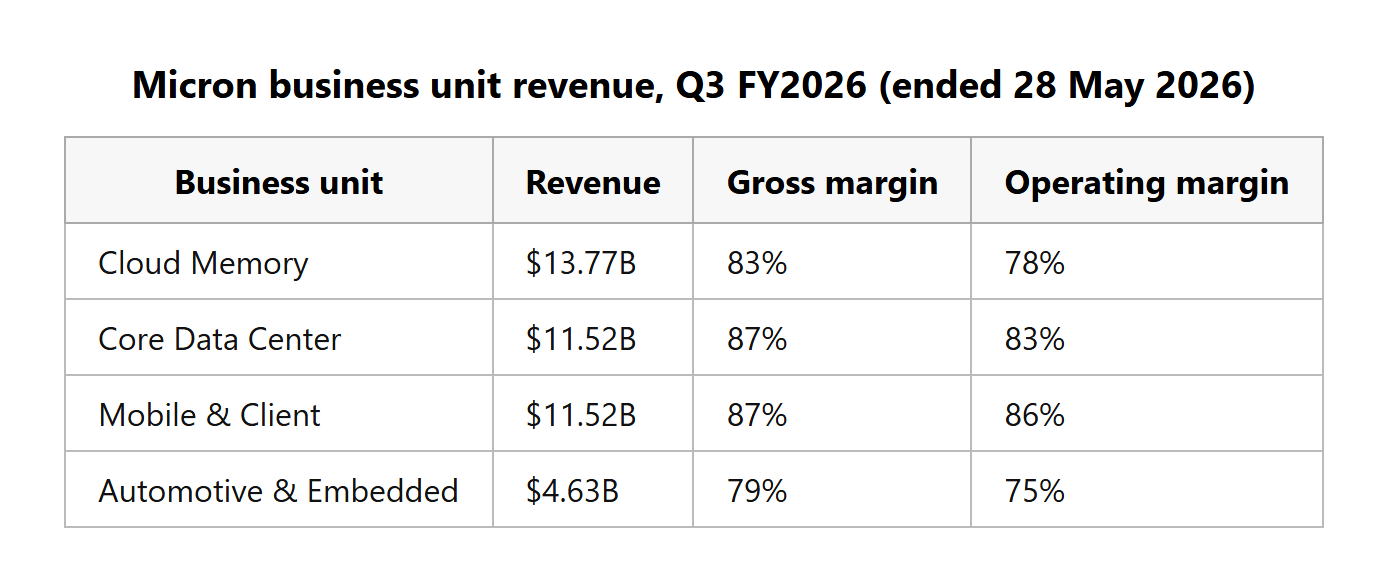
Cloud Memory, the line that carries most of the HBM revenue sold directly to data centre operators, was the largest at $13.77 billion. Core Data Center and Mobile & Client were tied at $11.52 billion each, and Automotive & Embedded, the steadiest and least AI-exposed line, still grew to $4.63 billion. Add them up and the total is $41.44 billion against a reported $41.46 billion, close enough that the small gap is rounding rather than an omission. Roughly three-quarters of that revenue is DRAM and the remainder NAND, per industry trackers, though Micron does not disclose that exact split in its own release.
🚀 The supercycle that will not end on schedule
Every memory cycle in the industry's history has ended the same way: prices rise, all three producers add capacity to chase the margin, supply eventually overshoots demand, and prices collapse. Investors who have watched Micron for a decade have that pattern burned in, which is a large part of why the stock trades the way it does. The argument for why this cycle runs longer is specific and, for once, comes with numbers attached rather than just a story.
First, the demand side is structural rather than seasonal. An AI training server does not use marginally more memory than a laptop, it uses many multiples more, because every additional accelerator needs its own bank of HBM sitting inches away from the compute. A single Nvidia rack-scale system in the NVL72 family carries more than 20 terabytes of HBM; AMD's competing Helios rack carries roughly 31 terabytes, per company disclosures. Multiply that by the pace at which hyperscalers are building data centres and the memory bill scales in a way ordinary PC or phone demand never did.
Second, the supply side cannot respond quickly even if producers wanted it to. Micron's own next new fab, part of a roughly $200 billion multi-year US investment plan spanning Idaho, New York and Virginia, does not begin DRAM production until around mid-2027. Samsung and SK Hynix are in a similar position: new capacity from either does not ramp before the second half of 2027, according to industry reports. Deloitte has estimated combined capital spending across Micron, Samsung and SK Hynix could rise nearly 340% between 2024 and 2027, and even that spending will not show up as usable output for another year or more. Reports citing supply chain research firm Digitimes suggest customers across the industry are currently receiving only around 60% to 70% of the DRAM and HBM volumes they have requested for 2027.
Micron itself has put a number on the opportunity: it forecasts the total HBM market growing at roughly 40% a year, from about $35 billion in 2025 to around $100 billion by 2028. Whether that number proves exactly right matters less than the direction. A company selling a product it cannot make fast enough, with the next wave of competing capacity still more than a year from mattering, is not the same company that used to swing from feast to famine every eighteen months.