



Buying a social media company meant buying ad inventory tied to user attention. Not anymore. Meta’s AI stack, its open-source Llama models, and its ambitions in spatial computing have quietly turned this into a platform company with recurring-revenue characteristics, AI-driven efficiency gains, and optionality embedded in hardware that most people haven’t tried yet.
That’s why we built Winvesta Crisps—to break down what’s actually driving the companies you own, in plain language, before the consensus catches up. 60,000+ investors from all over India are already in. What about you?
🔔 Don’t miss out!
Add winvestacrisps@substack.com to your email list so our updates never land in spam.
Most investors still think of Meta as Facebook’s parent company—a digital advertising giant collecting data and selling reach. That frame is both accurate and dangerously incomplete. Today’s Meta is simultaneously the world’s most profitable attention marketplace and an open-source AI infrastructure company embedding itself into billions of daily interactions. It operates the largest social graph in human history, generates approximately $201 billion in annual revenue, and is channelling unprecedented capital into AI infrastructure and spatial computing—betting that whoever owns the platform layer in the next computing paradigm wins everything.
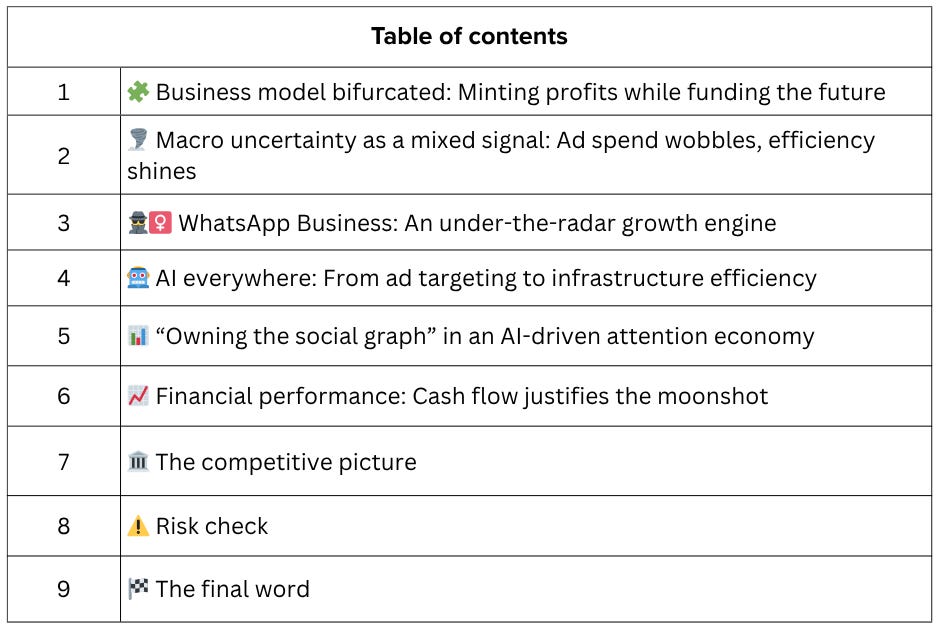
🧩 Business model bifurcated: Minting profits while funding the future
Meta’s revenues now come from two completely different engines: a hyper-efficient advertising platform generating roughly 98% of total revenue, and a forward-deployed R&D laboratory consuming capital at startup-like burn rates.
Family of Apps (FoA)
This segment contributed the vast majority of Meta’s approximately $201 billion in revenue in 2025, per company disclosures. It includes Facebook, Instagram, WhatsApp, Messenger, and Threads. The business model remains elegantly simple: aggregate attention, understand intent through behavioural signals and AI, sell precisely targeted ad placements. Facebook still reaches over 2 billion daily active users. Instagram adds over a billion more. WhatsApp connects roughly 2.8 billion users monthly, though monetisation there remains in early innings. Operating margins on this segment have been in the high-40s to 50%-plus range in recent quarters, making it one of the most profitable franchises in technology.
Reality Labs
Meta recorded a substantial operating loss on Reality Labs in 2025, funding development of its Quest 3 headset range—the current flagship hardware—Orion AR prototypes, Horizon virtual worlds, and underlying spatial computing infrastructure. Revenue from this division remains modest, coming mostly from headset sales and related content. Mark Zuckerberg has signalled this investment will continue through 2030 at minimum, framing it as a buildout of position in “the next major computing platform after mobile.” Wall Street remains divided on whether this represents visionary positioning or empire-building hubris.
In other words, ‘Meta’ is now a cash-generating advertising platform funding what is effectively a separate moonshot hardware company—not just a renamed Facebook.
🌪️ Macro uncertainty as a mixed signal: Ad spend wobbles, efficiency shines
Global macro uncertainty—wobbling growth, sticky inflation, and geopolitical friction—has historically made advertisers cautious. Yet Meta’s recent results suggest its advertising platform has become increasingly resistant to macro wobbles.
Advertiser consolidation toward performance
When budgets tighten, brand spending often gets cut first while performance marketing—ads tied directly to conversions—proves stickier. Meta’s AI-driven targeting, especially Advantage+ campaigns that automate creative and placement decisions, delivered measurably better ROAS (return on ad spend) than competing platforms in 2025. Advertisers increasingly treat Meta as infrastructure rather than discretionary spend. Small and medium businesses, which represent a majority of Meta’s advertiser base, rely on Facebook and Instagram as their primary customer acquisition channels.
International growth is offsetting any softness in the U.S
Meta’s user growth now comes almost entirely from Asia-Pacific and rest-of-world markets. Average revenue per user in North America reached around $68 in Q4 2025, per Meta’s earnings disclosures, while Asia-Pacific ARPU—still well below $10—grew meaningfully year-over-year. That gap represents structural runway. If Meta can lift international ARPU even halfway toward Western levels, the advertising business materially expands without adding a single user.
Reels closing the TikTok engagement gap
Reels has grown to represent a large share of time spent on Instagram and a meaningful share on Facebook. Monetisation efficiency on Reels initially lagged feed and Stories, and management has indicated Reels monetisation is approaching parity—a significant turnaround for a format that launched with near-zero ad load. For a firm that monetises attention at scale, format shifts only matter if engagement drops or monetisation breaks—neither occurred.
For a firm that sells targeting and reach, macro uncertainty usually means short-term volatility but sustained structural demand.
🕵️♀️ WhatsApp Business: An under-the-radar growth engine
One of Meta’s fastest-growing franchises sits far away from the feed: Business messaging on WhatsApp and Messenger.
WhatsApp Business’s momentum
Over 200 million businesses now use WhatsApp Business tools. Meta monetises through click-to-WhatsApp ads (driving users from Facebook/Instagram into WhatsApp conversations) and business messaging fees (charging for customer service interactions beyond the first 24 hours). This segment is growing at a strong clip annually—though precise revenue breakdowns are not disclosed in Meta’s public filings—and is widely regarded as a meaningful emerging contributor to overall revenue. In markets like India, Brazil, and Indonesia, WhatsApp is the internet for hundreds of millions of users, making it the natural layer for commerce and customer service.
Expanding payment integration
WhatsApp Pay has rolled out across India and Brazil, enabling peer-to-peer transfers and merchant payments inside chat threads. While payment volume remains modest relative to incumbents, the strategic positioning is clear: own the conversation layer, then monetise transactions. Meta charges for premium business features like verified accounts and automated responses.
“The operating system for business communication”
Meta is positioning WhatsApp as the customer relationship layer for SMBs that lack resources for custom CRM systems—think Salesforce-light, embedded in a 2.8 billion-user messaging app. Adoption in markets where SMS and email never became dominant suggests WhatsApp could become the primary business-to-consumer channel across the Global South.
This segment is capital-light, high-margin, and structurally differentiated—very different economics from the core advertising business.
Want to add Meta to your portfolio? Trade META directly from India on the Winvesta app. No US bank account needed!
🚀 Join 60,000+ investors—become a paying subscriber or download the Winvesta app and fund your account to get insights like this for free!