


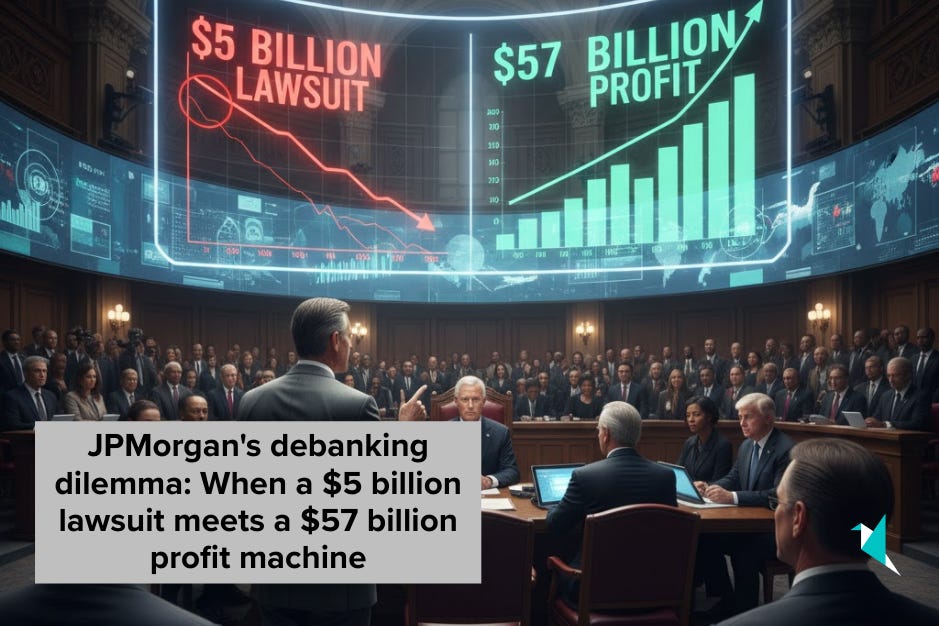
JPMorgan Chase enters the final week of February 2026 with an uncomfortable admission on the record. After years of speculation, America’s largest bank confirmed in a court filing this week that it closed accounts tied to Donald Trump and his businesses in February 2021, weeks after the January 6 Capitol attack. The confirmation transforms whispered suspicion into documented reality—and it lands at the worst possible moment. Trump is suing the bank and its CEO, Jamie Dimon, for $5 billion, alleging political discrimination in what has become the highest-profile “debanking” case in American financial history. As JPMorgan navigates the explosive intersection of political risk management, regulatory compliance, and litigation exposure, the bank demonstrates how crisis-era decisions can become litigation landmines years later—even for an institution that just posted the most profitable year in US banking history.
🔔 Don’t miss out!
Add winvestacrisps@substack.com to your email list so our updates never land in your spam folder.
🍏 Current landscape
JPMorgan Chase dominates American banking with unmatched scale—and that scale makes every operational decision nationally consequential. Court documents filed this week revealed what insiders long suspected: the bank informed Trump-related plaintiffs in February 2021 that certain private-bank and commercial-bank accounts would be closed.
Franchise scale: JPMorgan holds around $4.4 trillion in assets as of late 2025 and operates the largest branch network in the country, making it a systemically important institution where every client decision carries political weight. The bank is planning to open more than 160 new branches in over 30 states this year as part of a multibillion-dollar expansion, even as competitors shrink their physical footprints.
The lawsuit: Trump filed a $5 billion suit in January 2026 in a Florida state court, naming both JPMorgan and Jamie Dimon as defendants. The complaint involves Trump and several of his business entities, alleging that their accounts were closed for political reasons, disrupting business operations. JPMorgan is seeking to move the case to New York federal court, arguing that the g plaintiffs agreed to that jurisdiction when they opened their accounts.
Leadership pressure: Dimon, who has met with Trump since the lawsuit was filed, now defends decisions made during Trump’s final weeks in office—creating awkward optics for a CEO who has historically positioned himself as apolitical. Trump’s lawyers allege Dimon personally assured the president he would look into the closures but failed to follow up.
Broader political context: Debanking has evolved from an obscure compliance issue into a politically charged battleground. Conservative politicians have accused banks of discrimination since the Obama-era “Operation Choke Point” controversy, and Trump’s banking regulators have moved to stop banks from using “reputational risk” as justification for denying service. Trump has also clashed with other financial institutions over banking relationships in recent years.
In short, JPMorgan is discovering that crisis-era banking decisions don’t stay buried—they become litigation landmines years later, especially when the affected client returns to the White House.
🌀 Turning the tables

How is JPMorgan positioning its account closure decisions as standard risk management rather than political targeting?
1. Risk-based justification framework
Reputational risk protocols: The bank’s core defence centres on the argument that accounts associated with the January 6 attack created unacceptable reputational exposure, triggering standard risk committee reviews regardless of political affiliation. JPMorgan’s statement to the media has been consistent: the bank “does not close accounts for political or religious reasons” but does close accounts that “create legal or regulatory risk for the company.”
Regulatory cover: JPMorgan has pointed to anti-money laundering regulations and beneficial ownership rules that require heightened scrutiny of accounts linked to controversial events, framing the closures as compliance-driven rather than politically motivated. The bank has publicly stated it has “been asking both this Administration and prior administrations to change the rules and regulations that put us in this position.”
2. Legal precedent establishment
Private entity rights: JPMorgan’s defence centres on banks’ legal authority to exit customer relationships for any non-discriminatory reason—arguing political activity is not a protected class under federal law. However, Trump’s lawyers are leaning on Florida law, which includes provisions barring banks from discriminating based on political beliefs, potentially complicating this defence.
Jurisdiction strategy: By seeking to move the case from Florida state court to New York federal court, JPMorgan is attempting to shift the legal terrain to a jurisdiction widely seen as more favourable to financial institutions and away from Florida’s consumer-friendly statutes.
3. Controlled disclosure over discovery surprises
Strategic transparency: The court filing confirming the account closures represents a calculated move—acknowledging the basic facts while contesting the characterisation. By confirming closures proactively, JPMorgan may be choosing controlled disclosure over the risk of more damaging revelations emerging through discovery. Trump’s lawyers, however, framed the admission as “a devastating concession that proves President Trump’s entire claim.”